16.06.2026
250
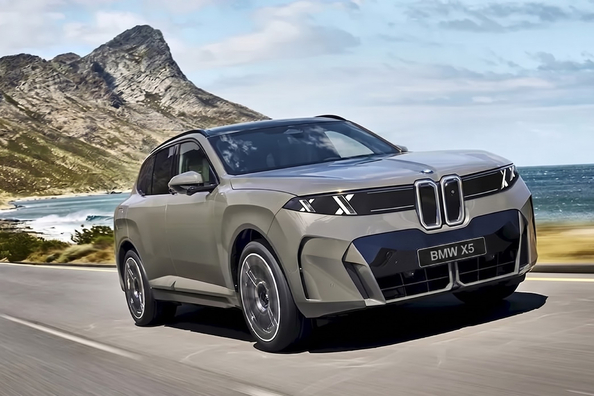

When it comes to the official presentation of the BMW X5 G65, the key is not to confuse confirmed facts with expectations. Under the G65 index, the market usually refers to the next generation X5, set to replace the current G05. But there is still no full official technical dossier for the G65, so the only honest way to talk about the model is through the X5 lineup history and the real specs of the current generation.
Essentially, the X5 is a large premium crossover for those who need one car for the city, the highway, family trips, and long-distance routes. It’s not small, not cheap to run, and not meant for hardcore off-road use, but it is very strong in comfort, performance, and versatility.
The BMW X5 sits between the X3 and X7 and meets the most popular demand in the premium segment: a tall body, powerful engines, a large trunk, and proper handling without the “bus” feel. That’s why any news about the G65 draws attention: customers aren’t waiting for a change in character, but for an evolution of an already proven formula.
This model suits those who drive a lot on the highway, carry family and gear, sometimes a trailer, and want a quiet, solid, composed ride. It’s not the best choice for those who need a compact city crossover or a vehicle you won’t mind regularly pushing through serious off-road conditions.
The X5 clearly shows BMW’s evolution: from a relatively simple large crossover to a complex digital vehicle with electrified powertrains. To understand the G65, it’s important to see where this model comes from.
| Generation | Production years | Key feature |
|---|---|---|
| E53 | 1999–2006 | The first X5, focused on on-road behavior rather than a classic SUV format |
| E70 | 2006–2013 | Grew noticeably, added technology, and became more family-oriented |
| F15 | 2013–2018 | Lost weight, became more efficient and more digital |
| G05 | since 2018 | Modern platform, extensive electronics, air suspension, and hybrid versions |
| G65 | expected next generation, benchmark 2027+ | A new generation of X5 that it’s still too early to discuss in exact numbers |
For the BMW X5 G65, the official final engine lineup has not yet been disclosed. So the realistic reference point is the current X5 G05 range, which shows what BMW considers the working formula for this class. The set of versions may vary depending on the market and model year updates.
| Version | Engine | Power | Comment |
|---|---|---|---|
| xDrive30d | 3.0 L diesel | 286 hp | One of the most rational choices for high mileage |
| xDrive40d | 3.0 L diesel | 340 hp | Better torque reserve without moving into very expensive running costs |
| xDrive40i | 3.0 L gasoline | 381 hp | A quiet, smooth gasoline version for those who don’t want a diesel |
| xDrive50e | 3.0 L gasoline + plug-in hybrid | 489 hp | Makes sense where regular charging is available and there’s lots of city driving |
| M60i xDrive | 4.4 L V8 gasoline | 530 hp | For those who knowingly accept high costs for the sake of performance |
The shared logic for the X5 is this: an 8-speed automatic, xDrive all-wheel drive on most versions, and a strong emphasis on low-end pull and stability at high speed. If the G65 changes the powertrain lineup, it will more likely move toward even more electrification rather than abandoning the familiar 3.0-liter engines.
The exact factory dimensions of the G65 are still worth waiting for separately. Below is a verified reference for the current BMW X5 G05, which is a convenient baseline when you’re evaluating the model’s practicality.
| Parameter | BMW X5 G05 | What it means in practice |
|---|---|---|
| Length | 4935 mm | The car is large, and you feel it in tight parking spaces |
| Width | 2004 mm | Provides stability and space, but in the city it takes getting used to |
| Height | 1765 mm | Comfortable seating position without the feel of an excessively tall body |
| Wheelbase | 2975 mm | Helps second-row comfort and ride smoothness |
| Ground clearance | about 214 mm | Enough for everyday needs, but it’s not a dedicated off-roader |
| Trunk | 650 L | One of the model’s main practical advantages |
In terms of chassis tuning, the X5 is traditionally strong because it doesn’t fall apart at speed and doesn’t feel too heavy in a corner. On many versions, the suspension configuration matters more than the engine itself: adaptive dampers and air suspension noticeably affect comfort, while large wheels can easily take it away.
The X5 interior isn’t about flashy luxury, but about a well-assembled space for long trips. Up front it’s comfortable for almost any driver, the seating position is high, visibility is good, and highway sound insulation is usually one of the reasons people come back to the X5.
In higher trims, the difference is made by the seats, ventilation, audio system, and suspension—not just the logo on the hood. In terms of safety, the X5 has long been among the class leaders: active driver assists, lane keeping, adaptive cruise, and a set of cameras make a large vehicle less stressful in daily traffic.
In daily life, the X5 is convenient if you accept its size and budget. The 3.0-liter diesel versions are most often chosen by those who drive a lot and want solid range without constant fuel stops. The plug-in hybrid makes sense for the city and short routes, but only when there’s a consistent charging routine.
| Pros | Cons |
|---|---|
| A very successful balance of comfort, performance, and practicality | Expensive tires, brakes, and options, especially on powerful versions |
| Strong 3.0-liter engines for daily driving and highway use | Complex electronics and rich equipment increase repair costs |
| Large trunk and comfortable seating for family use | Size isn’t convenient for everyone in the city and in tight parking spaces |
| Good residual value and steady demand on the used market | Not the type of vehicle you want to take through tough off-road terrain without a second thought |
From an owner’s perspective, the X5’s biggest strength is that it rarely fails badly in any single area: it’s not the roomiest, not the cheapest, and not the sportiest vehicle, but overall it’s a very cohesive product. The weak point is also typical for the class: any mistake in trim choice, wheels, or engine quickly turns into extra costs.
For the G65, the tuning logic will be the same as for any new X5: start with practical protection, then cargo solutions, and only after that decorative elements. At the beginning of the model life cycle, it’s not worth rushing into expensive exterior parts until exact compatibility in mounting points and body shape has been verified.
While the dedicated G65 product range is still taking shape, this is the healthiest approach: buy what makes life easier, not what simply changes the car’s appearance.
The BMW X5 G65 should still be viewed as the next step in an already well-understood model, not as a car with fully disclosed specifications. If you need a large premium crossover for highway driving, family use, and everyday versatility, the X5 remains a very strong concept. If your priority is compact size, lower costs, or true heavy off-road capability, it’s not the most accurate direction.
The main thing is not to judge the G65 by rumors. Wait for precise factory data on the new generation, and for practical evaluation, use what the current X5 G05 has already proven. This material is based on real selection experience, practical know-how, and real-world usage scenarios—not on decorative promises surrounding the new model.
| ✔ | The large 650 l trunk and comfortable seating make the X5 practical for family use, trips, and everyday driving. It easily fits suitcases, a stroller, or sports gear without any packing gymnastics. |
| ✔ | The X5 is well suited for highway driving: the article specifically highlights a quiet ride, good sound insulation, and stability at high speed. This makes the model convenient for long routes and frequent intercity trips. |
| ✔ | The engine lineup looks well balanced: there are economical diesels, a smooth gasoline engine, a plug-in hybrid, and a powerful V8. This makes it possible to choose a version for your own use case rather than a single universal template. |
| ✔ | The model has strong handling for a large crossover: it doesn’t feel like a bus and doesn’t fall apart in corners. For this class, that is an important practical advantage, especially in everyday driving. |
| ✔ | The X5 has good liquidity and steady demand on the used market. For the owner, this means the car is easier to sell without a major drop in value. |
| ✘ | Its size noticeably makes city life more difficult: in tight parking spaces, old courtyards, and narrow driveways, the car feels distinctly inconvenient. For compact city use, this is not the best format. |
| ✘ | Ownership can be expensive, especially on powerful versions and with large wheels. The article explicitly mentions costly tires, brakes, and options, as well as higher repair costs due to complex electronics. |
| ✘ | This is not a car for serious off-road driving: ground clearance is enough for everyday tasks, but the model’s format is not about regular heavy-duty outings. If you need real off-road capability, the X5 is not suitable for that. |
| ✘ | A plug-in hybrid only makes sense if you can charge it regularly. Without that, its practical benefit quickly diminishes, and part of the advantages of this version simply won’t be realized. |
Shipping to EU
Wholesale and retail
Own warehouse
Опис продукту
Подарунки не надаються при оформленні покупки у кредит під 0,01% або при покупці частинами.