25.06.2026
223
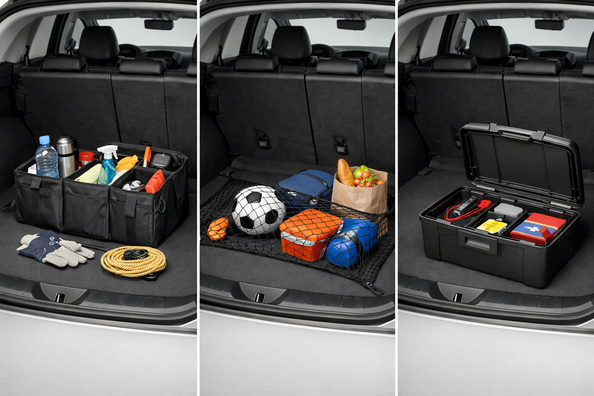
If you need a short takeaway without detours, then for most drivers the most practical starting point is an organizer, a net works best as a quick secondary way to secure things, and a box is the right choice when you need a separate closed volume for dirty, wet, or fragile items. These are not three interchangeable accessories: each solves its own task.
Here, “box” means a separate trunk box or storage chest, not a roof box. The main mistake when choosing is looking only at the price and ignoring mounting, noise while driving, material durability, and how much usable space will actually remain.
An organizer is for sorting. It separates the first-aid kit, tools, cables, car care chemicals, and small purchases into individual compartments, so the trunk doesn’t turn into one big pile.
A net is for quick securing. It doesn’t create new compartments, but it takes up almost no space and holds down light bags, sports gear, blankets, and other small cargo that would otherwise slide around on the floor.
A box is for isolation. If you often have wet shoes, care products, small tools, fragile items, or anything dirty in the trunk, a closed volume works better than open solutions.
Mounting. A net depends on anchor points: if your car doesn’t have factory loops or they’re placed awkwardly, it will be less useful. An organizer is usually just placed in the trunk, but ideally it shouldn’t slide. A box is also easy to install, but because of its size it’s more important to test-fit it for width and height right away.
Noise. Most often it’s not the accessory itself that makes noise, but poorly secured contents. A net only partially restrains rigid items. A soft organizer is usually quieter; a rigid one holds its shape better but can rattle when empty if it isn’t pressed in place. A box is good because it isolates small items inside, but cheap lid-style models can also squeak.
Durability. A net’s weak points are stretching and the hooks/fasteners. For an organizer, wall stiffness and the quality of seams and handles matter. For a box, it’s the material, lid, handles, and resistance to moisture and dirt.
Practicality. If you need to take items out one by one frequently, an organizer is more convenient. If you just need to keep bags from sliding, a net is faster. If you need to separate items from a clean trunk, the box wins.
Price. The most affordable solution is usually a net. Next come soft organizers. More expensive are rigid organizers and boxes with a lid, water-resistant material, and proper handles.
| Option | Strengths | Weaknesses | Who it’s for |
|---|---|---|---|
| Organizer | Sorts items well, has compartments and pockets, often folds, convenient for an everyday kit | Takes up some volume, soft models hold shape worse, rigid ones are heavier and more expensive | Those who carry a first-aid kit, tools, small purchases, cables, care products |
| Net | Installs quickly, takes up almost no space, good for bags and light items | Works only with light loads, depends on anchor points, doesn’t sort contents | Those who need to quickly stop bags and small items from sliding |
| Box | Provides a separate closed volume, better protection from dirt and moisture, convenient for fragile items | Bulkier, less flexible for daily rearranging, takes up more space | Those who regularly carry dirty, wet, fragile, or mixed small cargo |
DD Tuning expert comment: Most often people overestimate how universal a net is and try to hold everything with it. If you have tools, bottles, or car chemicals riding in the trunk, a net won’t replace a proper container. A second common mistake is buying a large organizer without measuring trunk height and then having to fold it before every trip.
This is the most straightforward base for a daily car. Its advantage isn’t that it “holds cargo,” but that every item gets its own place. For city driving this is usually the most useful: you don’t have to turn the whole trunk upside down every time to grab gloves, a compressor, or a first-aid kit.
Soft models adapt better to the trunk shape and usually fold up more easily. Rigid ones hold their shape better and handle fragile contents more confidently. The downside is the same for both: if the organizer is too large for your car, it quickly becomes more annoying than helpful.
A net isn’t a storage system—it’s a quick retainer. Typically it works via four mounting points, and in some cars it can be installed in different trunk positions. It’s convenient when you need to hold down bags or a few light items without losing usable volume.
Its weak points are load limits and dependence on mounting geometry. It’s fine for small purchases, but boxes, jerry cans, or heavy tools can still shift under the net. In short, a net isn’t for weight—it’s for keeping light cargo tidy.
A box makes sense when you need not just to hold contents, but to separate them from everything else. A lid, dense walls, and water-resistant material make it practical for dirty shoes, car chemicals, post-workout items, or small tools.
The main downside is less flexible use of space. If today you need a stroller and tomorrow a suitcase, a large box can get in the way. That’s why it works best where the set of items is more or less consistent rather than changing chaotically every day.
For a daily city car, the organizer most often wins: it brings order without extra hassle. For occasional shopping and a gym bag, it’s cheaper and more logical to start with a net. For trips out of town, kids’ items, fishing, small construction supplies, or anything that can soil the trim, a box looks more convincing.
If you need one universal solution, the closest is an organizer. But in real life the best setup is often a combo: an organizer for your permanent set of items and a net for whatever shows up in the trunk situationally.
| Scenario | Best choice | Why |
|---|---|---|
| Daily shopping and city trips | Organizer | Gives quick access to small items and doesn’t turn the trunk into one shared pile |
| Bags, sports gear, a blanket, kids’ small items | Net | Barely steals space and quickly secures light items |
| Car chemicals, dirty shoes, wet items | Box | Better isolates contents from the trim and other luggage |
| Tools, first-aid kit, compressor, cables | Rigid organizer or a small box | Holds its shape and keeps important items from mixing |
| Small trunk where every liter matters | Net or a compact organizer | A large box most often takes up too much usable space here |
| Frequent out-of-town trips with mixed cargo | Organizer plus net | One accessory sorts permanent items, the other quickly holds temporary cargo in place |
A pricier option is justified not when you want to “buy with a reserve,” but when your scenario is regular. If tools, care chemicals, kids’ items, cables, and small gear live in your trunk all the time, it’s worth looking at a sturdier organizer or a lidded box. If your task is simply to hold shopping bags occasionally, paying extra brings almost no benefit.
Before buying, it’s useful to match your scenario with the trunk organization guide, separately review how to choose an organizer without going oversized, and understand when a rigid option is truly better than a soft one. This is exactly the case where “more expensive” only makes sense with frequent use.
From a customer’s experience: at first the person wanted a large box to “solve it once and for all,” but in a compact crossover it took up too much space. In the end, they kept a rigid organizer for permanent items and added a net for shopping bags. That combination delivered order without losing usable volume.
If you need one short reference point: an organizer is the base, a net is a quick helper for light cargo, and a box is the solution for isolating and protecting contents. For most drivers, the smartest move is to start with an organizer and only then add a net or switch to a box for specific tasks. This conclusion isn’t based on abstract promises, but on real selection experience, practice, and typical trunk-use scenarios.
| ✔ | An organizer sorts items neatly into compartments, so a first-aid kit, tools, cables, and small purchases don’t end up all mixed together. For everyday city use, that’s more convenient than just an open trunk. |
| ✔ | The net takes up almost no usable space and quickly secures light items like bags, sportswear, or blankets. It’s a practical option when you only need to stop the load from sliding around. |
| ✔ | A box provides a separate enclosed space and better isolates dirty, wet, or fragile items from the rest of the trunk. This is especially useful for car chemicals, shoes after rain, or clothes after a workout. |
| ✔ | A rigid organizer or a small box is convenient for tools, a compressor, a first-aid kit, and cables because it keeps its shape and prevents the contents from mixing together. For items that need to be within reach, this is more practical than a net. |
| ✔ | Using an organizer and a net together gives more flexibility: permanent items can be kept tidy, while temporary cargo can be secured separately in a hurry. It’s a good compromise for mixed scenarios. |
| ✘ | The net depends on the mounting points, so without factory loops or if they’re positioned poorly, its usefulness drops sharply. It also doesn’t separate the contents and isn’t suitable for heavy or fragile items. |
| ✘ | An organizer, especially a large one, takes up part of the trunk volume and can start getting in the way during loading. If you choose one without measuring the height, it becomes inconvenient in everyday use. |
| ✘ | A box is bulkier and less flexible for everyday rearranging of items because it takes up more space. In a compact trunk, this is quickly noticeable, especially if the load changes often. |
| ✘ | Cheap or poorly matched models can create noise: an empty rigid organizer rattles, and a cheap box can creak. So the problem is not only the solution itself, but also the quality and how well it fits the trunk. |
Shipping to EU
Wholesale and retail
Own warehouse
Опис продукту
Подарунки не надаються при оформленні покупки у кредит під 0,01% або при покупці частинами.