09.07.2026
248
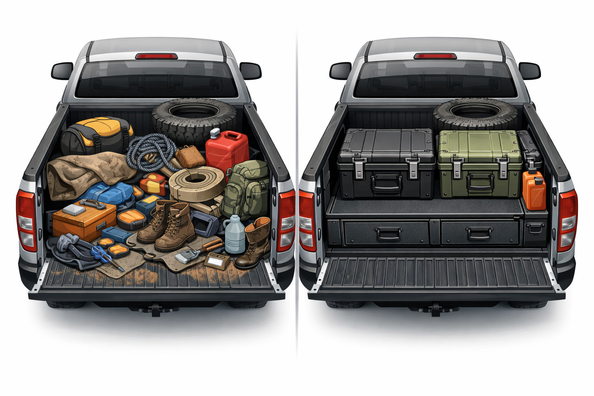
If a pickup bed is constantly full of tie-down straps, tools, a shovel, a compressor, jerry cans, and small gear, the problem usually isn’t a lack of space. The problem is that the same bed is being used at once for work, trips, seasonal items, and bulky cargo. Expedition storage boxes really do eliminate this chaos—but only when the mess is created by small to mid-size items you need quick access to.
A drawer system gives you separate closed compartments, drier and more secure storage, and breaks the habit of tossing everything under the side rails. But it’s not a universal answer: a typical full-size system raises the bed floor by about 309.9 mm and adds roughly 94–106 kg. If you often haul tall, long, or random oversized items, the root cause of the mess may not be organization—it may be the wrong storage format.
Clutter in a pickup bed almost always appears where different use scenarios get mixed. In the morning there are tools and recovery straps in the bed, in the evening you add a trip kit, and on weekends you stack a large load on top. As a result, things don’t have a permanent place, small items slip under bigger bags, and what you need often ends up either by the tailgate or in the cab.
The second reason is the bed geometry itself. The front of the bed is inconvenient for quick access, so rarely used items get thrown up there—and then they block everything else. And when the bed is open or semi-covered, you also get dust, moisture, and constant shifting of gear from the bed to the cab and back.
DD Tuning expert comment: The most common mistake is buying a drawer system before measuring the real height under the canopy or tonneau cover. The second typical mistake is putting tools, recovery gear, and everyday small items into one big compartment with no dividers. In that case the mess doesn’t go anywhere—it just moves inside the drawer.
| Symptom | Likely cause | What to do |
|---|---|---|
| Small tools and gear constantly roll around the bed | No separate compartments and fixed storage locations | Switch to closed boxes or drawers with dividers and small organizers |
| To get the item you need, you have to unload half the bed | Access to the front of the bed is the issue | Consider a drawer system or a sliding tray depending on cargo height |
| After rain or dust, items are dirty even though they seem stored separately | The bed isn’t covered or the system doesn’t provide full protection | First solve bed coverage, then organize the inside |
| After installing the system, a fridge, bike, bags, building materials no longer fit | Too much usable bed height has been lost | Skip drawers in favor of a sliding tray or keep full bed depth |
| In a tight parking space, drawers are inconvenient to open | The system needs operating space you don’t have in your conditions | Consider removable boxes, a tray, or another access scheme without long extension |
Expedition storage boxes work best when you have a permanent set of items: tools, a repair kit, recovery straps, a compressor, a first-aid kit, a camp kitchen, small spare parts. In this scenario, each group gets its own place, and access doesn’t require unloading the whole bed.
The second thing that truly helps is internal division inside the system itself. If there are no dividers and small organizers inside the drawer, small-item chaos simply moves from the bed into the drawer. The right logic here is simple: tools separately, recovery gear separately, consumables and small items separately.
The third advantage is that the top deck doesn’t necessarily kill capacity. In typical systems it can hold up to 907.2 kg of evenly distributed load, and one drawer—about 90.7 kg. That means you can still carry heavy cargo on top, as long as it isn’t too tall.
One large box without internal division works poorly. At first it feels organized, but after a few trips it turns into a common compartment you have to dig through just like the bed.
The idea “I’ll install drawers and everything will be dry” also helps only briefly. In real use, protection from water and dust depends on the system design, the installation, and whether the bed itself is covered.
Another false scenario is installing a permanent drawer platform on a pickup that hauls tall or oversized cargo every week. Here the mess comes back as compromises: things no longer get lost, but the cargo simply doesn’t fit.
If you have a permanent set of tools, a repair kit, recovery straps, small consumables, and trip gear, it makes sense to look toward expedition storage boxes. This is exactly the case where order shows up every day—not only after a deep clean.
If your items suffer more from rain, dust, and unwanted access than from a lack of compartments, it’s worth covering the bed first with a canopy. And if you’re not yet sure you need a permanent drawer system, it’s better to build your setup step by step through pickup accessories rather than immediately investing in a rigid solution that takes away bed height.
| Solution | When it works | When it’s not worth spending money |
|---|---|---|
| Expedition storage boxes or a drawer system | You have a permanent set of small/medium inventory, need quick access, and rarely haul tall bulky cargo | You haul bikes, fridges, bags, building materials, or other tall cargo weekly; you often park in tight spaces |
| Sliding tray | You need to pull heavy or long cargo from the front of the bed without losing much height | You need closed, compartmentalized storage for lots of small items |
| Canopy or hard bed cover | The main problem is water, dust, and the desire to leave items in the bed | The cause of the mess is mixing small gear without dividing it into zones |
| Removable boxes and simple organizers | Your gear set is seasonal, the budget is limited, or you’re testing a storage scheme before a serious purchase | The pickup works daily in mixed mode, and small tools must always be within reach |
From a customer’s experience: a pickup owner carried a compressor, recovery straps, hand tools, a trip kit, and small spare parts in the bed, and from time to time added large bags and jerry cans on top. After switching to drawer storage, the small inventory stopped migrating into the cab, and the top deck remained available for larger cargo. Satisfaction came specifically because he doesn’t haul tall items often; for a daily construction-duty use case, this solution would have been a bad fit.
Expedition storage boxes solve bed clutter when the chaos is caused by small items—not a lack of height or volume. They provide quick access, compartmentalization, and closed storage, but they take about 309.9 mm of bed height, add weight, and don’t always protect equally well from dust and water.
That’s why before buying, it’s important not to guess but to measure: what you carry permanently, how tall it is, whether there’s room to open the system, and whether you’d be better off with a sliding tray or a bed cover. This material is based on real selection experience, hands-on practice, and real use scenarios: first we define the cargo type and the cause of the mess, and only then do we spend money on a storage system.
| ✔ | Expedition boxes do a good job of getting rid of the mess of small and medium gear: tools, straps, a compressor, a first aid kit, and consumables. For items you need often, this gives quick access without unloading the bed completely. |
| ✔ | A drawer system creates separate enclosed sections, so items don’t roll around in the bed as much and are easier to sort by group. If you add dividers and organizers, small clutter won’t spill into the box. |
| ✔ | The system can reduce the risk of items getting wet or dirty if the bed is covered and the installation is done properly. This is useful for pickups that regularly sit in dust, rain, or working conditions. |
| ✔ | The upper platform does not necessarily cancel out the bed’s payload: the article mentions that typical systems can hold up to 907,2 kg of evenly distributed cargo. This still allows you to carry heavy items on top, as long as they are not too tall. |
| ✘ | The system takes away a noticeable part of the usable bed height — about 309,9 mm. For tall, long, or construction cargo, this quickly becomes a problem. |
| ✘ | A full-size drawer system adds about 94–106 kg of weight, so the pickup becomes heavier even before loading. For frequent trips with a large load, that is an additional drawback. |
| ✘ | In a tight parking spot, the drawers can be inconvenient to use because they need space to slide out. In everyday conditions, this can be more annoying than the mess in the bed itself. |
| ✘ | If you constantly carry tall or oversized cargo, drawers may turn out to be a poor compromise. In that case, they do not solve the problem but simply shift it toward a lack of space. |
Shipping to EU
Wholesale and retail
Own warehouse
Опис продукту
Подарунки не надаються при оформленні покупки у кредит під 0,01% або при покупці частинами.