18.06.2026
615
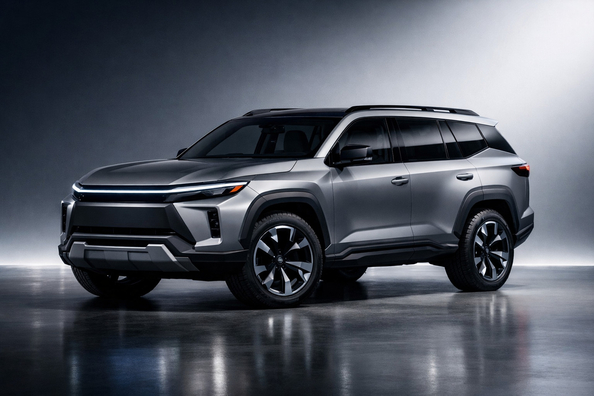

Toyota never showed an official model called Toyota Prado 350. In the 2021–2023 rumors, this name was often used for the successor to the Prado 150, but something else was officially confirmed: the production vehicle debuted as the Land Cruiser 250, and the world premiere took place on August 2, 2023 in Toyota City, Japan. In other words, at launch it wasn’t a concept or a pre-production mock-up, but an official reveal of the production car.
So it’s correct to view “Prado 350” not as a separate project, but as an early unofficial name for the future Prado. The more interesting part is different: which early rumors came true, which turned out to be false, and how this SUV was imagined even before the manufacturer’s official announcement.
Before the debut there were only teasers, market reports, and conflicting insider claims. Toyota did not showcase a separate concept car called Prado 350. Officially, the manufacturer’s press release confirms that the vehicle shown is the Land Cruiser 250, i.e., the production successor to the Prado for some markets.
| What is known | What is expected | What is unknown |
|---|---|---|
| Official name — Land Cruiser 250 / 250 Series | In some markets the model will still be called Prado | Whether the “350” index will ever be used officially |
| The world premiere took place on August 2, 2023 | Further lineup expansion for specific markets | Full global list of trims |
| Production body-on-frame GA-F architecture confirmed | Regional differences in engines and equipment | A single global specification for all countries |
| Sales launch announced for 2024 | Gradual appearance of local special editions | Exact prices and timelines for all markets outside the US and Japan |
If you look specifically at the period of the first rumors, the status back then was roughly “unconfirmed future production vehicle.” After Toyota’s announcement, that uncertainty disappeared: it was already a market-ready model, not a designer’s fantasy.
The biggest intrigue in the early rumors was the underlying platform. According to older assumptions, the new Prado would retain the previous body-on-frame logic with almost no major leap in architecture. Later, closer to the debut, information appeared about the switch to GA-F and technical kinship with the new Lexus GX.
GA-F has now been officially confirmed. This matters not only for marketing: Toyota stated significantly higher frame and body rigidity, which means better stability on asphalt, more precise suspension behavior, and fewer compromises between off-road capability and daily use. For the model people were expecting as the “new Prado,” this transition is more important than any exterior restyle.
Here, the first rumors were partly accurate and partly not. Toyota officially confirmed several powertrains depending on the market: a 2.4-liter gasoline turbo-hybrid rated at 330 hp and 630 N·m, a 2.4-liter gasoline turbo at 281 hp, a 2.8-liter turbodiesel at 204 hp and 500 N·m, as well as a 2.7-liter naturally aspirated gasoline engine. The main transmission for the more modern versions is an 8-speed automatic.
According to pre-debut rumors, more powerful gasoline options, including a V6, could be prepared for the “Prado 350.” But the manufacturer did not confirm this for the 250 Series. So the main takeaway is simple: the new Prado isn’t about chasing maximum numbers, but about a broad regional engine lineup and the first hybrid in the Land Cruiser family.
DD Tuning expert comment: The most common mistake in topics like this is looking for accessories or technical solutions for a “Prado 350” without realizing that in the manufacturer’s catalog the vehicle is listed as the Land Cruiser Prado 250. The second typical issue is ordering parts by a rumor-based name rather than by the actual body, year, and market. For body-on-frame Toyotas this is critical, because differences between versions in bumpers, electrics, and bolt-on equipment can be very noticeable.
In terms of design, Toyota did exactly what people expected from a new Prado: straight surfaces, an almost vertical front end, pronounced wheel arches, and simple body geometry without excessive sculpting. Before the premiere, a more utilitarian, “boxy” style was expected in the rumors—and that came true. The vehicle looks like a body-on-frame SUV, not a crossover with a decorative off-road package.
The interior didn’t go to extremes either. Toyota officially showed a modern digital architecture, while keeping physical controls for core functions. In my view, that’s the right balance: this cabin is easier to live with day to day, and for a model in this class it’s not only about visuals but also usability with gloves, on rough roads, and with a loaded vehicle.
Toyota officially confirmed the dimensions of the debut version: length 4925 mm, width 1980 mm, height 1870 mm, wheelbase 2850 mm. For the US, fuel consumption of about 10.2 l/100 km in the combined cycle was also announced for the hybrid version, and towing capacity of approximately 2722 kg.
Some off-road figures like 221 mm ground clearance and approach/departure angles were most often cited in industry reports from the debut. So it’s more accurate to call them expected or stated in market materials, rather than universally confirmed for all versions worldwide.
In essence, the Land Cruiser 250 sits between utilitarian body-on-frame vehicles and more expensive premium SUVs. The logic is clear: offer more comfort and technology than strictly utilitarian models, but avoid excessive luxury like much pricier rivals.
| Competitor | How it pressures the Prado | How Toyota positions itself |
|---|---|---|
| Lexus GX | More premium interior and a closely related technical base | A more practical, restrained option without paying extra for luxury |
| Land Rover Defender 110 | Strong image, wide range of versions, very capable chassis | Focus on simpler long-term ownership and Toyota’s body-on-frame heritage |
| Ford Bronco | Bold image and strong off-road reputation | A more family-friendly, versatile format for daily driving |
| Jeep Wrangler Unlimited | True hardcore off-road capability | A better balance between highway, city, and off-asphalt trips |
Officially confirmed: in Japan, the start of sales was announced for the first half of 2024; in the US—for spring 2024. The starting price for the US market was announced from $55,950, and in Japan the range reached from 5.2 to 7.85 million yen depending on the version.
It’s important not to mechanically transfer these figures to other countries. For the “Prado 350” topic this is especially telling: rumors often look for one universal price and one universal engine, but in reality Toyota split the specifications by region from the start.
Even after the official debut, a few open points remain. First, there’s no point in talking about a single global configuration: the name, engines, and equipment vary by market. Second, it hasn’t been officially announced whether all powertrain variants will appear simultaneously in every region. Third, the term “Prado 350” still hasn’t been confirmed by Toyota.
For the buyer, this means one simple thing: you should base your decisions not on a rumor index, but on the specific market, VIN logic, engine type, and the model’s actual production name.
From a customer’s experience: one typical scenario looked like this—someone followed the “new Prado 350” rumors for a long time, and after the official debut it turned out they needed to search for Land Cruiser Prado 250 instead. As a result, they canceled ordering elements for the old Prado 150, verified the actual body, and selected solutions for the current model. That kind of real-world verification—by the actual vehicle, not a forum nickname—usually saves time and money.
In short, “Toyota Prado 350” turned out not to be a separate official model, but an informal name for the future Prado at the early-rumor stage. The official result we already see as the Land Cruiser 250: on GA-F, with a hybrid in the lineup, and with a clear return to body-on-frame utilitarian aesthetics. So the main expectation has already been fulfilled—Toyota didn’t dilute the model’s character; on the contrary, it made it technically more modern. And if you need not a forecast but a practical understanding of the production vehicle, you can separately check selection for Prado 250. This material is based not on pretty promises, but on real selection experience, practice, and real-world use cases.
Shipping to EU
Wholesale and retail
Own warehouse
Опис продукту
Подарунки не надаються при оформленні покупки у кредит під 0,01% або при покупці частинами.