17.04.2026
440
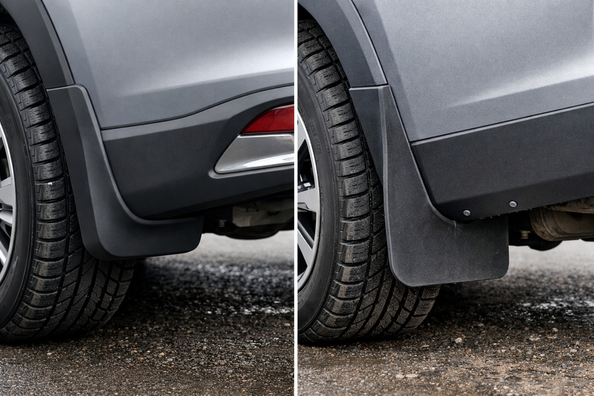
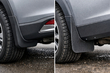
Overpaying for original mud flaps is justified not when there’s a brand logo on the box, but when you need a precise fit, installation without unnecessary drilling, and minimal risk that the edge will start rubbing the tire or making noise at speed. If the car has non-standard wheels, increased ground clearance, or you need more coverage for less money, universal solutions are often more practical.
The main mistake is comparing names instead of design. The word “original” can hide very convenient no-drill kits—or options with trim-level limitations or even mandatory modifications. That’s why you should look at installation, noise, service life, real wheel coverage, and the final cost including installation.
In most cases, the choice comes down to two questions: how important a neat fit for your specific model is, and how much time you’re willing to spend on installation. Original and vehicle-specific mud flaps usually follow the wheel-arch shape better, sit closer to the body, and less often look out of place on a stock vehicle.
Universal ones, on the other hand, give you freedom in size and coverage. That’s useful when the factory wheels have already been replaced, the tires are wider, the vehicle is lifted, or it’s driven on gravel roads and in winter. But for that flexibility you almost always pay with test fitting, trimming, choosing hardware, and carefully checking clearances.
| Option | Strengths | Weaknesses | Who it suits |
|---|---|---|---|
| Original | Precise fit, neat look, often installs to factory points, lower risk of rubbing | More expensive, not always the most coverage, sometimes trim-level limitations or drilling required | Owners of stock vehicles who want a quick, clean installation |
| Vehicle-specific aftermarket | Fit for a specific vehicle, often a better balance of price and coverage, possible options without complicated installation | Quality depends heavily on the manufacturer; hardware and accuracy can vary | Those who want a model-specific fit without overpaying specifically for the factory kit |
| Universal | More size choices, useful for wider tires and lifted vehicles, can provide more coverage | Requires test fitting, drilling or selecting hardware, higher risk of noise and installation mistakes | For non-standard setups, gravel roads, winter, towing, or when you need a large guard |
DD Tuning expert comment: The most common mistake is buying mud flaps based on photos without checking wheel offset, the fender-liner edge, and compatibility with body kits. On a vehicle with wider tires, even a quality kit can rub at full lock. If you choose a universal option, do a test fit first and only then drill; if it’s an original kit, separately confirm the trim level and compatibility with add-on moldings.
| Option | Real-world example | What’s important to remember |
|---|---|---|
| Honda original kit | 4 mud flaps + hardware; no drilling required; injection-molded thermoplastic; not compatible with side or rear underbody spoilers. | Even an OEM kit must be checked for compatibility with your specific trim level. |
| Mopar original kit for Durango | 2 front mud flaps; drilling required; not suitable for SRT, Heat, GT, or R/T versions; hardware included. | OEM doesn’t always mean easy installation without modifications. |
| Husky Universal Splash Guards | 105,95 $; 356 × 546 mm; choice of 305 or 356 mm; 14-gauge; sold in pairs; drilling required; lifetime warranty. | Universal heavy-duty models can be expensive, but they offer good durability. |
Their strength is geometry. On a stock vehicle with factory wheels, they usually match the wheel-arch shape most easily, have predefined mounting points, and don’t spoil the overall look. This is exactly where the extra cost is often justified: less chance of getting a crooked edge, rubbing, or an unnecessary gap between the body and the mud flap.
But don’t assume an original kit always installs in five minutes and provides maximum protection. Some kits are no-drill, while others still require additional holes. In addition, certain solutions aren’t compatible with specific moldings, side skirts, or trim levels—and the guard itself can be quite short.
For example, an original Subaru kit is offered as 4 mud flaps for 115,01 $ with an MSRP of 149,95 $, and it does not require drilling. And Ford mud flaps are often sold as a 2-piece set, with separate front and rear kits, and may be installed at a specialized workshop.
This is a middle-ground option for those who need a fit for a specific vehicle but without necessarily overpaying for factory packaging. If the manufacturer designed the shape well, such a kit often beats typical universal ones in installation, and original ones in the price-to-real-coverage ratio.
The weak point is uneven market quality. One kit fits almost like OEM, another requires adjustment or has mediocre fasteners. So what matters here isn’t generic wording in the description, but the edge shape, material thickness, and the fixing method.
In practice, vehicle-specific solutions are often the most sensible compromise for a daily driver: they can be designed for a particular model yet cost noticeably less than OEM. That’s why it’s worth considering them separately rather than lumping them together with classic universal sets.
Universal mud flaps shine where standard geometry no longer works: wider tires, different wheel offset, lifted suspension, frequent driving on wet gravel or snow. In this segment it’s easier to find a larger size, thicker rubber, or a more rigid material—and sometimes significantly more coverage behind the wheel.
The price of that freedom is installation. You often have to mark holes, cut the material, select hardware, and repeatedly check the clearance to the tire at full lock. If you do it carelessly, the mud flap will start flapping, vibrating, or rubbing—then any nominal savings disappear quickly.
Universal models also vary widely: RokBlokz offer several sizes and colors, Putco offer three sizes and a price range, and Rally Armor explicitly note the need for cutting, drilling, and selecting fasteners. So “universal” doesn’t mean “simple”—it’s more about freedom to tailor the fit.
For a stock city car on factory wheels, original or good vehicle-specific kits most often win. Here, fast installation, a precise edge, and no surprises in use matter. If the car is new or well cared for, the extra cost is also justified by the lower risk of unnecessary interference with the fender liners and paintwork.
For winter, gravel roads, and highways with puddles, what matters more is not the word “original,” but the coverage area and structural rigidity. A short, neat guard may look better, but a large universal or vehicle-specific mud flap sometimes objectively does a better job of stopping dirt, salt, and small stones.
For vehicles with non-standard wheels, fender flares, or increased ground clearance, universal solutions often have the advantage. An original kit is designed for the stock configuration, so on a modified vehicle it’s more often too short or too close to the wheel.
| Scenario | Best choice | Why |
|---|---|---|
| Stock sedan or crossover for the city | Original | The easiest way to get a precise fit, clean installation, and a tidy look without lengthy fitting |
| New car where you don’t want extra drilling | Original or good vehicle-specific | This segment more often includes kits that use factory mounting points |
| Lifted vehicle or wider tires | Universal | Easier to choose a larger size and set the coverage you need for non-standard geometry |
| Frequent driving in snow, mud, gravel | Vehicle-specific with more coverage or universal | Real effectiveness depends on the guard area, not the wording on the box |
| Need to save on purchase but avoid risky, complex installation | Vehicle-specific aftermarket | Often offers a better balance of price, fit, and installation costs |
A more expensive kit makes sense when what matters to you isn’t formal specs, but a predictable result after installation. If the vehicle is stock, on factory tire size, and you want minimal risk during installation, it’s logical to look at original mud flaps. When you need model-specific fit without necessarily overpaying specifically for a factory kit, it’s worth comparing vehicle-specific mud flaps. And for a vehicle with wider tires, increased ground clearance, or the need for more coverage, it’s more rational to go straight to universal mud flaps, understanding that test fitting will take more time.
In other words, the extra cost is justified when it buys you a precise fit, time savings, and a lower chance of rework. If you can’t avoid fitting anyway, it’s better to pay not for the name, but for the size, rigidity, and coverage you need.
From a customer’s experience: the owner of a crossover on factory wheels initially wanted a cheap universal set, but after test fitting it turned out the edge would need trimming and hardware would have to be selected separately. In the end he switched to a vehicle-specific kit without unnecessary drilling: installation took less time, nothing rubbed at full lock, and the protection was sufficient for city and highway use. On another vehicle with wider tires, a large universal kit worked better because the stock option didn’t cover the area where dirt was being thrown.
In short, original mud flaps are worth buying when you need a precise fit, a neat look, and predictable installation on a stock vehicle. Universal ones are more advantageous where size, extra coverage, and adaptation to a non-standard vehicle setup matter. Vehicle-specific aftermarket options often become the most sensible compromise between these two extremes.
The key is to compare not the label on the box, but compatibility, installation method, tire clearances, and how much protection you’ll actually get after installation.
| ✔ | Original mud flaps are usually a precise fit for a specific model, so there is less risk of misalignment, rubbing against the tire, or extra gaps between the body and the mud flap. |
| ✔ | For a stock car, they are often easier to install: they may fit into the factory mounting points and not require extensive adjustment. |
| ✔ | Model-specific aftermarket ones often offer a better balance between price, fit, and actual wheel coverage than classic universal options. |
| ✔ | Universal mud flaps are useful for non-standard setups — wider tires, increased ground clearance, or a different wheel offset, since it is easier to choose the right size and coverage. |
| ✔ | For winter, dirt roads, and frequent drives on wet gravel, a larger mud flap can really do a better job of blocking dirt, salt, and small stones than a short, neat set. |
| ✘ | Genuine mud flaps are more expensive, and sometimes their coverage is not the best, so the extra cost does not always mean more protection. |
| ✘ | Even genuine kits do not guarantee easy installation: on some models, drilling is still required, or there are compatibility limits with certain trims and body kits. |
| ✘ | Universal options often require test-fitting, trimming, and choosing the right fasteners, so the savings on purchase can disappear because of the extra time and work. |
| ✘ | If selected incorrectly or mounted too loosely, universal mud flaps can flap, vibrate, or rub against the tire, especially at speed or at full steering lock. |
Shipping to EU
Wholesale and retail
Own warehouse
Опис продукту
Подарунки не надаються при оформленні покупки у кредит під 0,01% або при покупці частинами.