12.06.2026
156
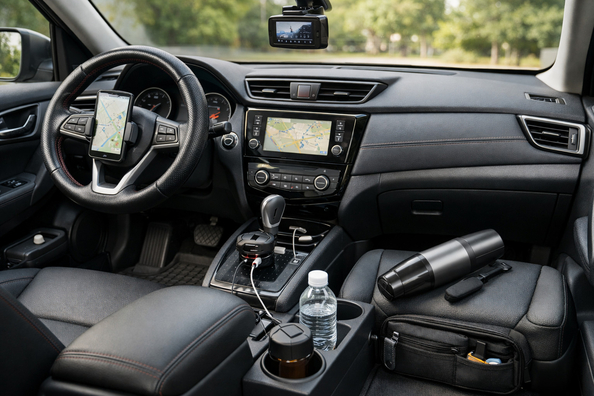
This plan is for those who’ve just bought a car and don’t want to blow the budget on random small stuff. The scenario is simple: the car should be ready for daily driving, a minor puncture, a weak battery, dirt in the cabin, and trips where your smartphone is the navigation.
When money is tight, the logic is straightforward: safety and technical readiness first, then cabin protection, then convenience, and only after that anything bought for looks. If the car is driven in a cold region, on highways, or came to you in an unknown condition, tires and basic preparation matter more than any decor.
After buying a car, the main task isn’t to quickly buy something extra—it’s to eliminate the typical weak points of the first month of ownership. That means tire pressure, being ready for a dead battery or a minor puncture, good visibility, safe phone use, and protecting the cabin from water, dirt, and road salt.
With a used car, the priority is even stricter: you don’t always know when the tires were last checked, whether there’s a proper spare, what condition the headlights are in, and what’s in the trunk in case you have to stop on the shoulder. So a good upgrade here isn’t a set of nice-looking accessories, but a minimum of things that reduce the risk of downtime and unnecessary costs.
The first wave of purchases should cover three questions: can you drive safely, can you quickly solve a minor issue on the road, and will the interior start getting wrecked from week one.
In a cold climate, tires are a separate first priority. If the rubber is worn or the season is wrong, any mats, mounts, and dash cams come second.
| Upgrade | Why it’s needed | Who it really benefits |
|---|---|---|
| Emergency kit | Provides minimum readiness for a stop, a minor breakdown, or waiting for assistance | Basically everyone, especially those who drive on highways or bought a used car |
| Tire pressure gauge | Lets you quickly spot incorrect pressure and avoid wearing out tires for no reason | Everyone without exception, because it’s basic wheel control |
| Compressor or tire repair kit | Helps you make it to a service shop without a tow after a slow puncture | Those without a full-size spare, those who often drive far, or carry family |
| Jump starter | Saves you with a weak battery without needing to find another car | For winter use, infrequent driving, older cars, and long routes |
| Phone mount | Reduces distraction when a smartphone serves as navigation | Those without convenient factory multimedia |
| All-weather floor mats and trunk liner | Take the hit from water, snow, salt, sand, and dirt from items | For regions with dirty weather, family cars, crossovers, wagons, and anyone who often hauls things |
| Dash cam | Provides footage of accidents, road conflicts, and parking damage | Those who drive a lot in the city, leave the car outside, or want evidence |
| Winter tires | Improve grip, braking, and control in the cold | For regions where temperatures consistently drop and there’s snow or ice |
DD Tuning expert comment: Most often, after a purchase people start with seat covers, trim pieces, and small decor—and only then remember tire pressure or the lack of a proper kit in the trunk. The second typical mistake is choosing the cheapest universal items without proper mounting: those mats or mounts get annoying fast and often work worse than one properly selected basic item.
The second stage starts once you’ve covered road readiness. Here, cabin protection and things that save time on upkeep come first. All-weather floor mats and a trunk liner quickly pay off if the car sees wet shoes, snow, kids’ stuff, tools, or groceries every day.
This is also often the stage when a dash cam makes sense. If the car spends a lot of time parked outside, drives in dense city traffic, or you don’t want to argue after a minor accident, a dash cam brings more value than most decorative accessories. Headlight restoration also belongs here if the light is already noticeably dim.
This group includes everything a car can live without, but that makes it nicer to use. For example, vehicle-specific mats instead of very basic universal ones, neat hardwiring of a dash cam without cables in your line of sight, a trunk liner for your exact body style, and small organizers for everyday order.
Exterior mods only make sense once you’ve covered tires, lighting, pressure, an emergency kit, and basic cabin protection. If the budget is strictly limited, any “because it looks nice” purchase should lose to “because it won’t leave me stranded or ruin the interior.”
Most often, people waste money on things that don’t match their use case. If the car already has convenient factory multimedia and solid hands-free calling, a phone mount won’t be a first necessity. If you have a full-size spare and you barely ever leave the city, a compressor can be postponed a bit instead of buying the first one you see in a rush.
A separate category of mistakes is overpaying for looks. Decorative seat covers, steering wheel covers, soft seat belt pads, universal mats without proper fixing, and cheap plug-in gadgets often deliver less benefit than it seems. Some can even interfere with safety. Another mistake is buying an expensive dash cam while driving on tired tires with incorrect pressure.
| Scenario | What to install first | What can be postponed | What’s optional |
|---|---|---|---|
| Daily city driving | Tire pressure gauge, emergency kit, phone mount, tire and light check | Dash cam, trunk liner, jump starter | Decorative seat covers, trim pieces, random small gadgets |
| Long trips | Emergency kit, compressor or repair kit, jump starter, good tires | Mats, dash cam, interior upgrades | Exterior decor |
| Cold region | Seasonal tires, ice scraper, gloves, compressor, battery check | Dash cam, phone mount, trunk liner | Any “for looks” purchases until winter readiness is covered |
| Family car or frequent dirty trips | All-weather mats, emergency kit, tire pressure gauge, trunk liner | Dash cam, jump starter, comfort extras | Cabin decor without practical benefit |
This order works for almost any vehicle class, but it’s adjusted for body style and how the car is used. For a crossover or wagon, a trunk liner is more useful; for a small city hatchback, less so. For a new, clean car, you can postpone mats a bit; for a used car or winter operation—no.
More expensive items make sense not when you just want something cooler, but when there’s a clear scenario. Vehicle-specific mats are justified if water, snow, or sand is often brought into the cabin, or if you simply don’t want to keep cleaning the factory carpeting. In these conditions, cheap universal options usually lose in mounting and edge coverage.
A more powerful compressor is worth getting for a heavier vehicle, long routes, and frequent pressure checks—not just as a backup. And if your basic kit is already assembled and you want to add a few truly useful items, check out useful accessories, but don’t change the order: expensive small extras don’t solve tire, battery, and road-readiness problems.
From a customer’s experience: after buying a used hatchback, the person initially planned to get seat covers and decorative trim, but ended up starting with a tire pressure gauge, compressor, mats, and a phone mount. Within the first month, the compressor came in handy because of a slow puncture, and the cabin didn’t need to be scrubbed after wet snow. The dash cam was bought later, once it became clear the car regularly spent nights in an open parking lot.
If the budget is limited, the smartest approach is not to spread yourself thin: road readiness and tire control first, then cabin protection, then convenience, and only after that exterior or decorative upgrades. That’s the easiest way to filter out marketing junk and avoid spending money on things that don’t solve any real task.
This material is based on real selection experience, hands-on practice, and real usage scenarios: what truly helps after buying a car, what benefits not everyone, and what’s better postponed without regret. For most drivers, the winner isn’t the longest shopping list, but the right order.
| ✔ | After buying a car, the article clearly advises first covering the basic readiness for the road: tires, lights, an emergency kit, and a spare wheel or repair kit. This is practical because it reduces the risk of being left on the roadside over a minor problem. |
| ✔ | The tire pressure gauge is separately highlighted as a cheap but useful purchase for constant tire pressure monitoring. This helps both handling and tire wear. |
| ✔ | A compressor or tire repair kit is described as almost essential if there is no full-size spare wheel. For trips far from service stations, it really saves time and money. |
| ✔ | The plan clearly sets priorities between safety, cabin protection, and comfort. This helps avoid spending the budget on decorative items before more important tasks are resolved. |
| ✔ | There is a useful link to scenarios: city driving, long trips, a cold region, a family car. This approach makes it possible to buy not “everything at once,” but only what will really be needed in those conditions. |
| ✘ | The article does not sufficiently explain how exactly to choose budget models of each accessory and which characteristics can be saved on without losing usefulness. Because of this, the reader will have to separately figure out specific brands and parameters. |
| ✘ | Many recommendations depend on the car’s condition, the region, and the driving style, but there is no clear universal budget or minimum set with an approximate amount. This makes it harder to plan expenses after purchase. |
| ✘ | Some recommendations are given rather generally, for example regarding the jump starter or dash cam, without explaining which features are really needed and which are unnecessary. Because of this, it is easy to overpay for a poor configuration. |
Shipping to EU
Wholesale and retail
Own warehouse
Опис продукту
Подарунки не надаються при оформленні покупки у кредит під 0,01% або при покупці частинами.