 Author: Radomskyi Maksym Vasyliovych
This upgrade plan is for the owner of a tall SUV who’s tired of having to pull themselves into the cabin every time, catching the seat edge with a foot, and staining pant legs on the sill or road slush from the wheels. The scenario is typical: the vehicle is tall from the factory or slightly lifted, it’s used daily, and kids, older passengers, or shorter people often get in.
The logic is simple: first create a proper, stable foothold, then reduce road grime, and only after that think about expensive or decorative solutions. If your SUV isn’t very tall, some of these upgrades may not help and can actually make entry a two-step, awkward process.
What problem this upgrade should solve
The right upgrade in this scenario should solve two issues at once: provide a clear, safe support point when getting in, and reduce how much your clothing touches the dirty zone under the doors. In other words, this isn’t about “decorating the side of the car” — it’s about your foot landing on a wide, non-slip surface, and getting out not turning into a jump.
For a truly tall SUV, the main obstacle is usually the entry height. That’s why a narrow side tube rarely solves the problem: it’s awkward to place your foot on, and in rain or snow it’s even more slippery. If the vehicle isn’t that tall, any fixed side step needs to be chosen carefully, because it can start getting in the way as you step out.
What to upgrade first
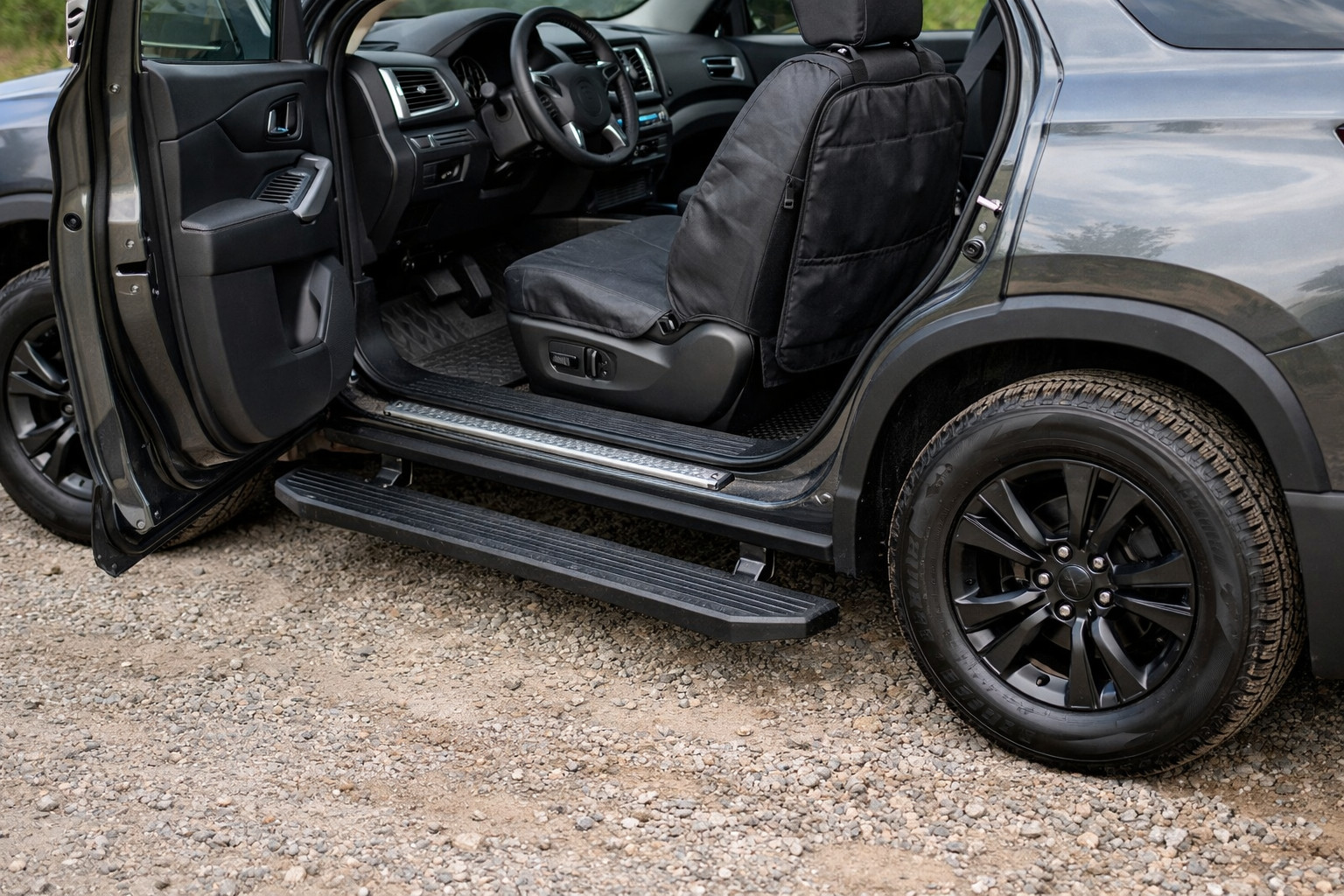
Top priority: wide fixed side steps or step-style running boards with a textured surface. A practical usable area is typically about 127–171 mm: it’s something you can actually step on, instead of aiming the toe at a narrow tube. For daily use, matte, textured surfaces or anti-slip inserts work better than smooth chrome.
If you have a body-on-frame SUV, the best approach is mounting to the frame. If it’s a unibody, look for vehicle-specific brackets and factory mounting points, not purely decorative kits. The point is the same: the step must handle regular adult weight, not exist just for looks.
If your main complaint isn’t only the entry height but also dirt on the doors and pant legs, plan mud flaps right after the steps. They don’t replace a step, but they significantly reduce slush, water, and small stones hitting the lower door area.
Upgrade: why it’s needed, who it benefits (table)
| Upgrade | Why it’s needed | Who it really benefits |
|---|---|---|
| Wide fixed running boards | Create a proper foothold, make entry and exit easier | Owners of tall SUVs, families with kids, shorter people, older passengers |
| Power retractable running boards | Provide a convenient step only when the door is opened; when retracted they collect less dirt | Those who often carry passengers and are willing to pay for comfort and upkeep |
| Mud flaps | Reduce slush, water, and dirt on doors, arches, and clothing | Those who drive in wet weather, on highways, or in winter with road chemicals |
| Assist grab handles | Make it easier to pull yourself up when getting into the cabin | Families, older passengers, if the model has factory mounting points |
| Rock sliders | Protect the body in serious off-road use | Only for those who actually drive over rocks and rough terrain |
| Narrow tubular side steps | Often more about looks than a truly usable foothold | Limited benefit; for daily entry they usually lose to wide running boards |
In short, for city or highway use the best cost-to-benefit combo is usually a standard wide running board plus mud flaps. Everything else makes sense only after that base setup.
DD Tuning expert comment: The most common mistake is buying steps “because they look nice” without checking the real usable width and the mounting method. The second typical story is overpaying for chrome or a narrow tube that doesn’t make getting in any easier in real life. If the vehicle is truly tall, what solves it isn’t shine — it’s a wide platform and a proper anti-slip surface.
What makes sense to add as a second stage
At the second stage, mud flaps are most often next. They’re especially useful when, after rain, grime flies onto the lower part of the doors and you step out and catch that exact area with your pant legs. It’s an inexpensive upgrade compared to retractable systems, but in daily use the effect is very noticeable.
Another smart second step is assist grab handles — but only where the model has factory or otherwise safe mounting. They don’t replace a step on a tall SUV, but they work great together: your foot lands on the step, your hand helps you pull up, and entry feels more natural.
What’s more about comfort or looks
In this group I’d include illuminated step lighting, chrome finishes, decorative covers, and other accents that don’t change the mechanics of getting in. These are fine if the core task is already solved, but they shouldn’t replace a proper step.
Power retractable running boards are in a category of their own: it’s not just decor, it’s expensive comfort. They’re convenient because they appear only when needed and tuck under the body while driving. But you pay for that convenience not only with money, but also with system complexity: motors, hinges, wiring, and the need for more attentive maintenance, especially in winter.
What people often buy for nothing
Most often, people waste money on narrow tubular steps purely for appearance. In photos they add “off-road character,” but in real life you still end up searching for somewhere to place your foot. In wet weather it’s even worse, because a smooth narrow surface doesn’t give proper control.
The second mistake is buying cheap decorative solutions without understanding how they mount and whether they’re designed for daily load. The third is installing rock sliders on a purely urban SUV: they’re heavier, rougher, can effectively steal usable clearance, and don’t provide the most comfortable step-in. And one more common story: installing steps on an SUV that isn’t very tall, where the entry problem is actually overstated.
What to install first, what to postpone, what isn’t necessary (table)
| What to install first | What can be postponed | What isn’t necessary |
|---|---|---|
| Wide fixed running boards with an anti-slip surface | Mud flaps, if right now entry convenience matters more | Chrome, lighting, decorative covers |
| Mud flaps, if clothing gets dirty from wheel slush | Assist grab handles, if kids or older passengers rarely ride in the car | Narrow tubular steps “for the look” |
| Checking the mounting method and the real platform width | Power retractable running boards until you understand that standard ones aren’t enough | Rock sliders for a daily city-use scenario |
So the basic order is: first fix the entry geometry, then the cleanliness of the side area, and only after that — additional comfort or visual effects. That approach gives you the lowest chance of overpaying for something that doesn’t work for your real use case.
A ready upgrade plan for this scenario
- Assess whether the SUV is truly tall for you: how the driver and main passengers get in, where exactly clothing gets dirty, and whether there are kids or older people.
- Choose wide fixed running boards with a non-slip surface, not narrow tubes. For a body-on-frame vehicle, frame mounting is the priority; for a unibody, vehicle-specific brackets.
- Make sure the platform is wide enough and not positioned too far from the body — otherwise entry becomes clumsy.
- If clothing gets dirty from slush and spray, add mud flaps as the second practical step.
- If kids, parents, or shorter passengers often ride with you, consider assist grab handles where your model supports them.
- Only after that decide whether you need pricier retractable systems, lighting, or other comfort options.
When it makes sense to choose more expensive solutions
More expensive solutions make sense when the vehicle is truly tall, used daily, and different passengers regularly get in. In that case, you can look not only at standard side steps, but also retractable systems: they stay cleaner in everyday use, don’t hang under the body all the time, and better preserve normal entry for those who don’t need a step.
But it’s worth buying them only if you’re ready for a higher budget and you won’t ignore winter maintenance. If the problem is mixed — both a high step-in and lots of dirt on the side — it’s often more practical to build a set from a proper running board and mud flaps. If you’re unsure, it’s useful to first understand why doors and sills are constantly covered in mud, and only then pay extra for a more complex system.
Financially, the difference is noticeable: simple running boards usually fit a basic budget, while power systems are a separate expense category. That’s why the expensive option is justified not when it looks better, but when it’s genuinely used every day and saves your nerves on every entry.
Conclusion
From a customer’s experience: we were looking for a solution for a tall family SUV, where the biggest complaints were kids struggling to get in and dirty pant legs after rain. At first we wanted narrow tubular steps, but in the end we chose wide fixed running boards and added mud flaps. The result was simple: getting in became easier every day, and there was less dirt on the lower part of the doors.
For this scenario, the best order is: first a wide practical running board, second stage mud flaps, then grab handles or pricier retractable solutions if there’s a real need. Don’t overpay for looks if the basic entry mechanics aren’t solved. This material is based on real selection experience, hands-on practice, and real usage scenarios, so the main takeaway is simple: what’s useful here is what makes the step into the cabin easier and keeps your clothing away from the dirty zone.
How it works
- Assess what exactly makes entry difficult First, determine whether the problem is the high step into the cabin or also the fact that clothes get dirty from the sill or slush from the wheels. This will help you understand whether you need only a sill or also mud flaps right away.
- Install wide fixed sills First of all, choose wide fixed sills or step boards with a rough, non-slip surface. For everyday use, they are more practical than narrow tubular step boards, because they provide proper foot support.
- Choose the right mounting For a body-on-frame SUV, the priority is mounting to the frame; for a unibody vehicle, model-specific brackets and factory mounting points. It is important that the sill can withstand regular load and is not just a decorative element.
- Add mud flaps If trips leave the lower part of the doors and trouser legs dirty, install mud flaps as a second step. They do not replace sills, but they noticeably reduce slush, water, and small stones thrown up from the wheels.
- Add grab handles or retractable sills if needed Grab handles make sense if children, older passengers, or shorter people often ride in the car, and if there is a safe mounting solution for the model. Electric retractable sills should be considered only when a standard solution is no longer enough and you are ready for a higher price and more complicated maintenance.
Pros and cons
Wide fixed side steps provide solid footing, making it easier to get in and out of a tall SUV. For everyday use, they are more practical than a narrow tube because you can actually place your foot on the step instead of aiming with your toes.
An anti-slip or textured step surface reduces the risk of slipping in rain and snow. This is especially useful when children, older passengers, or shorter people are getting into the car.
Mud flaps do a good job of reducing slush, water, and small stones that get thrown onto the lower part of the doors and onto clothing. In wet weather or in winter, this noticeably reduces trouser leg dirt.
Grab handles add another point of support when getting into the cabin. Paired with a side step, they make boarding feel more natural for those who find it difficult to pull themselves up into a tall vehicle.
Electric retractable side steps are convenient because they appear only when the doors are opened and tuck away under the body while driving. As a result, they are less of a nuisance in daily use and do not hang constantly under the vehicle.
Narrow tubular side steps are often more about looks than real convenience. They are awkward to place your foot on, and in wet weather they are even more slippery.
On a not very tall SUV, fixed side steps can start to get in the way when getting out. In that case, getting in and out becomes a two-step process and less convenient than without them.
Electric retractable side steps cost significantly more than simple solutions and have a more complex design. They include motors, hinges, and electrics, which means they need more careful maintenance, especially in winter.
Rock sliders mainly make sense for serious off-road use, while in a city setting they are unnecessary. They are heavier, rougher, and do not provide the most convenient step-in for everyday use.