13.07.2026
215
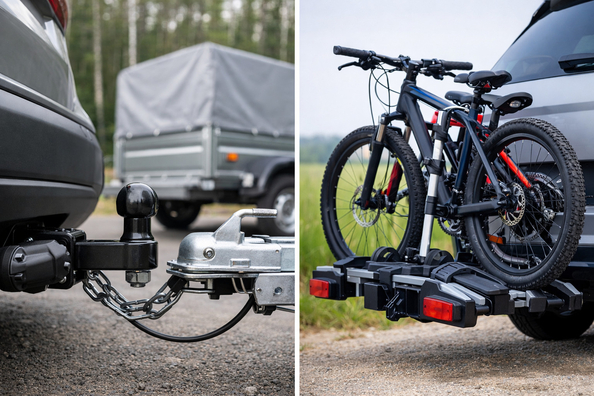
The key question here isn’t which tow bar is better on its own, but what exactly you’re going to carry. For a trailer you need a full towing system with a ball, safety chains, wiring and, if required, trailer brakes. For bikes, a compatible receiver tube and a correctly selected bike rack are enough—but for heavy e-bikes and frequent trips, the selection logic changes.
The most expensive mistake is buying a tow bar “for the future” without checking tongue weight, receiver size, ground clearance, and your real use case. Below is a short comparison without extra noise: when you need a towing kit, when a bike-rack setup is enough, and where it makes sense to pay more.
If you truly need a trailer, you should treat the tow bar not as a standalone piece of metal under the bumper, but as part of a system. What matters is the tow bar itself, the ball, mount, pin, trailer coupler, safety chains, wiring—and for heavier trailers, their brakes as well. The weakest-link rule applies: that’s what limits the whole system.
If you’re not planning a trailer and only need bikes, other things come first: allowable tongue weight, receiver size 31.75 or 50.8 mm, the rack type, and everyday convenience. For 1–2 light bikes, a simpler solution is often enough; for e-bikes, carbon frames, fatbikes, and regular trips, a platform rack is noticeably more practical.
| Option | Strengths | Weaknesses | Who it’s for |
|---|---|---|---|
| Trailer towing tow bar | Enables real towing, works with a trailer, lets you build a complete kit for the task | The most expensive and most complex scenario; requires additional components; more legal and safety requirements | Those who actually tow a trailer, boat, car hauler, or utility load |
| Tow bar for a light hanging bike rack | Low own weight, lower price, easier to remove and store | Less versatile; frames without a top tube often need an adapter; not the best option for heavy bikes | Those who carry 1–2 regular bikes not very often |
| Tow bar for a platform bike rack | Better compatibility with different frames, suitable for heavy bikes, easier loading | Higher price, higher own weight, stricter requirements for tongue weight and ground clearance | Those who travel often and carry expensive MTBs or e-bikes |
DD Tuning expert comment: most mistakes happen at two points. First, people choose a minimal setup for 1–2 light bikes, and a season later want to carry two heavy e-bikes; or they buy a trailer tow bar but don’t budget for wiring and the full safety kit. Before paying, calculate not only the payload weight, but also the rack’s own weight—and plan not just for today, but at least for the next year.
This is the right choice if you have a real towing task. What matters is not only the vehicle mount, but the full set of elements without which a trailer can’t be considered properly road-ready. For heavier trailers, the requirement for their brakes is added. The advantage is that it solves the towing task directly, rather than disguising it as an accessory.
The downside is simple: it’s the most expensive and least “everyday” scenario. If you don’t use a trailer, buying a system at this level just for bikes makes no sense.
This is a light and relatively affordable route when you need to carry 1–2 bikes without heavy loads. There are very light models that one person can remove easily and store off-season without hassle. For occasional trips, that’s a strong argument.
The weak spot is frame compatibility. Bikes without a classic top tube, BMX, and some non-standard frames often require a separate adapter—and the adapter has its own weight limit. That’s why for heavy e-bikes this option is usually not the best.
A platform holds the bike by the wheels, so it works better with different frame types, including carbon, step-through, and heavy frames. This is the type more often chosen for regular trips and expensive bikes. If we’re talking about two heavy e-bikes, it’s more practical to look right away at solutions for 50.8 mm.
But you pay for versatility with weight and price. The rack itself can weigh 17–26 kg, which is already an additional load on the tow bar. Add leverage, ground clearance, and fit requirements in the receiver—and it becomes clear why for this setup it’s not only “paper compatibility” that matters, but correct installation.
For pure towing there’s no substitute: choose the tow bar as an element of the towing system. If you need a trailer even occasionally, saving on wiring, safety, and the correct configuration usually backfires.
If the vehicle is low or roads are rough, check ground clearance separately. The farther the mass is offset from the mounting point, the more sensitive the system becomes to speed bumps, potholes, and swaying.
| Scenario | Best choice | Why |
|---|---|---|
| You need a trailer for household or work tasks | Trailer towing tow bar with a full kit | Only this gives you not just a mounting point, but a full system for pulling and safety |
| 1–2 regular bikes a few times per season | Tow bar for a light hanging bike rack | Lower cost, lower weight, easier to remove and store |
| 2 heavy e-bikes or heavy MTBs | Tow bar for a 50.8 mm platform | Better compatibility, higher practicality, fewer compromises on bike weight |
| Frames without a top tube or different bike types in the family | Platform bike rack | No need to adapt to frame shape and less chance of hitting adapter limits |
| Both a trailer and bikes, but not at the same time | Trailer tow bar with compatibility headroom | The base should meet the towing task; the rack is chosen as a second scenario |
A more expensive kit is justified when you know the system will be used often or under a heavier scenario. If you’re already choosing a tow bar, look not only at vehicle compatibility, but also tongue weight, class, and receiver size.
For two heavy e-bikes, saving on the base often ends with a second purchase. In that situation it’s more logical to immediately look at platform-type bike carriers; and if you’re still deciding between transport methods, it’s useful to separately compare roof vs tow bar for trips.
Overpaying also makes sense when a trailer will definitely be in use. A cheap start is misleading here: on top of the tow bar price you also need the ball, mount, pin, wiring, safety chains, and for heavier trailers, brake-related components.
From a customer’s experience: a person initially looked for a tow bar only for two bikes, but during selection it turned out one of them was an e-bike, and the vehicle occasionally tows a small trailer. In the end they chose a tow bar with compatibility headroom and a 50.8 mm platform rack. It cost more upfront, but meant no adapters, no repeat purchase a season later, and no hassle loading a heavy bike.
In short: for a trailer you need a full towing kit; for bikes you need a compatible base and the right rack—not just any tow bar. A light hanging option makes sense for occasional trips with 1–2 regular bikes; a 50.8 mm platform is worth it for frequent use, heavy bikes, and a need for versatility. The main advice is simple: don’t buy “just in case”—buy for your real load and your riding routine.
| Criterion | What to check | Why it matters |
|---|---|---|
| Installation | Whether you need a ball, mount, pin, wiring, safety chains, or brake components | Without the full set, towing or carrying can be incomplete and unsafe |
| Service life | How easy it is to remove, clean, and check fasteners | This directly affects play and corrosion |
| Practicality | Whether you need trunk access, fast loading, and a tilt design | This determines everyday convenience |
| Price | How much not only the base costs, but all additional components too | The total cost is often multiples different |
| You need | Best type | Comment |
|---|---|---|
| Trailer | Trailer towing tow bar | The basic and correct option for pulling |
| 1–2 light bikes | Hanging bike rack | Cheaper and lighter for everyday use |
| E-bikes or frequent trips | Platform bike rack | Stronger in compatibility and convenience |
Before paying, check the limits for your specific vehicle again—because even within one class, manufacturers set different tongue-weight and towing values. If you need a kit for years, the best solution is often not the cheapest, but the one you won’t have to replace after the first season.
| ✔ | For a trailer, the article clearly recommends buying a complete towing kit, not just settling for a mount under the bumper. This reduces the risk of buying a solution that won’t be enough for towing and safety. |
| ✔ | For 1-2 regular bikes, a hanging bike rack looks practical: it is lighter, cheaper, and easier to store. This option is convenient for occasional trips without extra costs. |
| ✔ | A platform bike rack is better suited for heavy electric bikes, carbon frames, and different frame types in general. It is also easier to use in families where the bikes differ in design. |
| ✔ | The article points out important technical details: vertical load, the receiver tube size, ground clearance, and the rack’s total weight. This helps avoid buying something “just in case” that then does not fit the real scenario. |
| ✔ | It is also emphasized separately that a more expensive kit makes sense if the system will be used often or with heavier cargo. In other words, the extra cost is justified here not by the brand, but by the actual usage pattern. |
| ✘ | For a trailer, the towing version is the most expensive and the most complicated to assemble, because it includes a ball, bracket, pin, wiring, safety chains, and sometimes braking components. Because of this, the starting price is noticeably higher than it seems at first. |
| ✘ | A hanging bike rack has limited compatibility with frames without a top tube, BMX, and some non-standard bikes. For heavy e-bikes, this type is often not the best choice. |
| ✘ | A platform bike rack is heavy and more expensive on its own, and it also requires greater reserves in vertical load and ground clearance. For low cars or bad roads, this can create inconvenience. |
| ✘ | If you leave a bike rack on the car without regular inspection, cleaning, and protection from salt, play and corrosion appear. So even a convenient solution requires ongoing care. |
Shipping to EU
Wholesale and retail
Own warehouse
Опис продукту
Подарунки не надаються при оформленні покупки у кредит під 0,01% або при покупці частинами.