

































































 Author: Radomskyi Maksym Vasyliovych
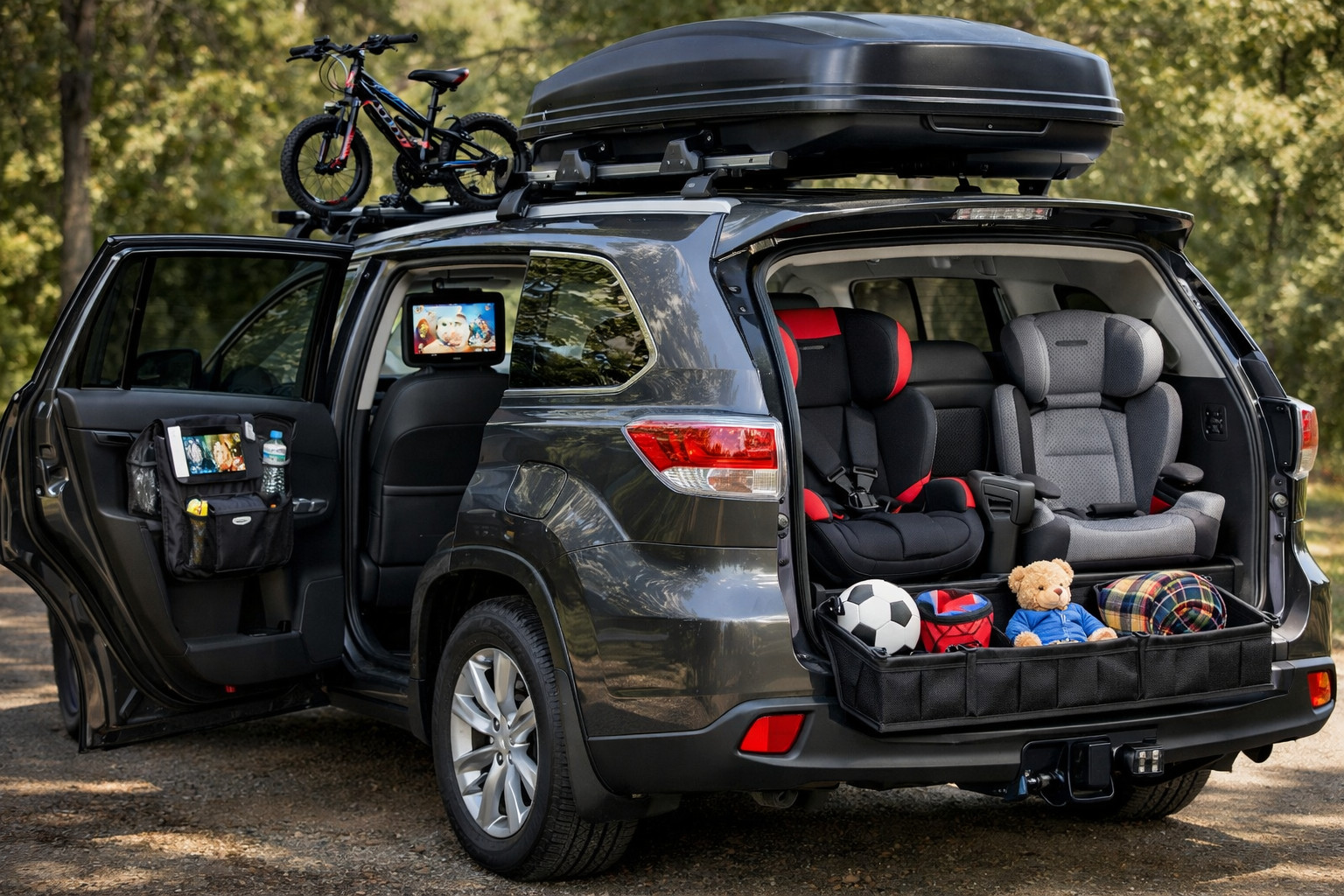
This upgrade plan is for a Toyota Highlander owner who hauls kids, periodically raises the third row, and doesn’t want to choose between passengers and luggage every time. In this scenario, the first upgrades aren’t about decor—they’re about protecting the interior, making the cargo area work logically, and keeping quick access to the third row.
For the Highlander 2014-2019 this is especially relevant: the second row makes it easier to get to the back, and the third row actually gets used, but with all seats up the cargo area is already small. If yours is a 2013 model, keep in mind it’s a different generation, so floor mats, cargo solutions, and roof components must be checked separately for compatibility.
What this upgrade needs to handle
The main task is simple: the car should survive daily family use without constant cleaning, scratches, and reshuffling. That means no bare flooring under the kids’ feet, a cargo area that can handle a stroller, bags, scooters, and suitcases, and a third-row fold that doesn’t turn into a compromise because of a poorly chosen mat or organizer.
The second task is not to duplicate what’s already factory-equipped. The Highlander’s family baseline is solid as is: child-seat anchors, rear vents, separate rear climate control, child locks, and on some trims enough USB ports and a power outlet. So it’s smarter to put the first money not into gadgets, but into things that truly save the interior and simplify everyday life.
What to upgrade first
First priority — floor mats for all three rows. If the third row is sometimes used for kids and sometimes folded for cargo, a two-row set doesn’t fully cover the use case: dirt and moisture will still make their way to the back.
Second priority — a cargo mat or tray, ideally designed so it doesn’t interfere with folding third-row sections separately. For the Highlander this is critical, because the 60/40 flexibility is what lets you keep one rear seat for a child while placing gear next to it.
Third priority — protection for the loading zone: the third-row seatbacks and the top edge of the rear bumper. If the family regularly loads a stroller, bikes with wheels removed, bags, or boxes, scratches show up very quickly—this is exactly the case where a small upgrade saves nerves.
Upgrade / why it’s needed / who it really benefits (table)
| Upgrade | Why it’s needed | Who it truly benefits |
|---|---|---|
| 3-row floor mats | Cover the full path kids take through the cabin; trap water, sand, and crumbs | Anyone who actually uses the third row or often seats kids in the back |
| Cargo mat that accounts for the third row | Protects the cargo floor without breaking the 60/40 folding use case | Those who alternate between “rear passengers” and “cargo” modes |
| Seatback protection | Takes the dirt and scuffs when items are placed on folded seats | Families with a stroller, sports gear, weekend trips |
| Rear bumper protection | Reduces the risk of scratches when loading heavy or awkward items | Anyone who frequently uses the cargo area in city driving |
| Roof solution | Moves part of the load outside when you need both the cabin and the third row at the same time | Those for whom 390 L behind all rows is regularly not enough |
DD Tuning expert comment: The most common mistake is this: people buy a nice-looking cargo tray without checking how it works with the third-row seatbacks, or they get mats for only two rows because “almost nobody sits in the back.” In a family Highlander, that backfires quickly—the third row and cargo area get the most accidental dirt. Another typical mistake is choosing accessories only by model year, ignoring that 2013 and 2014 are already different generations.
What makes sense to add as a second stage
In the second stage, it’s worth adding what solves logistics rather than protection. First of all, that’s a roof solution if you often go on vacation fully loaded and don’t want to fold the third row just for suitcases. It only makes sense once you’ve confirmed that interior volume is consistently not enough.
You can also include simple cargo-organization items here: nets, bags, dividers—if they don’t get in the way of quickly changing the cabin configuration. For a family vehicle, this is more useful than decorative trims, because it helps keep the cargo area from turning into one big box of stuff.
What’s more about comfort or looks
This group includes side steps, window deflectors, some trims, and seat covers. They’re not useless, but their value depends heavily on your use case. For example, side steps are genuinely helpful if small kids or elderly relatives get in often; if entry is already easy in your family, the effect will be more visual than practical.
Seat covers also shouldn’t be installed automatically. If the interior is already durable and the main impact is handled by the right mats and cargo protection, covers can wait. The same goes for small exterior decor: it adds neither space, nor easier access to the third row, nor peace of mind in daily use.
What people often buy for nothing
Most often, people waste money on universal cargo mats that seem to “almost fit,” but block third-row operation or don’t cover the seatbacks. The second common miss is two-row mats in a vehicle where the third row is used for kids even once a week.
Another mistake is paying for looks before the practical basics are covered. Chrome, big body kits, decorative trims, and “just in case” roof baskets look like progress, but don’t solve any of your core tasks. It’s also worth calling out the 2013 model year: you can’t buy accessories “like for 2014-2019” without checking compatibility.
What to install first, what to postpone, what’s optional (table)
| Install first | Can be postponed | Not required |
|---|---|---|
| Floor mats for all 3 rows | Seat covers | Chrome trim pieces inside and out |
| Cargo mat that preserves third-row logic | Nets and organizers | Body kits and decorative bumper elements |
| Seatback and rear-bumper protection | Side steps, if entry is already comfortable | Roof basket, if long trips are rare |
| Compatibility check by generation, year, and cabin configuration | Roof solution before the first truly cramped trip | Any accessories that duplicate factory family features |
A ready upgrade plan for this scenario
- Confirm the generation and cabin configuration: 2013 separately, 2014-2019 separately; 7- and 8-seat versions should also not be mixed.
- Install mats for all three rows, not just the front and middle.
- Protect the cargo area: floor, third-row seatbacks, bumper edge.
- Use the car in this setup for at least a few trips and see whether you truly lack space behind all rows.
- If space is regularly not enough, move to a roof solution—not random organizers.
- Only after that decide on side steps, seat covers, deflectors, and other secondary equipment.
When it makes sense to buy more expensive solutions
More expensive items only make sense after the basics are covered. For the Highlander 2014-2019, a logical start is EVA mats for 3 rows, and only then look higher up the budget ladder.
A roof rack for rails is justified when you need the third row all the time, and suitcases, a stroller, or seasonal items no longer fit inside. This isn’t a “just in case” purchase—it’s a solution for regular full-capacity trips.
Side steps also aren’t for everyone. They’re worth it if they genuinely make it easier for kids or older passengers to get in; if there’s no such need, it’s better to invest in practical protection for the cargo area.
From a customer’s experience: in a family Highlander, they initially wanted a roof box because the cargo area seemed too small. After choosing three-row mats and proper cargo protection with the ability to fold the third row sections separately, it turned out this was enough for city driving and short trips, and a roof solution was only needed for vacation. As a result, they didn’t blow up the budget, and the car became more convenient every day—not just a few times a year.
Conclusion
For a Toyota Highlander in the “kids, cargo, and third row” scenario, the right start is protecting the floors in all rows, a well-designed cargo mat, seatback and bumper protection—not decorative tuning. Roof solutions, side steps, and other pricier upgrades only make sense after you’ve covered daily needs and understood your real limits in terms of volume and access.
This material is based on real selection experience, hands-on practice, and real-world use cases: first install what works every day, then what saves you on trips, and everything else only if it truly adds value for your specific Highlander.
How it works
- Clarify the generation and configuration First, check whether your Highlander is a 2013 model separately, or a 2014-2019 model, because these are different generations and accessory compatibility differs. Also consider whether the vehicle is a 7- or 8-seater so you do not make a mistake with floor mats and cargo solutions.
- Install mats for all three rows Start with mats that cover not only the front and middle rows, but also the third row. In family use, it is the rear part of the cabin that most often collects dirt, crumbs, and moisture.
- Protect the trunk and loading area Next, install a cargo mat or tray that does not interfere with folding the third-row sections 60/40 separately. Add protection for the third-row seatbacks and the upper edge of the rear bumper if you often load a stroller, bags, or sports gear.
- Check whether the interior space is enough After the basic protection is in place, use the vehicle on a few family trips and see whether there is really enough space behind all rows. This will help you avoid buying unnecessary items and understand whether you need a solution for carrying part of the cargo outside.
- If needed, add a roof solution and cargo organization If space is regularly not enough, move on to a roof rack or another roof-mounted solution. For everyday logistics, simple organizers, nets, or dividers are also appropriate, as long as they do not interfere with quickly changing the cabin configuration.
- Postpone secondary upgrades Sill covers, seat covers, deflectors, chrome, and other trim should be installed only after protection and practicality are covered. If entry is already comfortable and family tasks are already solved, these elements will not give a noticeable benefit in daily use.
Pros and cons
Floor mats for all three rows really cover the family use case: they collect dirt, crumbs, and moisture not only in the front, but also where kids most often ride.
A cargo mat or tray that takes the third row into account helps preserve cabin flexibility when you need to alternate between passengers and luggage without constant cleaning.
Protection for the seat backs and rear bumper is practical for everyday loading: it takes the wear when you carry a stroller, bags, bikes, or boxes.
The Highlander already has a useful factory setup for families — child seat anchors, rear vents, separate climate control for the rear of the cabin, child locks — so upgrades can focus specifically on protection and practicality.
A roof solution makes sense as an additional step when the cabin is already consistently short on space on vacations or on long trips with a full load.
Universal cargo mats often do not fit properly: they either interfere with the third row or do not protect the seat backs properly.
A two-row mat set in versions where the third row is actually used does not cover the entire path of dirt and moisture, so savings here quickly turn into extra cleaning.
For the 2013 model year, accessories cannot be taken as for 2014-2019 without checking compatibility, because it is a different generation.
Covers, chrome trim, body kits, and other decoration do not solve the main everyday tasks — they do not add space, do not make access to the third row easier, and do not protect the cargo area.