12.06.2026
164
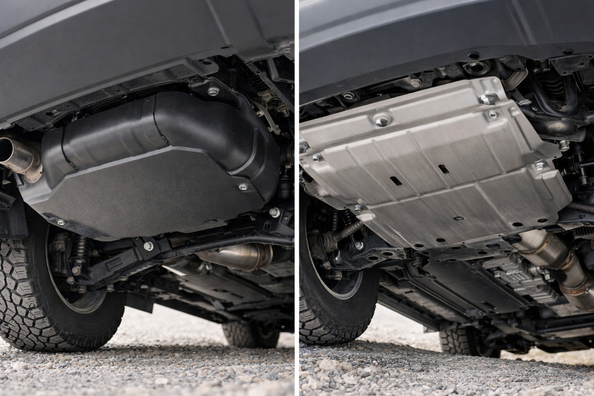
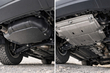
If you reduce the choice to one phrase, then for most crossovers and light SUVs what matters more is not a separate fuel-tank skid plate, but high-quality underbody protection. The reason is simple: it covers more expensive components, and hits to the underside happen not only off-road, but also from potholes, curbs, winter ice ridges, and broken asphalt.
A separate fuel-tank protection makes sense when the tank itself is a genuinely low and vulnerable point on your vehicle. In other words, it’s not a universal rule, but a decision based on your route, the geometry of a specific model, the mounting method, noise, service access, and budget.
A separate fuel-tank skid plate solves a specific task: it shields the fuel tank, fuel lines, and the access area to the fuel pump. This matters if the vehicle regularly drives over rocks, deep ruts, or terrain where the tank actually contacts obstacles.
Full underbody protection works more broadly. It can cover the engine oil pan, transmission, transfer case, front differential, steering components, and part of the central underside. That’s why for mixed use it’s more often the better option: the probability of a hit to the front and central areas is usually higher than a pinpoint hit to the tank.
There’s also a third practical option: staged upgrades. First, install what takes the first contact with obstacles, and cover the tank later if your routes truly show that need.
Also check compatibility with your trim level. For some vehicle versions, hybrids, or cars with non-standard bumpers, there simply isn’t a universal solution.
| Option | Strengths | Weaknesses | Who it’s for |
|---|---|---|---|
| Separate fuel-tank protection | Solves the risk of tank puncture locally; lighter and cheaper than a full kit | Doesn’t protect the oil pan, transmission, transfer case, and other components | Those whose tank truly hangs low and often contacts terrain |
| Full underbody protection | Covers several expensive components at once; better for mixed roads and regular trips | More expensive, heavier, sometimes complicates servicing | Most crossovers and SUVs that drive beyond asphalt |
| Staged upgrades | Lets you avoid overpaying and build protection around a real use case | You need to correctly determine where to start | Those who want to allocate the budget wisely and not buy unnecessary parts |
DD Tuning expert comment: the most common mistake is this—people see a low-mounted tank and immediately buy a shield for it, without checking that the first contact marks on the vehicle are already on the oil pan or transmission. The second typical issue is looking only at sheet thickness and not evaluating mounting, service access, and compatibility with a specific trim. For mixed use, it’s almost always better to start with systemic protection up front and in the center, and add the tank plate later based on actual routes.
This is a targeted solution. It’s justified where the tank or its mounting area falls into a real impact zone. On rocks, in ruts, and on forest roads it can save you from a fuel leak, downtime, and expensive repairs.
The advantage of this option is that it’s lighter in both weight and budget. The downside is narrow specialization: if the first hit in your scenario lands in the front, a separate tank shield won’t solve the problem.
This is the most rational baseline option for most vehicles that go beyond smooth asphalt. It works as a systemic barrier: one kit shields several components whose repairs are more expensive—and more often more painful—than a localized tank repair.
Here, it’s not only about thickness. In branded solutions you’ll see steel plates around 3 mm and aluminum around 4.8–6.35 mm, but the number alone doesn’t decide everything: stiffness depends on shape, ribs, area, and mounting points. It’s best when installation uses factory locations, and servicing doesn’t require tearing down half the kit every time.
The weak side of full protection is weight, price, and added maintenance attention. After mud, salt, and water, it should be inspected, and the fasteners periodically tightened—otherwise unwanted noises appear.
This is a healthy compromise when it doesn’t make sense to buy the maximum right away. First, you install protection for the zones that take the first hits: the oil pan, transmission, and central underbody. If over time it becomes clear that the route also catches the tank, then you add a separate plate for it.
This approach is especially useful for crossovers that spend most of their time in the city but occasionally go onto dirt, snow, or ruts. You don’t overpay for what doesn’t work in your driving pattern.
For a city crossover that regularly meets potholes, curbs, winter ice ridges, and broken driveways, it’s more logical to make underbody protection your first purchase. The risk there is broader than just the tank area.
For a light SUV with trips for hunting, fishing, or into the mountains, the choice depends on the layout. If the tank is tucked higher and isn’t the lowest point, systemic underbody protection wins again. But if the tank hangs exposed and often works against the terrain, separate tank protection becomes not an add-on, but a practical necessity.
For regular heavy off-roading, the question isn’t “either/or” at all. It usually calls for a complete approach: a reinforced front zone, central panels, and fuel-tank protection as the final piece of the system.
| Scenario | What to choose | Why |
|---|---|---|
| City, highway, winter, rough yards | Full underbody protection | More frequent risks to the front and central areas than to the tank itself |
| Dirt roads, forest roads, shallow ruts | Full underbody protection or staged upgrades | First you should cover the oil pan and drivetrain, adding the tank as needed |
| Rocky routes, deep ruts, low-mounted tank | Separate fuel-tank protection or a kit that includes the tank | The risk of a direct hit to the fuel system is no longer theoretical |
| Regular heavy off-roading | Complete underbody protection kit plus tank | A local shield won’t cover all critical components |
| Limited budget, mixed use | Staged upgrades | Lets you avoid buying unnecessary parts and build protection around real contacts |
A more expensive kit is justified when the vehicle regularly drives routes where underbody hits are inevitable and repairs would keep the vehicle down for a long time. In that case, it’s better to pay not for “thicker,” but for precise mounting to factory points, correct geometry, proper service access, and a well-thought-out sequence of component protection.
If the issue is clearly in the fuel-system area, it makes sense to start with fuel-tank protection. If we’re talking about a body-on-frame SUV and a systemic approach, it’s useful to look at model-specific solutions like underbody protection for Lexus GX460. And when the main contacts fall on the front end, it’s smarter to first evaluate oil pan protection for Lexus GX460, and only then choose a plate for the tank.
From a customer’s experience: a crossover owner initially looked for a separate tank shield because he feared damaging the fuel system on trips to the water. After an inspection it turned out that the first contacts on his vehicle weren’t on the tank, but on the front and center of the underbody, so he chose underbody protection and skipped the separate tank shield. One season of trips proved it was enough, and he didn’t have to overpay for an unnecessary part.
For most crossovers and light SUVs, quality underbody protection is more important because it covers more real-world risks. A separate fuel-tank shield isn’t for everyone—primarily it’s for those whose tank is genuinely vulnerable due to the vehicle’s layout and the nature of their routes.
So the right logic is: first assess what takes the first hit on your vehicle, then look at installation, noise, durability, practicality, and only after that the price. This conclusion is based on real selection experience, practice, and real use scenarios—not on the abstract rule of “the more metal, the better.”
| ✔ | Full underbody protection covers several expensive components at once — the oil pan, transmission, transfer case, differential, and part of the central area. For most crossovers and light SUVs, this is more practical than protecting only the fuel tank. |
| ✔ | A separate fuel tank guard has a narrow but clear benefit: it really reduces the risk of damaging the tank, lines, and fuel pump area on rocks or in deep ruts. |
| ✔ | Step-by-step retrofitting lets you avoid paying for the entire kit at once and choose protection based on the vehicle’s actual contact with obstacles. |
| ✔ | The article emphasizes important practical details: factory mounting points, service access, and compatibility with a specific trim are often more important than metal thickness itself. |
| ✔ | For mixed use, it makes sense to first protect the areas that take the initial impacts, and add the fuel tank only when the route has truly shown the need. |
| ✘ | A separate tank guard does not solve the problem of other vulnerable components. If the first impact hits the oil pan or transmission, such a shield will not help. |
| ✘ | Full underbody protection is more expensive, heavier, and can make servicing more difficult, because sometimes individual panels have to be removed for access. |
| ✘ | Any poorly installed protection can start rattling or shifting, so saving on installation can negate the benefit. |
| ✘ | There is no universal solution: for some vehicle versions, hybrids, or cars with non-standard bumpers, compatibility must be checked separately. |
Shipping to EU
Wholesale and retail
Own warehouse
Опис продукту
Подарунки не надаються при оформленні покупки у кредит під 0,01% або при покупці частинами.