21.08.2026
147
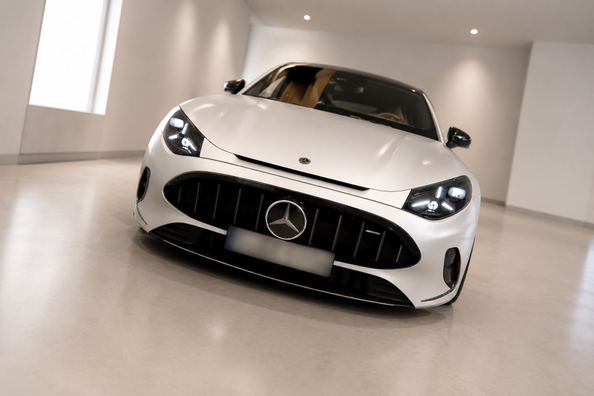

Mercedes-AMG GT 53 4-door Coupe is not an EV with 600 kW charging, but a gasoline grand tourer with a 3.0-liter inline “six,” mild-hybrid tech, and all-wheel drive. For this version, the real point is different: fast cruising on the highway, uninterrupted pull, and a driving range of around 800 km in calm highway use. The 600 kW figure refers to a different, future electric model: the AMG GT 55 4-Door.
In short, the GT 53 is for someone who wants a very fast four-door car for long trips and daily use without stepping up to a V8. What it’s not built for: broken roads, constant maneuvering in tight courtyards, and expectations of “EV-like” efficiency or crossover ground clearance.
The GT 53 sits in the Mercedes-AMG GT 4-Door range as a fast, yet still relatively rational option. It stands between a pure image-driven coupe and a large sporty liftback: you get four doors, a big trunk, and all-wheel drive, without giving up the AMG character.
Conceptually, it rivals the Porsche Panamera, Audi RS7, and BMW 8 Gran Coupe. Its trump card isn’t record power, but the mix of long-distance capability, high cruising speed, and everyday usability. That’s why the GT 53 often makes more sense than the higher V8 versions if the car isn’t just for “weekends.”
The AMG GT 4-Door Coupe lineup with the X290 index has been produced since 2018. As of today, it’s still the first generation, although equipment, multimedia, safety packages, and some technical details have changed depending on the year and market.
The GT 53 is known as the six-cylinder balance in the family: it’s not as heavy or as costly as the V8 variants, yet already quick enough that it doesn’t feel “junior” only on paper. An important nuance: the announced electric AMG GT 55 4-Door for 2027 is a separate model, so figures like 600 kW charging shouldn’t be carried over to the gasoline GT 53.
For the current Mercedes-AMG GT 53 4-door Coupe, there’s one key powertrain: a 3.0-liter inline six-cylinder turbo engine with a mild-hybrid system and an electric auxiliary compressor. It’s paired with a 9-speed AMG SPEEDSHIFT TCT automatic and permanent AMG Performance 4MATIC+ all-wheel drive.
| Parameter | Value | What it means in practice |
|---|---|---|
| Engine | 3.0 L, inline 6-cylinder turbo | Smooth pull and fewer vibrations than many V6s |
| Power | 429 hp | Plenty of speed for the city and very fast highway driving |
| Torque | 520.6 N·m at 1800–5800 rpm | The car accelerates well without constant downshifts |
| Transmission | 9-speed AMG SPEEDSHIFT TCT automatic | Quick shifts without nervous behavior in traffic |
| Drivetrain | Permanent all-wheel drive | Better grip and stability in rain and cold |
| Acceleration | 4.4 s to 60 mph or 4.5 s to 100 km/h depending on market | This is already true fast grand-tourer territory, not just a comfortable sedan |
| Fuel consumption | Roughly 9.8–12.4 L/100 km in official cycles | Tolerable on the highway; in the city the budget is no longer modest |
| Tank and range | 80 L; up to about 800 km on the highway | 809 km is possible, but not in active city driving |
Formally it’s a 4-door coupe, but in daily life what matters is this: the car is long, wide, and low. For the autobahn that’s a plus; for old-format parking structures it’s already a compromise. The suspension is adaptive AMG RIDE CONTROL, with an emphasis on body control rather than softly absorbing small joints.
| Parameter | Value | Practical takeaway |
|---|---|---|
| Length | 5054 mm | You’ll need to get used to the footprint in the city |
| Wheelbase | 2951 mm | Stability at speed and better highway comfort |
| Width | 1953 mm without mirrors, 2069 mm with mirrors | Tight parking garages and narrow entrances aren’t its natural habitat |
| Height | 1455 mm | Low seating position and coupe-like silhouette |
| Weight | 2045 kg | A substantial car, so tires and brakes work under load |
| Trunk | 456 L | Enough for a trip for two or a family getaway |
| Turning circle | 12.6 m | In underground garages you’ll need to maneuver carefully |
| Ground clearance | The official value for the current version isn’t publicly stated | Think of the GT 53 as a low sports car, not a curb-friendly wagon |
The key takeaway on the chassis: on a smooth road the GT 53 feels very tight and composed, but short bumps and patched asphalt come through quite directly. That’s not a flaw—it’s the car’s character.
Inside, the GT 53 combines a sporty driving position with real long-distance usability. By default it’s a four-seater, and in some configurations a five-seat version is possible. A 456 L trunk and a proper second row make the model more practical than you’d expect from a coupe-like body.
Comfort here is specific: sound insulation and cruising stability on a good highway are strong, but the seats can feel firm, and rear visibility isn’t the easiest. On safety, the set is generous: active braking, blind-spot monitoring, 360-degree camera, PRE-SAFE, parking assistance, crosswind stabilization, and seven airbags.
In real life, the GT 53 isn’t as thirsty as the bigger V8 AMGs, but it’s not cheap to run daily either. A benchmark for calm highway driving is about 10 L/100 km; for mixed driving roughly 10.5–11.5 L/100 km; for city use, higher. It needs premium fuel, and the wide tire setup plus large brakes mean consumables aren’t cheap.
Long trips are a strong use case for this model: a big tank, good stability, and effortless quick overtakes. But in daily routines the typical low-and-wide-body nuances show up: parking ramps, automatic car washes, high curbs, limited visibility. Before buying, it’s also worth checking the VIN for completed service campaigns, including those related to starter wiring on early cars and starter-generator software on some newer vehicles.
| Aspect | Pros | Cons |
|---|---|---|
| Long trips | Fast cruising pace, big tank, all-wheel drive | Firm suspension on poor surfaces can be tiring |
| Practicality | Four doors, 456 L trunk, proper second row | Coupe-style visibility and the large width complicate daily use |
| Performance | 429 hp and smooth low-end pull, quick-working gearbox | Not everyone considers the steering and brake feel class benchmarks |
| Costs | More moderate than V8 rivals | Premium fuel, expensive tires, and potential electronic niggles don’t go away |
Who the GT 53 is for: those who drive a lot on the highway, want a very fast four-door car, and aren’t ready to live with the thirst of the larger AMGs. Who it’s not for: those who commute daily on broken streets, often park in tight courtyards, or want the softest possible luxury car.
For the GT 53, the healthiest approach to tuning is not to turn it into an overly stiff show car, but to enhance the traits people buy it for. That means carefully working with aerodynamics, interior protection, and exterior personalization. Because of the low front overhang, any protruding elements should be chosen with your route in mind, not just photos.
Mercedes-AMG GT 53 4-door Coupe is a strong option for those who need a fast grand tourer with four doors, all-wheel drive, and real long range on a single tank. But it shouldn’t be confused with the future electric AMG: 600 kW charging isn’t about this car. If you want a low, wide, very fast car for highway travel and road trips, the GT 53 is convincing; if your priority is a soft ride, easy daily livability, and lower running costs, it’s better to look elsewhere.
This material is based on real selection experience, hands-on practice, and real usage scenarios, so the focus here isn’t on marketing figures, but on how this model behaves in an owner’s everyday life.
Shipping to EU
Wholesale and retail
Own warehouse
Опис продукту
Подарунки не надаються при оформленні покупки у кредит під 0,01% або при покупці частинами.