12.06.2026
176
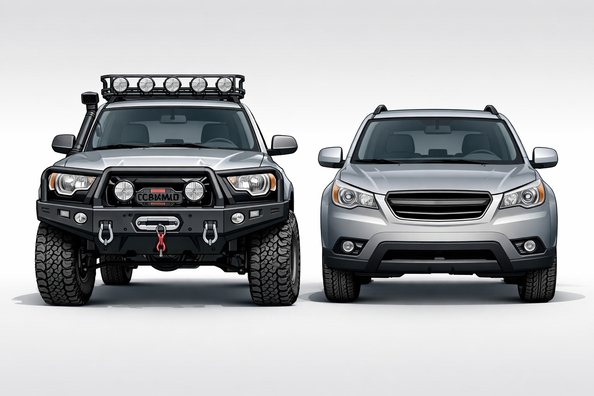

A heavy-duty bumper isn’t for everyone. For a vehicle that regularly drives off-road, on rural or remote routes, carries a winch and genuinely risks meeting rocks, branches, or animals, it’s a working component. For a daily city vehicle, it often brings more compromises than benefits.
The problem is that the decision only seems simple before installation. After fitting it, you add weight to the front, the nose can sag, suspension loads change, and sensors and radar don’t always work correctly without precise compatibility. So the question isn’t whether the bumper is “strong,” but whether it’s truly needed for your specific vehicle.
People often buy a heavy-duty bumper “just in case” or for looks, even though its logic is different: front-end protection on tough routes, a winch mount, additional lighting, and recovery points. In those conditions, extra weight is justified. In the city—maybe not, because the load on the front axle increases and compatibility requirements with electronics become stricter.
There’s also a second reason: designs vary a lot. A lighter aluminum option can weigh about 41.5 kg, while steel kits often add 64–95 kg, sometimes nearly 90 kg already together with a winch. For a stock suspension, that’s noticeable, so after installation you often need to check for sag, do a wheel alignment, and, if needed, switch to different springs.
DD Tuning expert comment: Most often the mistake isn’t the bumper type itself, but selecting it for a specific trim. People choose a heavy steel kit for a vehicle that hardly ever sees off-road, don’t calculate the added weight, and only after installation face front-end sag, false sensor triggers, and the need to change springs. If there’s any doubt about electronic compatibility, it’s better to stop before purchase, not after the first warning on the dashboard.
| Symptom | Likely cause | What to do |
|---|---|---|
| The front end has noticeably sagged | Bumper weight is too high for stock springs | Check front axle height, spring condition, and select suspension components for the additional load |
| Parking sensors trigger incorrectly | Incompatible sensor placement or bumper shape | Verify model-specific compatibility, sensor seats, and correct sensor relocation |
| Radar or other system errors appeared | The bumper isn’t designed for this trim or installation was compromised | Cross-check trim compatibility, inspect mounts, and verify component positioning |
| Vibrations or noise appeared | Incorrect installation, loose fasteners, modified parts | Reinstall per the instructions and avoid DIY modifications |
| The vehicle started tracking straight differently | Front axle geometry changed after installation | Do a wheel alignment and re-check ride height and front-end load |
Only a practical approach works: a vehicle-specific kit, compatibility with airbags, electronics taken into account, no modified mounts, and a post-install check. If the bumper is needed for a winch, recovery points, and additional lighting, plan that from the start rather than adding random parts later.
A sober material choice also helps. When extra front-end weight is critical, a lighter option makes more sense. When the vehicle constantly works on demanding routes, a stronger steel kit is justified—but only together with checking suspension, lighting, sensors, and geometry after installation.
A weak strategy is to buy a universal or cheapest kit and hope installation will solve everything. Ignoring weight works just as poorly: if the front has already sagged, getting used to it won’t replace a proper solution. Disabling sensors instead of finding a compatible option also won’t help.
Another dead end is installing a heavy-duty bumper purely for looks on a vehicle that drives in dense city traffic every day. You get extra weight, risk of conflicts with electronics, and a worse compromise for pedestrian safety, but you don’t get the benefits of a winch, recovery points, or real off-road front-end protection.
If a heavy-duty bumper is installed for real tasks, then a supporting setup is logical too. The bumper itself makes sense to consider in the heavy-duty bumpers category when you need front-end protection, a winch mount, and functional recovery points. For night drives on forest and rural roads, it’s practical to complement it with LED fog lights, and if the vehicle regularly runs hard routes, it’s worth separately considering a winch for an off-road vehicle.
Replacing springs or correcting the suspension makes sense not “just in case,” but when there’s real sag after adding weight. If the vehicle is urban, without a winch, without regular off-road use, and without the risk of impacts with animals or branches, then the whole set of accessories around a heavy-duty bumper usually doesn’t pay back either the cost or the compromises.
| Solution | When it works | When it’s not worth spending money |
|---|---|---|
| Vehicle-specific heavy-duty bumper | Regular off-road use, remote routes, need for a winch and protection | The vehicle is almost always in the city and the bumper is only for looks |
| A lighter option instead of a heavy steel one | You need the functionality, but extra front-end weight is critical | You need maximum strength for constant heavy-duty use |
| Selecting springs for the added weight | There’s sag after installation or geometry changes | The stock suspension hasn’t sagged and the kit weight is small |
| Checking and calibrating sensors and radar | The vehicle has parking sensors, cameras, front driver-assistance systems | With an unverified incompatible kit where the problem is built into the design |
| Skipping the heavy-duty bumper | Daily city vehicle, no real trips out and no need for recovery gear | Regular long trips on difficult routes and risk of front-end contacts |
From a customer’s experience: a pickup owner initially wanted a heavy steel bumper only for its appearance, but after reviewing the route it turned out the vehicle truly goes to the countryside and on field roads only in winter and at night. In the end, he chose a vehicle-specific kit compatible with sensors, checked the suspension right away, and got neither sag nor electronic errors. For a purely city use case, this scenario would have been nothing but unnecessary complication.
A heavy-duty bumper is needed not because it looks “serious,” but when the vehicle truly works where there’s a risk of impacts, a need for a winch, additional lighting, and recovery. In all other cases it’s often a heavy compromise: more weight up front, more compatibility requirements, and unclear benefits in daily city driving.
The right decision is simple: look not at the picture, but at your route, weight, trim, and installation. If the tasks are real—a heavy-duty bumper works. If not—it’s better not to complicate the vehicle. This material is based on real selection experience, hands-on practice, and real-world use scenarios.
| ✔ | Suitable for regular off-road use, remote routes, and situations where there is a risk of impacts from stones, branches, or animals. In such conditions, a bull bar really does perform a protective function. |
| ✔ | Provides space for a winch, extra lighting, and recovery points. This is useful for vehicles that genuinely work in demanding conditions, not just drive around the city. |
| ✔ | Lets you choose a design for the specific task: a lighter aluminum version reduces extra weight, while a steel one offers greater strength for heavy-duty use. This makes it possible to choose a solution not by guesswork, but for the intended usage mode. |
| ✔ | With the right selection for the model and trim, you can preserve the operation of sensors, radar, and cameras. The article explicitly emphasizes that compatibility and post-installation checks are critically important. |
| ✔ | If there is sagging after installation or the geometry changes, the issue can be compensated for by checking the springs and doing a wheel alignment. In other words, the effects of the added weight can be controlled if they were anticipated in advance. |
| ✘ | For a city car or a vehicle that hardly ever goes off-road, this is often just extra weight with no real benefit. In this mode, the bull bar makes the vehicle more cumbersome than useful. |
| ✘ | Additional weight at the front can noticeably lower the front end and increase the load on the suspension. Because of this, different springs and an extra geometry check are sometimes needed. |
| ✘ | Not every trim is compatible with parking sensors, radar, cameras, and factory lighting. If you choose an unsuitable kit, system errors or incorrect sensor operation are possible. |
| ✘ | Installation does not forgive haste: modified mounts, under-tightened bolts, or homemade modifications can cause vibrations, noise, and electronic errors. In other words, installation becomes a separate technical task rather than a simple part replacement. |
| ✘ | A bull bar does not make a vehicle safer in every collision and does not improve conditions for pedestrians. If it is installed only for the looks, it brings almost no benefit. |
Shipping to EU
Wholesale and retail
Own warehouse
Опис продукту
Подарунки не надаються при оформленні покупки у кредит під 0,01% або при покупці частинами.