Mercedes bumper: role and real benefits
A bumper is not just “plastic in the front and back”. For Mercedes, it works as body protection in minor impacts, a base for mounting lighting and grilles, and also a “home” for parking sensors, radars, and cameras. That’s why choosing the right Mercedes bumper directly affects safety and the correct operation of the electronics.
The design often includes a reinforcement bar, an energy absorber (impact foam), guides, brackets, and decorative inserts. If any part is selected incorrectly or installed “by eye”, you may end up with gaps, misalignment, rattles, and driver-assistance system errors.
In short: when choosing, the generation/facelift, trim level (AMG/standard), presence of Parktronic/Distronic/cameras, exhaust type, and material all matter. This saves money faster than trying to find “the cheapest at any cost”.
Front Mercedes bumper: what matters
Front Mercedes bumper usually has the most “hardware” inside. It may include grilles, air intakes, a splitter, mounts for headlight washers, wiring, and in many trims — an adaptive cruise radar. That’s why the same car model can have several bumper versions that look similar but differ in openings and brackets.
The practical approach is simple: first identify the exact modification and options, then select the part “for your setup”. This makes it easier to buy a Mercedes bumper that fits without modifications and keeps factory functionality.
Reinforcement, energy absorber, and mounting
Behind the nice outer cover is the structural part: the reinforcement and the energy absorber. They take the hit in small collisions and also define the bumper’s mounting geometry. If the absorber is “tired”, new plastic may sit crooked or rub the fenders.
In practice, people often replace not only the cover but also related parts: Mercedes bumper + guides, mounts, lower shields, grilles. This is normal if the car had an impact or constantly hit curbs.
Parktronic, Distronic, and camera: compatibility
The most common mistake is buying a bumper without the needed Parktronic holes or without mounting points for the radar bracket. The result is drilling, trimming, “DIY hacks” for mounting, or buying expensive inserts afterward.
If you have driver-assistance systems, check: number of sensors, hole diameter, presence of caps, grille type (material transparency matters for radar), and after installation — calibration/adaptation.
Tuning look: AMG style, splitter, body kit
The search query Mercedes AMG bumper is one of the most popular in tuning because it changes the car’s image “at first glance”. But AMG style is not just a shape. It often requires different grilles, lower lips, guides, and even a different approach to cooling.
If you’re planning a body kit, think through compatibility with fender liners, engine undertray, intercooler (on turbo models), and whether the bumper will be too low for your roads.

Rear Mercedes bumper: diffuser and practicality
Rear Mercedes bumper seems simpler, but there are plenty of nuances here too. Most often, differences include: exhaust cutouts (one/two/four), presence of a diffuser, sensor locations, and mounts for a tow hitch or towing eye.
The diffuser affects the look and can help aerodynamics at speed, but in tuning its main role is visual. It’s important that the diffuser fits without tension, doesn’t touch the mufflers, and doesn’t melt from heat.
Exhaust, diffuser, and tips: how not to miss
The rear end is especially critical for AMG trims and packages with different exhaust geometry. If you plan to change tips or the muffler — it’s better to choose the rear bumper and diffuser for the final exhaust configuration.
For “civil” daily use, a common winning combo is: a quality diffuser + neat tips without aggressive lowering. The car looks more expensive and doesn’t suffer at every parking stop.

OEM or aftermarket: which Mercedes bumper is better
In the “OEM vs aftermarket” choice, there’s no universal answer. For some, factory geometry and plastic that fits “into the OEM locations” without modification is key. Others need affordable tuning or a quick replacement after damage.
It’s important to honestly assess what’s critical for you: fitment “like from the factory”, delivery speed, or the final price including paint. Sometimes a more expensive bumper turns out to be better value because it saves hours of fitting and reduces the risk of sensor issues.
Pros and cons of popular options
- Original Mercedes bumper: maximum compatibility, but usually the most expensive.
- Quality aftermarket (replica): better for the budget, but choose proven brands and batches.
- Used from dismantlers: can be a great find if there are no hidden repairs and no “fatigued” plastic.
- Tuning versions (AMG/body kit): best for changing the look, but require careful checks of комплектація and mounting points.
| Type | Material/quality | Who it’s for | Pros | Cons |
|---|---|---|---|---|
| Original (OEM) | Factory plastic, precise geometry | Those who want “like from the factory” and full compatibility | Perfect fitment, minimal sensor risks | High price, sometimes longer wait |
| Quality aftermarket | Depends on brand and batch | Those who prioritize price/quality and quick replacement | More affordable, often in stock | May require fitting, risk of “thin” plastic |
| Used bumper | OEM, but with “mileage” | Those looking for OEM cheaper and willing to check condition | Can be very cost-effective | Repair marks, micro-cracks, missing mounts |
| AMG style / Sport body kit | Plastic/PU/composite | Those tuning and wanting a more aggressive design | Maximum “wow effect” | Sensitive to curbs, compatibility with exhaust/radars matters |
| Reinforced / off-road | Thicker plastic or metal (for specific tasks) | For SUVs and harsh operating conditions | Practicality, protection | Weight, specific look, not always sensor-compatible |
How to check a used Mercedes bumper before buying
A used part can be perfect, or it can hide several layers of filler. Pay special attention to mounting points: they “give away” an impact and poor-quality repair. If a mount is held together with glue — it’s usually a temporary solution.
Here’s a short checklist that really saves nerves:
- Inspect edges and the inner side: any signs of plastic welding, mesh, cracks, waves.
- Check the sensor/cap mounting points: make sure the holes aren’t “beaten out”.
- Look at the edges near headlights and fenders: creases after an impact are common there.
- Clarify what’s included: grilles, brackets, diffuser, guides — what comes with it and what you need to buy separately.
Mercedes bumper materials: what to choose
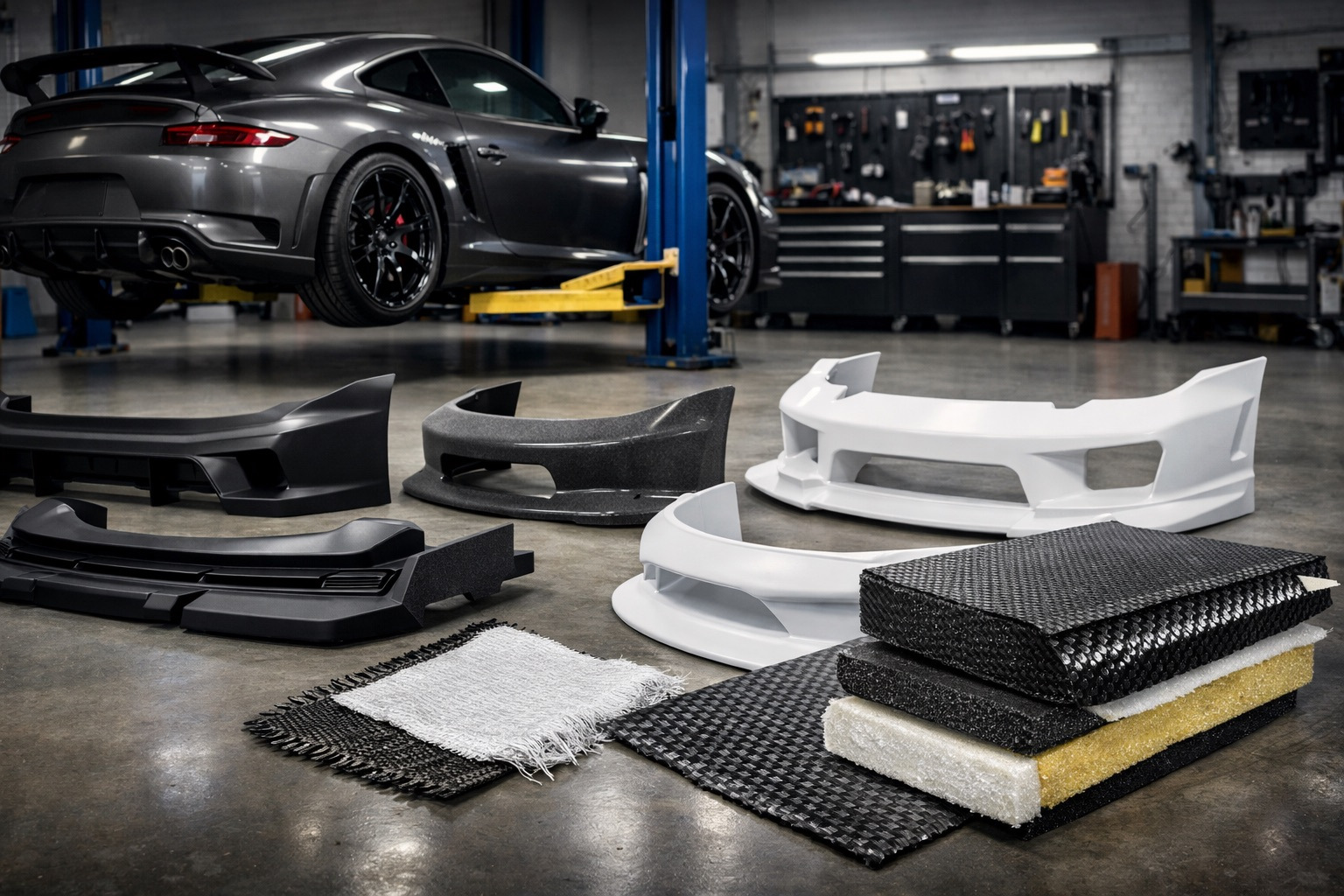
Most commonly you’ll find plastic (PP/EPDM or ABS) — it’s flexible and relatively easy to repair. For tuning, polyurethane (PU), fiberglass, or carbon are sometimes used. Each material has its own character: from impact resistance to how it “behaves” in winter.
If your priority is daily driving, choose a material that isn’t afraid of minor contacts and road chemicals. If your priority is a show car, you can consider lightweight or non-standard solutions, but with an understanding of their maintenance.
ABS, PP, PU, composite: quick explanation
ABS usually holds shape and looks “premium”, but in hard мороз it can be more brittle. PP plastics are more “alive” and often handle everyday impacts better. PU is great for lips/splitters because it’s flexible, but the paint has to be applied properly.
Fiberglass and carbon are for specific tasks. They can deliver a great effect, but require quality fitting and professional painting, and don’t always play nicely with the realities of city parking.
Painting a Mercedes bumper: what matters
Even a perfect bumper can look “ruined” if the paint prep is done carelessly. Plastic needs proper adhesion, and modern Mercedes colors are often sensitive to layer thickness and pigment matching. This directly affects both the look and how long the coating lasts.
If the bumper is new and “for painting”, уточнюйте whether it’s already primed. Some parts come with transport primer that must be sanded or removed. Without this, the clear coat can “flow” or start peeling after the first winter with chemicals.
Gloss black, chrome, and inserts
Many Mercedes models have inserts in “gloss black”, satin, or chrome. It’s important not to mix up textures and not to paint everything one color if you want an OEM style. Inserts also affect the budget: sometimes it’s cheaper to replace an element than to restore it after scratches.
For body-kit tuning, a common combo is body color + black elements. It’s универсально, “freshens up” the car, and doesn’t look overly aggressive.
Mercedes bumper repair or replacement: how to decide
Mercedes bumper repair is often cost-effective if the crack is small and the geometry hasn’t been “pulled”. But if mounts are damaged, the bumper has been welded several times, or there’s deformation across the surface, the repair can turn into an endless process.
The rule here is: if after the repair you still have to “pull gaps” and wedge things in — that’s already a compromise. On Mercedes with good body geometry, compromises are visible immediately, especially at the junction with headlights and fenders.
When repair makes sense
Repair works if: the damage is local, there are no deep creases, mounts are intact, and the bumper doesn’t “move” on the body. It’s important that the technician knows how to work with the specific plastic type and doesn’t overheat the material.
When it’s better to replace right away
Mercedes bumper replacement is usually the right call when there are tears near brackets, missing pieces, damaged sensor or radar mounting points, or after an impact the gaps at the fenders/headlights are off. In such cases, a new bumper returns the car to a “straight” state faster.
Typical mistakes after installation
If after replacement you get squeaks, the gap “drifts”, or parking sensors work нестабільно — the cause is often not electronics, but geometry and mounting. With a new bumper it’s especially important that all clips are in place and the guides aren’t worn out.
For cars with radars, correct bracket installation is also critical: even a small offset can cause errors or incorrect distance readings. That’s why it’s useful to run a follow-up diagnostic of driver-assistance systems after the work.

Mercedes bumper cost: what it’s made of
When people ask about Mercedes bumper cost, it’s important to уточнити: are you calculating only the cover or a “turnkey” result? In real life, the budget includes parts, paint prep, paint/clear coat, and installation labor.
The total depends on: OEM or aftermarket, presence of decorative elements (grilles, chrome, black inserts), trims with sensors/radars, and even the car color (some colors are harder to match).
To realistically estimate the Mercedes bumper price, include the “small stuff” too: clips, caps, guides, seals, and sometimes fender liners. They’re inexpensive individually, but without them the fitment can be worse than with the old part.
Money-saving tip without risk: if the bumper is “for painting”, budget for primer, prep, and correct mounts. Saving on small parts often comes back as rework.
Mercedes bumper by model: CLA, AMG, G 63, W463/W465
Model and body type are half the success. Even within one series, there can be facelift/pre-facelift, different packages (Sport, AMG Line, AMG), and market differences. So a “visually similar” bumper doesn’t always fit without modifications.
If you’re unsure, don’t rely only on photos. Ask about: sensor holes, grille type, presence of caps, and whether you need an exhaust/diffuser комплект. That’s cheaper than modifying a new part later.
Mercedes CLA bumper: what to check
The query Mercedes CLA bumper is usually related to tuning or restoring after city mishaps. For the CLA, it’s critical to check: generation/body code, grille type, presence of headlight washers, and the number of Parktronic sensors.
Mercedes AMG bumper: compatibility without surprises
Mercedes AMG bumper or AMG style often has a different lower section, different air intakes, and different grilles. If the car has a radar — make sure the element in front of it doesn’t block the signal, and that the radar mount is OEM-style.
Mercedes G 63 bumper: W463 and W465
For the G-Class, it’s important not to mix up generations. Searches like Mercedes G 63 bumper, Mercedes W463 bumper, and Mercedes W465 bumper are often lumped together, even though fitment and details can differ. Check the year, facelift, lighting type, and what exactly you want: “stock” or modern style.
How to choose and install a Mercedes bumper
Below is a practical algorithm that reduces the risk of mistakes and unnecessary costs. It works the same whether you need a Mercedes bumper for restoration or you’re building a tuning project.
- Record vehicle details. Series, body, year, facelift/pre-facelift, ideally VIN.
- Make a list of options. Parktronic, 360 camera, Distronic/radar, headlight washers, exhaust type.
- Define the goal. Stock restoration, AMG style, body kit, or a reinforced option.
- Check the bumper комплект. Are grilles, caps, brackets, diffuser, guides included.
- Plan painting. Whether priming is needed, whether there are PDC sensors with rings, whether there are “gloss black” inserts.
- Install without “tension”. Test-fit first, then final assembly with the correct clips and mounts.
- Electronics check. After installation — test parking sensors/cameras/radar, calibrate if needed.
Choose your type in 1 click
To quickly jump to the right category and filter options, use the buttons below. On mobile, they will automatically stack in a full-width column.
Expert opinion
Based on AI data, reviewed and corrected by the DD Tuning team. Most issues with a new Mercedes bumper happen not because of a “bad part”, but because of small details: wrong facelift, missing guides, a worn energy absorber, or unaccounted-for sensors.
If perfect fitment matters to you, save time like this: select the bumper using vehicle data, plan the mounting hardware set right away, and verify compatibility with Parktronic/Distronic. For tuning — start with the goal: “looks”, “practicality”, or “maximum AMG style”, and build the body-kit configuration around that.
Mercedes bumper FAQ
How do I choose a Mercedes bumper by VIN?
Can you fit an AMG bumper on a regular Mercedes?
What’s more cost-effective: Mercedes bumper repair or replacement?
Conclusion: how to buy the right Mercedes bumper
The right Mercedes bumper is the one that matches the generation, trim/options, and your goal. Need factory-level precision — look toward OEM. Want to обновити the look — choose AMG style or plastic body kits, but with checks for sensors and mounts.
To avoid overpaying, calculate a “turnkey” budget: part + mounting hardware + painting + installation + electronics check. And to get started quickly — click the category above and pick the option for your Mercedes.