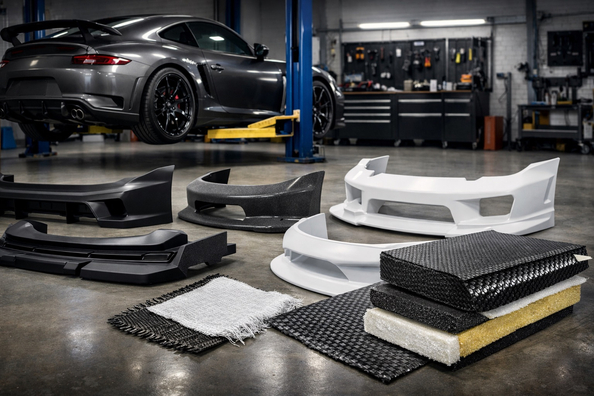
Body kit tuning is one of the most popular ways to change a car’s appearance. New bumpers, side skirts, spoilers, and other body elements give the vehicle a unique style and improve aerodynamics. However, the material from which such a kit is made plays a crucial role in its durability, strength, and ease of use. Owners of different car brands and classes often ask, which is better – ABS plastic, polypropylene, fiberglass, or carbon? This guide article takes a detailed look at all popular body kit materials, side skirts, and spoilers, their advantages and disadvantages. You’ll also learn what to look for when buying, how to avoid cracks and damage, and which material to choose for city driving, highways, off-road, or show cars.
ABS Plastic (Acrylonitrile Butadiene Styrene)
ABS plastic is an impact-resistant thermoplastic polymer widely used in the automotive industry. ABS body parts are made by injection molding, ensuring precise shape and dimensions. Many factory bumpers, grilles, and trims are made from ABS or related plastics. In tuning, ABS plastic is valued for its combination of strength and surface quality: it’s easy to paint to match the body color, resulting in a smooth, even finish.
Advantages:
- High strength and impact resistance. ABS is a fairly flexible material: under load, a part will bend slightly rather than crack suddenly. It withstands small stone impacts, minor collisions, or curb hits without shattering.
- Quality surface and appearance. ABS plastic produces parts with a smooth, glossy surface free of pores. They’re easier to prepare for painting; paint applies evenly and adheres well. This is especially important for exterior parts – a painted ABS kit looks almost identical to OEM parts.
- Weather and chemical resistance. Quality ABS plastic withstands temperature fluctuations from cold to heat without deforming under normal conditions. It’s also resistant to moisture, dirt, road salt, oils, and fuel. This means an ABS kit will last long even with daily use in rain, snow, and heat.
- Precise fit and easier installation. Since ABS parts are made in accurate molds, they usually fit the body perfectly without major adjustment. Mounting holes align, geometry is maintained – installing an ABS bumper or spoiler is easier than a fiberglass equivalent.
Disadvantages:
- Higher price. ABS plastic products are usually more expensive than fiberglass. The higher cost comes from complex production (metal molds and powerful equipment) and material quality. ABS body kits are often offered by well-known brands, and the price can be quite noticeable.
- Heavier weight. Compared to fiberglass, ABS parts can be slightly heavier. The plastic has higher density, and to ensure strength, parts are made with a certain thickness. The extra weight isn’t critical for street cars, but in motorsport, every kilogram counts.
- Less flexible than PP. Although ABS is resilient, it’s less elastic than polypropylene. Under a strong impact, an ABS bumper may crack where a PP one would only dent. In cold weather, the plastic becomes less flexible, increasing the risk of impact damage.
- Sensitivity to high temperatures. If an ABS part is close to a heat source (e.g., exhaust system) or the car stays long under direct sunlight, it may slightly deform. ABS has a lower heat threshold than some engineering plastics, so caution is needed. However, under normal conditions, this rarely happens.
- Average repairability. If an ABS kit cracks or breaks, repairing it is harder than fiberglass. ABS can be welded, and many workshops do it, but it requires special materials and skills. Epoxy glue won’t work – plastic welding is needed. Therefore, a severely damaged ABS part is often easier to replace.
Polypropylene (PP)
Polypropylene (PP) is another thermoplastic widely used in automotive parts production. Most OEM bumpers and wheel arch liners are made from polypropylene (often mixed with rubber for flexibility). PP is less common in tuning kits because molding also requires complex equipment. However, its properties make it ideal for exterior parts that must withstand impacts and bending.
Advantages:
- Exceptional flexibility and resilience. The main strength of polypropylene is its elasticity. A PP bumper usually bends and returns to shape after impact instead of cracking. It handles curb hits, parking pressure, and minor scrapes much better than rigid plastics – a big plus for city cars.
- Impact resistance in cold weather. Polypropylene remains flexible even at low temperatures. Unlike some plastics that become brittle in the cold, a PP kit stays relatively pliable and doesn’t crack from small winter impacts. (At extreme cold, any material becomes more brittle, but PP performs better than others.)
- Resistance to water, salt, and chemicals. Polypropylene is chemically inert – unaffected by water, road salt, oils, or fuel. It doesn’t rust or absorb moisture. Therefore, in rain, slush, or snow, such a kit retains its strength. UV radiation also has minimal effect: it may fade slightly over time but won’t degrade.
- Lowest weight. Among all materials discussed, polypropylene is the lightest (about 0.9 g/cm³). Parts made from it are lightweight and add almost no mass to the car. A lighter bumper or spoiler affects weight distribution less and puts less stress on mounting points.
- Relatively easy installation (for ready-made parts). If you buy a PP tuning bumper, it will likely fit OEM mounting points perfectly. Manufacturers usually design them for specific car models, so installation requires little adjustment. The material is flexible enough to “play” slightly during fitting.
Disadvantages:
- Difficult to paint. Polypropylene has a slightly oily surface and low adhesion, so regular automotive paint doesn’t stick well. Painting a PP bumper requires special plastic primers and proper technique. Ignoring this can cause peeling. Thus, painting a PP kit is more complex and costly.
- Less rigid – may deform at high speed. At high speeds, airflow and vibrations can cause overly flexible parts to “flutter.” PP parts are sometimes made thicker or reinforced; otherwise, long skirts may sag or flex. Overall rigidity is lower than ABS or composites, so PP suits bumpers and trims better than large wings needing stiffness.
- Limited availability. Few manufacturers produce PP tuning kits, mainly for popular mass models. Most aerodynamic kits on the market are fiberglass. Finding the right PP part can be harder. Often owners modify the OEM PP bumper with add-ons instead of buying a full kit.
- Repair only by welding. If a PP bumper cracks, it can be repaired, but only by welding with PP rods or patches. Regular glue won’t hold due to poor adhesion. Repairability is moderate: minor damage can be fixed, but major cracks are better replaced.
Fiberglass (FRP)
Fiberglass (also known as FRP – Fiber Reinforced Plastic) is an extremely common material for tuning kits. It’s a composite: plastic reinforced with glass fiber. Such parts are handmade – layers of fiberglass mat are laid into a mold and impregnated with resin (polyester or epoxy). After curing, a rigid, strong part is formed. Hundreds of workshops and brands produce fiberglass kits – from small garages to well-known European tuning studios.
Advantages:
- High strength with relatively low weight. Fiberglass provides excellent rigidity and tensile strength. A well-made fiberglass bumper can handle significant loads without deformation. At the same time, it weighs less than steel or even some plastics. Many race cars still use fiberglass panels for their strength-to-weight balance.
- Can be molded into any shape. The manual production process allows almost any design. Complex aerodynamic shapes, large spoilers, integrated vents – all possible with fiberglass. For enthusiasts, this means huge variety: the market offers countless shapes and styles. If you want a unique kit, it’s almost certainly made of fiberglass.
- Affordable cost. Fiberglass parts are usually the cheapest. Manufacturers don’t need expensive equipment – often molds are made from old bumpers. Even large kits (front/rear bumpers, skirts, fenders) are relatively inexpensive. This makes FRP kits popular among budget tuners.
- Repairability and modifiability. If a fiberglass part cracks, it can almost always be repaired. Cracks or holes are patched with new fiberglass layers and resin, restoring strength. Even broken pieces can be reattached by laminating. Fiberglass is easy to cut, drill, and sand – you can modify it (e.g., add vents) without major strength loss if done properly.
- Corrosion resistance. Unlike metal, fiberglass doesn’t rust. It’s unaffected by salt and chemicals. Resins and glass fibers resist water and most reagents. Even deep scratches won’t cause corrosion – damage can be repaired without fear of rust.
Disadvantages:
- Brittle under impact. The main drawback of fiberglass is low impact toughness. On impact (curb hit, collision), a fiberglass bumper or spoiler cracks or breaks instead of bending. The material is hard but not elastic, so even minor contact can cause cracks, especially in cheap, thin products.
- Possible fit and quality issues. Not all fiberglass parts are perfectly shaped. If the manufacturer cut corners, the kit may not fit precisely: uneven gaps, misaligned holes. Such parts often need prep work before painting – fitting, filling, sanding (fiberglass usually has a gel coat that must be smoothed). There’s also risk of defects: air bubbles, incomplete curing, or warping. Always buy fiberglass kits from trusted makers.
- Sensitivity to temperature and UV. Polyester resins commonly used in fiberglass have limited heat resistance. Around 70–80°C, the material softens – e.g., from hot radiator air or direct sun, large unpainted parts may warp. UV also degrades resin: unpainted parts can yellow or crack over years. Fiberglass needs protective paint or clear coat.
- Vibration and fatigue. On rough roads, the body and kit experience constant vibration. Plastics absorb some of it, but fiberglass is rigid. Over time, “spider” cracks may appear near mounts or large surfaces due to fatigue. These are microcracks in the gel coat and resin. To minimize this, use rubber washers and don’t overtighten bolts.
- Requires professional installation. Installing fiberglass kits is best done at a body shop. Proper fitting, drilling, and alignment require experience. Incorrect installation leads to faster cracking. So although the material is cheap, budget for fitting and painting work.
Note: Despite these drawbacks, fiberglass remains the main material for 90% of custom kits. Most well-known tuning brands also use high-quality fiberglass. For example, kits from Rieger, Zender, Seidl, and other premium manufacturers are often fiberglass but last long thanks to precise technology and quality control. The material itself can be reliable – it all depends on the maker and installation.
Carbon (Carbon Fiber)
Carbon is the common name for a composite material based on carbon fiber. In Ukrainian, it’s also called carbon plastic or carbon fiber. Production technology is similar to fiberglass, but carbon fibers are used as reinforcement in a polymer matrix (epoxy or other resin). After curing, the result is an extremely strong and lightweight material. Carbon parts are usually made in an autoclave or by vacuum infusion – a complex process that yields exceptional properties. In motorsport and supercars, carbon is used everywhere – from spoilers to monocoques.
Advantages:
- Best strength-to-weight ratio. A carbon body kit is extremely light yet very strong. Carbon fiber is about five times stronger than steel at one-fifth the weight! Even compared to fiberglass, carbon is far superior: breaking a carbon wing requires much more force. For sports cars, weight reduction is key, so carbon hoods, fenders, and spoilers are popular.
- Rigidity and shape stability. Carbon fiber gives parts high stiffness. A carbon splitter or wing barely flexes under airflow at speed, maintaining optimal shape and angle for consistent downforce. This is critical for racing – nearly all modern sports cars have carbon aero kits.
- Corrosion and weather resistance. Carbon doesn’t corrode, resists moisture, dirt, and salt. It withstands cold and heat (epoxy resin usually tolerates up to ~120°C or more). The main thing is UV protection with clear coat to prevent yellowing. Otherwise, a carbon kit is very durable and doesn’t weaken over time.
- Exclusive appearance. Woven carbon fibers create a distinctive carbon pattern – black and gray interlaced squares that shimmer in light. Many enthusiasts choose carbon for its look as much as performance. For example, a hood or mirrors made of exposed carbon under clear coat give a hi-tech style. On show cars, carbon parts always attract attention.
- Premium and status appeal. Having real carbon parts in your tuning project instantly raises its status. Carbon is expensive and associated with supercars, so even small accents add a “wow” effect. For show builds or those wanting to stand out, this is a strong argument for carbon fiber.
Disadvantages:
- Very high price. Carbon kits are the most expensive. The high cost comes from pricey raw materials (carbon fiber) and complex production. A carbon spoiler can cost dozens of times more than a fiberglass one. It’s an exclusive product, often overpriced for purely decorative use.
- Brittle under extreme load. Though very strong, carbon isn’t ductile. When its limit is exceeded, it breaks rather than bends (layered along fibers). A hard impact or crash shatters it. Unlike fiberglass, carbon cracks suddenly with little deformation. A curb hit can destroy a costly splitter.
- Difficult to repair. Repairing cracked carbon is complex. Techniques exist (adding new fiber layers and re-curing), but restoring original appearance and strength is nearly impossible. Usually, damaged carbon parts are replaced. Small cracks can be epoxied and re-lacquered, but they remain visible and weaker.
- Visible scratches and fading. Exposed carbon under clear coat is glossy and shows scratches easily. On black surfaces, every mark stands out, so maintaining appearance requires care and occasional polishing or re-coating. Without proper UV protection, resin can fade or yellow. Regular maintenance of the clear coat is essential.
- Attractive to thieves. Unfortunately, theft of carbon parts is common. Exclusive hoods, trims, or spoilers can attract criminals since they can be resold. When installing expensive carbon kits, ensure vehicle security. Some owners even remove carbon parts for daily driving, keeping them for shows only.
Comparison Table of Material Characteristics
| Material | Strength | Flexibility | Weather Resistance | Weight | Installation Difficulty | Price |
|---|
| ABS Plastic | High (impact-resistant) | Moderate | Moderate | Medium | Low (easy to install) | High |
| Polypropylene (PP) | High (impact-resistant) | Very high | High | Very low (lightest) | Low (easy to install) | Medium |
| Fiberglass (FRP) | High, but brittle under strong impact | Low (rigid) | Medium (requires painting) | Low | High (needs fitting) | Low |
| Carbon (Carbon Fiber) | Very high | Low (very rigid) | High (with UV protection) | Lowest (lightest) | Medium (preferably professional) | Very high |
*** Notes: Strength here refers to overall tensile and impact strength. Weather resistance includes UV, moisture, and temperature tolerance. Weight is relative (low = light, high = heavier). Installation difficulty reflects typical cases: ABS/PP factory parts usually fit easily, fiberglass needs fitting, carbon should be installed professionally to avoid damage.
How to Avoid Cracks and Damage: Tips
- Choose material by purpose. The first step to a long-lasting kit is choosing the right material. For daily city driving and frequent parking, flexible polypropylene or ABS that withstand light impacts is best. For show cars or track use, rigid but stylish carbon or fiberglass is fine. Remember: most cracks occur when the material doesn’t match usage conditions.
- Buy quality parts from trusted manufacturers. Cheap knock-offs may have hidden defects – thin walls, poor resin saturation, low-quality materials. This leads to cracks even without major impacts. Reputable brands ensure quality control: their bumpers or spoilers have strength where needed. It’s better to pay more once than twice for a broken cheap part.
- Professional installation ensures longevity. Have your kit installed by professionals or follow instructions carefully. The part must fit correctly without tension. All mounting points should align; if something doesn’t fit, don’t force bolts – that’s where cracks start. Drill or adjust instead. Use rubber washers under mounts to absorb vibration and prevent cracking around bolts.
- Avoid extreme impacts. Even the strongest kit can crack from rough handling. Don’t scrape curbs with the bumper – if your car is low, approach at an angle and slowly. Avoid potholes or objects that can hit the spoiler or skirt. Off-road with plastic kits requires extra care: branches, stones, and ruts can cause serious damage.
- Watch ground clearance and protect the underside. Lowered cars are at higher risk of damage. Consider air suspension or adjustable springs to raise the car on bad roads. Flexible rubber splitters on the bumper’s edge can absorb impacts and protect rigid kits from cracks. Such lips are easy to replace when worn.
- Regular inspection and maintenance. Periodically check the kit for small cracks, especially near mounts and paint. Fix small cracks immediately (reinforce from inside, drill crack ends to stop spreading, etc.) rather than waiting. Timely touch-ups prevent moisture and dirt from entering (important for fiberglass). A well-maintained kit looks better and lasts longer.
Material Recommendations by Vehicle Use
The best material choice depends on how you use your car. Ask yourself: where and how do you drive most, and do you value practicality or looks? Here are typical cases and tips:
For City Driving (Daily Use)
City roads are full of hazards for body kits: high curbs, tight parking, speed bumps, and minor scrapes. For daily cars, strength and flexibility matter most. The best choice is polypropylene or quality ABS plastic. They absorb minor impacts – a PP or ABS bumper flexes and stays intact. Plastic kits are also easier to maintain – you can wash them freely.
Fiberglass is less ideal in the city: it can crack even from small bumps or curb hits. If you choose FRP for design, drive carefully and expect occasional repairs.
Carbon for daily city driving is overkill. It’s expensive and attracts attention, with little benefit in traffic. Exceptions are sports models where style justifies cost – but even then, protect the splitter; the city isn’t the place to test its strength.
For Highways
If you often drive long distances or enjoy high-speed runs, consider stability and aerodynamics. On highways, there are fewer small impacts but strong airflow.
Carbon performs best here: light and rigid, it keeps spoilers and diffusers stable at speed. Weight reduction also slightly improves acceleration and fuel economy. If budget allows and performance matters, carbon kits are justified.
ABS plastic is also great for highway use. It’s rigid enough not to vibrate in airflow. Many OEM spoilers and deflectors are made from ABS designed for constant air pressure. ABS kits need little maintenance and withstand long hours of sun or rain.
Fiberglass can also work, especially quality products. Many track-day kits are fiberglass, designed for load. But remember: a stone from a truck at 130 km/h can chip or crack fiberglass, while plastic would only scratch. So for heavy highway use, plastic is more reliable.
Polypropylene also works but may flex: a long PP spoiler can flutter in wind. Ensure the part is structurally stiff or reinforced.
For Off-Road
Off-road driving is a real test for any kit. Branches, rocks, and uneven terrain can easily break unsuitable materials. For SUVs or crossovers, choose impact-resistant plastic parts. Ideally – polypropylene or flexible polyurethane (not covered above but similar). A PP bumper on an SUV withstands brush and ground contact much better than rigid fiberglass – it flexes and returns.
ABS plastic also works, though in severe cold or hard hits it may crack. Choose OEM-quality ABS kits (some pickups come with ABS trims). It’s strong but less elastic than PP.
Fiberglass for off-road is not recommended. One rock hit can break your bumper. The same goes for carbon: there’s no point ruining an expensive carbon kit in mud and trees. Off-road is the domain of metal “power” bumpers or flexible plastic flares. If you want a stylish wide kit for an SUV, look for ABS/PP options. Many 4x4 accessory brands make unpainted black plastic fender flares – they don’t crack and hide chips well.
For Show Cars
For projects built mainly for exhibitions, priorities change. Visual impact comes first, practicality second. Show cars usually travel little – often on trailers – so damage risk is minimal. This allows using the boldest and most fragile materials.
Carbon is the favorite for high-end show cars. Maximum carbon parts (hood, spoiler, diffuser, mirrors, etc.) showcase technology and luxury. Even fake carbon (fiberglass wrapped in carbon film) adds visual appeal. Many show builds use “display” carbon that rarely sees the road.
Fiberglass is also widely used for show cars, especially for complex custom shapes. Widebody kits, fantasy bumpers – all sculpted from fiberglass because it can be hand-shaped. Fragility doesn’t matter if the car only moves on and off the stand. The key is perfect finishing and paint so no one notices the material.
Polypropylene and ABS appear less often in show cars unless they’re OEM parts left unchanged. They don’t offer special visual benefits. Some projects use chrome ABS or clear acrylic – but that’s rare. In general, for show purposes, the material is chosen for appearance: if it’s carbon – it’ll be real carbon; if radical shapes – fiberglass painted “carbon” or metallic. The main thing: show kits rarely see roads, so they last long if handled carefully.
Conclusion
In summary, there’s no single “best” material for car body kits – it depends on your priorities and driving conditions. ABS plastic and polypropylene are excellent for those who value strength, practicality, and durability in daily use. They’re close to OEM quality and forgiving of road issues. Fiberglass attracts with variety and affordability – a good choice for stylish looks on a budget, but expect fitting and care. Carbon is the undisputed king for those seeking maximum effect, minimal weight, and who don’t mind the cost; it shines in racing and shows, less so in daily life.
Weigh all pros and cons, consider how and where you drive, and make an informed choice. The right material and quality installation will ensure your new kit delights you for years, highlighting your car’s individuality without unpleasant surprises. May your tuning be successful, and your car both beautiful and practical!