 Author: Radomskyi Maksym Vasyliovych
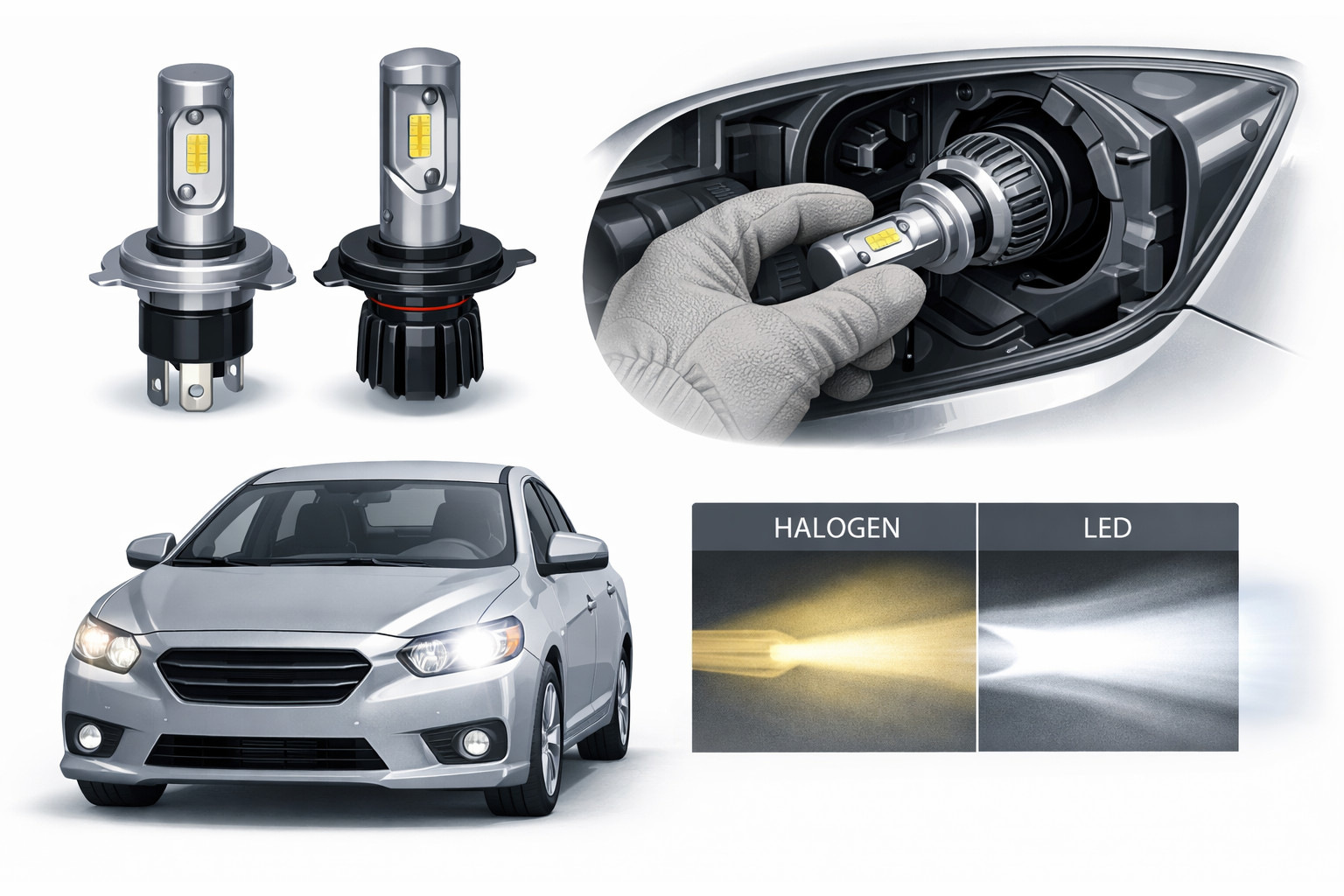
Choosing LED bulbs for a car doesn’t start with the maximum brightness on the box, but with three things: the exact socket type, the headlight type, and the free space under the rear cap. If you get even one of these wrong, the bulb either won’t fit physically, will produce a distorted beam, or will start flickering because of the car’s electronics.
This material isn’t tied to one specific vehicle, so the logic is universal: first determine the car, year, generation, and type of optics, then check the socket, the bulb body dimensions, cooling, and only after that look at brightness. That’s how selection becomes practical rather than marketing-driven.
The model and its place in the market
In the context of LED bulbs, the word “model” primarily means the car model. The same bulb can work fine in a simple halogen headlight on one car and be completely unsuitable for another due to different reflector geometry, a projector lens, bulb-failure monitoring, or limited space behind the headlight.
There are three main scenarios on the market: older cars with factory halogen, models with xenon, and cars with factory LED optics. If the car already has factory LED modules, choosing a replacement “bulb” by socket is often not relevant at all. Most often, an LED retrofit makes sense specifically where the car came with halogen from the factory.
Generation and model history
The model year and generation matter because even within the same model, before and after a facelift the sockets, headlight rear caps, presence of a lens, and error monitoring can differ. That’s why choosing “for the same car as a friend’s” often ends with a return or extra modifications.
The practical rule is simple: you need to look not only at the make and model, but also the generation, year, headlight type, and the exact installation position — low beam, high beam, fog lights, interior, or license plate light. For dual-function bulbs, check separately whether a dual-filament format like H4 is required.
Engines and transmissions
The engine by itself rarely determines the bulb socket. A car with a 1.6 engine making 110 hp and a 2.0 version making 150 hp may have the same front optics, or they may differ due to trim level. That’s why engine displacement and power are secondary indicators, not the basis for the choice.
What really matters technically: the onboard voltage 12 or 24 V, the presence of a bulb monitoring system, how sensitive the electronics are to current draw and driver startup. That’s exactly why on some cars LED works right away, while on others you need adapters for bulb error warnings or mounting rings.
Body, dimensions, and suspension
The vehicle’s exterior size, ground clearance, and even trunk volume have almost no direct impact on bulb choice. For LED, the headlight dimensions are far more important: depth behind the rear cap, the diameter of the mounting opening, space for a heatsink or fan, and access for installation.
For crossovers, vans, and cars that often drive on rough roads, it’s worth paying extra attention to vibration resistance, driver protection, and cooling quality. If the body is too large, the cap won’t close; if cooling is weak, brightness will drop quickly after warm-up.
| Installation position | Typical sockets | Practical brightness guideline | What to check before buying |
|---|---|---|---|
| Interior, license plate light | T10/W5W, C5W | 50-200 lm | Polarity, no error warnings, color without excessive blue tint |
| Position lights, daytime running lights | T10/W5W, P21W, W21W | 100-400 lm | Compatibility with bulb monitoring, uniform illumination |
| Fog lights | H8, H11, H16 | 800-1500 lm | Sealing, color temperature, space for the heatsink |
| Low beam | H1, H7, H11, HB4 | 1500-2500 lm | Correct cutoff line, LED chip geometry, cooling |
| High beam | H1, H7, HB3 | 2000-3000 lm | Beam focus, stable operation after heating |
These values are a practical guideline, not a universal formula. For headlight bulbs, the geometry of the light source matters more than the lumen number: an overly “powerful” bulb in an unsuitable headlight often performs worse than a proper halogen.
Interior, comfort, and safety
For everyday driving, bulbs with a neutral or slightly cool shade work best, without obvious blue. Overly white light can be tiring in rain and fog, and it also highlights dirt on the headlight lens more strongly. For the interior, the logic is different: even, soft light matters more than maximum brightness.
From a safety standpoint, the key is not to “shine brighter than everyone,” but to get a crisp beam without blinding oncoming traffic. If the cutoff line disappears after the swap, stray glare appears, or the headlight aims higher than normal, that LED choice can’t be considered successful even with good numbers on the packaging.
Daily use
In the city, moderately bright solutions with correct geometry work well: they don’t irritate, don’t trigger errors, and don’t overload the optics. For highway driving, stability after warm-up, range, and a predictable beam matter more. If the car often drives in rain, snow, and mud, an overly cool shade usually loses to a more neutral one.
A separate point is maintenance. Bulbs with active cooling need cleanliness and free space, while passive ones can be easier to install in tight headlights. If access to the bulb is difficult, it’s better to choose a solution right away that doesn’t require DIY modifications.
Strengths and weaknesses
| Pros of LED bulbs | Cons of LED bulbs |
|---|---|
| Fast reach to full brightness | Not every halogen headlight works correctly with LED |
| Lower load on wiring in well-matched solutions | Possible bulb errors, flicker, radio interference |
| Good lifespan with proper cooling | A large body or heatsink may not fit |
| Noticeable improvement for interior and auxiliary lighting | Claimed brightness is often overstated by the manufacturer |
| You can more precisely match light color to the task | A poor match causes glare and a worse beam than halogen |
From an owner’s perspective, the main advantage of LED isn’t abstract “technology,” but fewer compromises in everyday driving when the bulb is chosen correctly. The main drawback is how easy it is to buy a bright but unsuitable bulb that creates problems instead of improvements.
Tuning and accessories
Lighting tuning only makes sense when it solves a specific problem: weak low beam, dim interior lighting, a bulb error warning, or a difficult fit in the headlight. If the issue is a burned reflector, cloudy plastic, or incorrect aiming, a bulb swap alone won’t fix it.
For practical selection, you usually need three product groups: the LED bulbs themselves, bulb error adapters, and mounting adapters to secure them in the factory headlight. This combination lets you not just buy a bulb, but install it without play, flicker, and unnecessary modifications.
What to check out for this model
- LED bulbs — when the socket is already known and you need to choose sensible brightness without chasing advertising numbers.
- Bulb error adapters — if a fault message appears after installation or the bulb flickers.
- Mounting adapters — when the factory headlight mounting doesn’t match the LED bulb body.
Conclusion
The correct way to choose LED bulbs for a car goes in this order: car model and generation, headlight type, exact socket, free space under the rear cap, electronics, and only then brightness. If you shorten this chain to a single question — “which are the brightest to get” — the result is almost always mediocre.
In practice, it’s not record lumens that work best, but compatibility and the right beam pattern. This material is based on real selection experience, practice, and real-world usage scenarios, so the main takeaway is simple: choose LED not by a pretty box, but by the specific optics of your car.
How it works
- Identify the vehicle and headlight type First, determine the make, model, year, generation, and lamp installation location: low beam, high beam, fog lights, interior, or license plate lighting. It is also important to understand whether the car has halogen, xenon, or factory LED, because this determines whether replacing the bulb even makes sense.
- Check the exact base and compatibility Choose the bulb not “by similarity,” but by the specific base: H1, H7, H11, HB4, T10/W5W, C5W, etc. For dual-filament bulbs, check the format such as H4 separately, as well as whether the car has bulb monitoring that can cause an error or flickering.
- Assess space for the bulb and cooling Before buying, check whether there is enough depth behind the headlight cover, whether the radiator or fan will fit, and whether the bulb body will interfere with the factory mount. In tight headlights or on cars with vibrations, it is better to consider vibration resistance and cooling quality, otherwise the bulb may not close properly or will quickly lose brightness.
- Select brightness for the specific task Do not rely only on maximum lumens: interior and license plate lighting need soft light, fog lights and low beam need a different brightness level, and for main lights the beam geometry is also critical. For everyday driving, it is better to choose a neutral or slightly cool shade without an obvious blue tint.
- Check the electronics and required accessories If after installation there is a bulb error, flickering, or fitting issues, a CANBUS adapter or mounting adapter may be needed. This is especially relevant for cars with sensitive electronics and in cases where the factory mount does not fit the LED bulb body.
- Evaluate the result on the road After replacement, check whether there is a clear cut-off line, whether stray glare has appeared, and whether the headlight is shining above the normal level. If the beam has become worse or the bulb is dazzling oncoming traffic, even a high claimed brightness does not mean a good fit.
Pros and cons
The selection starts with specific vehicle parameters — the bulb base, headlight type, and available space under the cover. This reduces the risk of buying a bulb that physically won’t fit or won’t work properly.
For low beam, the material recommends focusing not only on lumens, but also on the geometry of the light source and the cutoff line. This approach is more practical, as it helps avoid glare and a poor beam pattern.
The article provides a clear brightness guide for different areas of the car: interior, parking lights, fog lights, low beam, and high beam. This makes choosing easier without relying on marketing figures on the package.
It explains when LED really makes sense: in halogen optics, for the interior, or for auxiliary lighting, rather than as a universal replacement for any car. This helps avoid wasting money where changing the bulb won’t make a difference.
The car’s electronics are considered separately — bulb monitoring, possible errors, flickering, and the need for adapters. This is useful for those who want to install bulbs without extra problems after fitting.
Choosing an LED bulb is not easy: you need to consider the model, generation, year, headlight type, base, housing dimensions, and cooling. For many, this means extra time spent checking compatibility before buying.
Even a bulb with the correct base may not fit because of limited space in the headlight or an unsuitable reflector geometry. In that case, you either have to look for another model or install adapters and modify the fitting.
LEDs do not always work correctly without additional solutions: bulb errors, flickering, and radio interference are possible. On some cars, installation may be problematic without adapters or mounting rings.
The claimed brightness often does not guarantee better light, and an overly powerful bulb in an unsuitable headlight may shine worse than halogen. Because of this, buying based on the numbers on the box can easily lead to disappointment instead of improvement.