12.06.2026
282
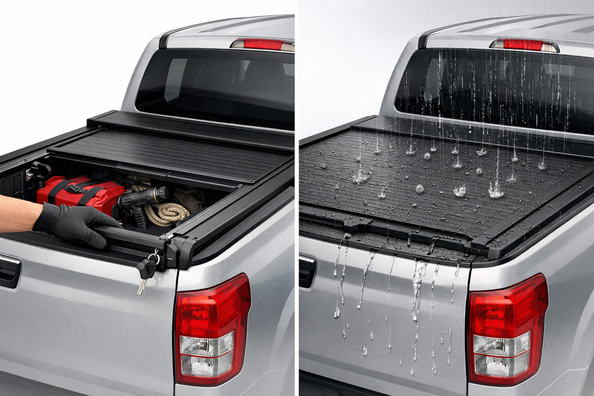
A roll-top cover for a pickup bed usually does a good job of protecting cargo from regular rain, snow, and road spray, but it doesn’t make the bed fully watertight. Theft protection is similar: it keeps items out of sight and makes quick access harder, but it doesn’t turn the bed into a safe.
The issue comes from inflated expectations and small design details: the type of cover, how it seals against the tailgate, the condition of the seals, drainage, and installation accuracy. Once you understand exactly where water gets in and what you’re trying to protect, the solution becomes pretty straightforward.
On most pickups, the weak point isn’t the cover surface itself, but the joints: the tailgate, front corners near the cab, the side rails, and the drainage channels. In light rain it may not show up, but in a long downpour, at highway speeds, or after a high-pressure wash, moisture can make its way into the bed.
With theft, it’s a different story. Even when closed, a roll cover mainly works as a deterrent: a passerby can’t see tools, bags, or gear. But if the items are valuable and the truck is left unattended for a long time, the cover alone doesn’t provide absolute protection.
First reason — unrealistic expectations for the cover type. A soft roll cover is weaker both in water resistance and break-in resistance than a hard one.
Second reason — a gap at the tailgate area. This is where water most often appears, especially if there’s no additional tailgate seal or the tailgate doesn’t compress the rubber evenly across the full width.
Third reason — loose front corners near the cab. On some beds there are cavities there that the factory side seals don’t fully close.
Fourth reason — misalignment after installation. If the rails aren’t centered and the rear bar sits under tension only on one side, water and dust will come in from that side.
Fifth reason — clogged drains. Water can’t exit, builds up in the channels, and overflows into the bed.
Sixth reason — an unsuitable use case. For documents, electronics, fabric, or cargo that’s sensitive even to condensation, a roll cover on its own is often not enough.
Start not with driving in the rain, but with a simple water test. Dry the bed, place paper or dry napkins in the rear corners, front corners, and along the sides, then hose down each area separately. This makes it clear where moisture appears first.
If it gets wet only near the tailgate, the issue is almost always with the rear bar fit or the seal. If moisture shows up in the front corners near the cab, check the front cavities, rail joints, and the front bed bulkhead.
Check the drainage separately: pour a little water into the rail channel and see whether it comes out under the bed. If not, tightening the cover won’t help—clean the drain tubes first. For cargo security, the logic is even simpler: if the cover is soft or easy to pry up at the edge, it’s protection from prying eyes, not from a targeted break-in.
DD Tuning expert comment: the most common mistake is trying to fix leaks only by increasing cover tension. If the rails are skewed or the tailgate doesn’t press the seal evenly, extra tension only masks the problem for a few days. The second typical mistake is assuming any closed roll cover is suitable for tools or equipment without additional boxes inside the bed.
| Symptom | Likely cause | What to do |
|---|---|---|
| Wet items near the tailgate | Poor fit of the rear bar or missing tailgate seal | Re-center the roll cover, check clamping pressure, add a tailgate seal |
| Moisture in the front corners near the cab | Cavities in the front corners, loose rail joint | Improve sealing in the corners, check rail fit and the bed bulkhead |
| After a car wash there’s more water than after rain | Normal limit of the cover’s water resistance; the jet hits seams under pressure | Don’t treat a pressure wash as a watertightness test; pack sensitive cargo separately |
| Water appears randomly on one side | Misalignment after installation or uneven tension | Loosen fasteners, re-align the rails, check closing symmetry |
| The bed is damp even without obvious gaps | Clogged drainage channels or tubes | Clean the drains and verify water exits freely |
| There’s a lock, but you still worry about the cargo | Soft construction or weak pry resistance | For valuable items, switch to a hard roll cover or a canopy; keep small items in locked boxes |
A hard roll cover with proper rail locking and a precise seal against the tailgate works best. It holds its shape better, flexes less at speed, and does a better job of keeping cargo away from quick access.
The second effective solution is correct installation. Installation typically takes up to an hour and a half, and this is exactly when it’s decided whether there will be misalignment and whether the rear bar will sit evenly. Often it’s enough to center the cover, adjust tension, and make sure the tailgate compresses the seal across the full width.
Third—local sealing of problem areas: the tailgate, the front bed bulkhead, the front corners. Fourth—regular drain cleaning. And fifth—a sensible approach to cargo: documents, electronics, and fabric are best placed in waterproof bags or boxes, even if the cover is high quality.
Simply over-tightening the cover hardly works if the cause is geometry or a gap near the tailgate. For the first few days it may seem better, but after the next heavy rain the problem returns.
Random stick-on sealing without understanding where water enters also helps only temporarily. If the entry point isn’t found, a new seal only redirects moisture to another place. Likewise, a high-pressure wash shouldn’t be considered a fair test for any roll cover: that mode is harsher than normal rain.
For break-in protection, a soft roll cover is a weak solution if expensive tools are regularly left in the bed. It’s useful as concealment, but not as a serious barrier.
If you carry everyday cargo, gear, or tools and want a daily balance between access and protection, it makes sense to look at bed roll covers. For a drier bed, not only the slat material matters, but also the seal kit and drainage.
If the cargo is moisture-sensitive, the truck often stays outside overnight, and you need not just to hide items but to truly isolate them, it’s worth looking toward a canopy. A closed top provides better protection from precipitation and better everyday security, though it costs space and adds weight.
When you need not one specific accessory but a comprehensive setup for work or travel, take a look at pickup accessories. Sometimes the right combination is a roll cover plus an internal box, not replacing one item with another.
| Solution | When it works | When it’s not worth spending money |
|---|---|---|
| Hard roll cover | When you need better protection from precipitation and a basic anti-vandal barrier | When you expect complete watertightness or safe-level security |
| Additional tailgate seal | When moisture mostly comes from the rear | When water enters through the front corners or the drains are clogged |
| Reinstalling and centering the rails | When there’s misalignment, uneven closing, different gaps left and right | When the roll cover design itself is too soft for your tasks |
| Drain cleaning | When water accumulates in channels and overflows into the bed | When drainage is fine and the main issue is the tailgate area |
| Canopy instead of a roll cover | When cargo is moisture-sensitive or stays in the bed for a long time | When you need the fastest top access and minimal loss of space |
| Waterproof boxes inside the bed | When you need to protect documents, electronics, tools | When you want them to solve a structural leak of the entire bed |
From a customer’s experience: a pickup owner was looking for a way to leave tools in the bed and not find puddles after rain. A water test showed the main leak wasn’t in the cover itself, but in the rear corners by the tailgate. After re-aligning the rails and installing a rear seal, the bed became noticeably drier in daily use, and for papers and small electronics he added a separate waterproof box.
A pickup bed roll cover really works if you treat it correctly: it’s good protection from most precipitation and a decent deterrent against opportunistic theft, but it’s not a waterproof box and not a safe. Most often, results are determined by the cover type, installation accuracy, tailgate sealing, and clean drains.
If the cargo is valuable or very moisture-sensitive, it’s better to plan from the start for either a more rigid construction, additional internal protection, or a canopy. This material is based on real selection experience, hands-on practice, and real-world usage scenarios—not on the promise that one roll cover will solve everything at once.
| ✔ | The roller cover does not make the bed completely airtight, so in prolonged rain, on the highway, or after a high-pressure wash, moisture can still get inside. This happens especially often through the seams and tailgate. |
| ✔ | It only provides partial theft protection: it hides the cargo from view, but it does not turn the bed into a safe. If the items are valuable and the vehicle is left unattended, this protection is not enough. |
| ✔ | A soft roller cover is weaker in both sealing and break-in resistance than a hard one. For tools or equipment, its capabilities may be insufficient. |
| ✔ | If the problem is misalignment, a clogged drain, or improper fit, simply tightening the cover does not provide a lasting effect. Such “treatment” often only masks the problem for a few days. |
| ✘ | The roller cover does a good job of protecting cargo from normal rain, snow, and road spray. For everyday use, this is often enough if there is no extreme downpour or pressure wash. |
| ✘ | A closed roller cover removes items from sight and makes quick access to the bed more difficult. This reduces the risk of random theft or a spontaneous attempt to take something from the pickup bed. |
| ✘ | A hard roller cover holds its shape better and “moves” less at speed. It is also better suited when a basic anti-vandal barrier is needed rather than just a cover. |
| ✘ | With proper installation, it is possible to significantly reduce leaks through typical weak points: the tailgate, front corners, and rail joints. The article separately emphasizes that precise installation and centering often produce a noticeable result. |
| ✘ | For sensitive cargo, the roller cover can be combined with sealed boxes or separate bags. This is a practical way to protect documents, electronics, and fabric even when the bed is not completely dry. |
Shipping to EU
Wholesale and retail
Own warehouse
Опис продукту
Подарунки не надаються при оформленні покупки у кредит під 0,01% або при покупці частинами.