11.04.2026
462
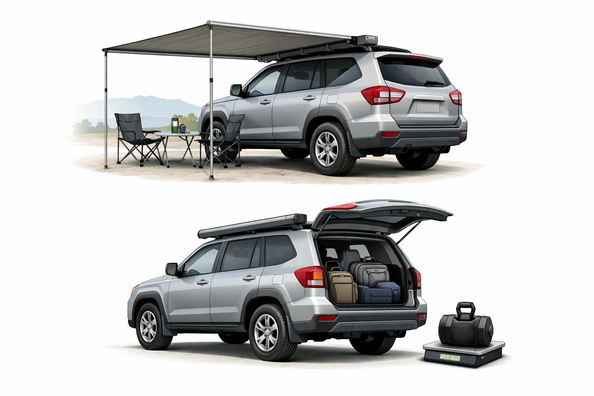
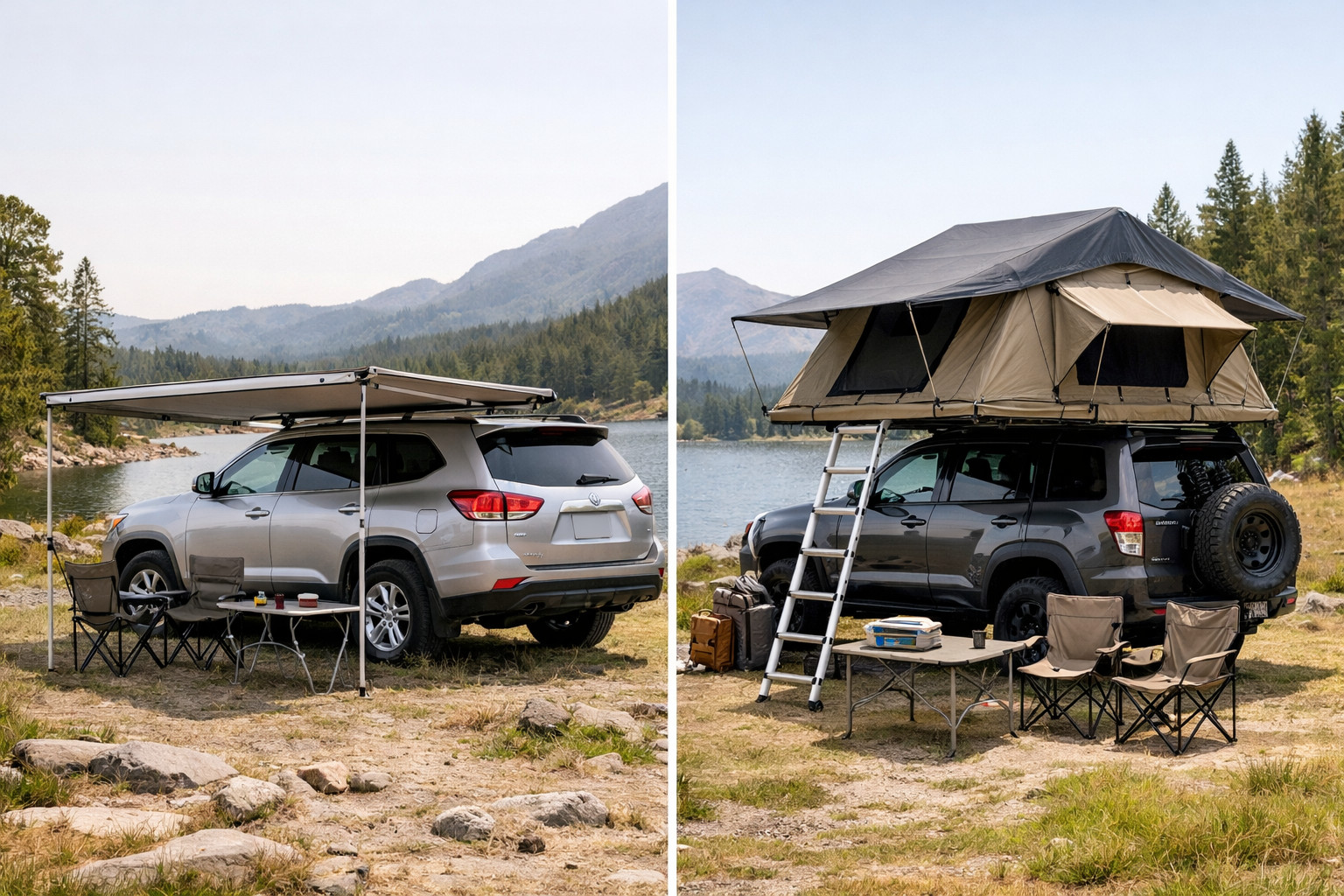
A car awning isn’t useful on its own—it only makes sense for a specific use case. If you often stop in the heat, stand in the rain, cook at camp, or take lots of short breaks, it genuinely saves time and gives you proper shade without a separate tarp. But if you go out rarely, hardly ever stay parked longer than 20–30 minutes, or drive mostly in windy locations, the awning often becomes just extra weight on the roof, extra height, and another component that needs maintenance.
The problem is that people often buy it because it looks good in pictures, not because it matches how they actually travel. As a result, an owner ends up with either a very convenient accessory or an expensive, heavy item that gets unfolded a few times a year. Below is how to tell the difference—without myths.
An awning looks like a universal solution: mount it on the roof and at any moment you have shade or shelter from rain. But in practice, its usefulness depends heavily on three things: how often you really stop, what conditions the vehicle is parked in, and whether the roof is ready for that kind of load.
The second reason is the difference between lightweight and heavy systems. Some models weigh around 10 kg, others are over 20 kg, and large constructions weigh even more. This affects not only installation convenience, but also vehicle height, noise, center of gravity, and the requirements for crossbars or a platform.
The third reason is wind. In the sun an awning seems perfect, but in gusty weather it becomes the most vulnerable element. If the owner isn’t ready to constantly watch the wind, use guy lines, and roll it up in advance, expectations from the accessory quickly turn into disappointment.
Start not with the catalog, but with your own trips over the last season. If you had at least 8–10 stops longer than an hour in sun or rain, an awning already makes practical sense. If there were only 2–3 such stops, the benefit is questionable.
Next, check the roof. Do you have compatible crossbars for integrated rails or a roof rack for standard rails? Without this, buying an awning often gets stuck at the installation stage. You also need to measure clearances to doors, the tailgate, and windows so the awning housing won’t interfere with opening.
Separately, assess the type of parking spots. If you often stop in windy places, look not only at shade area, but also at the safe operating limit, the presence of guy lines, and roll-up speed. A quick-deploy system is convenient, but you’ll still need to pack it away quickly in strong gusts.
DD Tuning expert comment: the most common mistake is buying a heavy awning and only then finding out whether the crossbars can handle it and whether the housing hits the doors. The second typical mistake is judging the accessory by shade area rather than by how many times a month it’s actually deployed. If there are doubts, first check the roof, the frequency of stops, and how windy your routes are—then choose the format.
| Symptom | Likely cause | What to do |
|---|---|---|
| You want to buy an awning, but aren’t sure you’ll use it | Trips without long stops | Count your actual stops per season; if there are few, it’s better to postpone the purchase |
| After installation the vehicle became taller and less convenient in the city | Too heavy or bulky a model for your use case | Look at lighter, shorter options—or don’t install an awning at all |
| The housing interferes with doors or the tailgate | Installed without checking clearances | Re-measure mounting points, change brackets, or отказаться from that specific model |
| In the wind the awning scares you more than it helps | Wind resistance overestimated or no guy lines | Use only with tie-downs and roll it up in strong gusts |
| After rain the fabric smells damp or spots appear | The awning was folded while wet | Unfold, clean, and fully dry before storage |
| The purchase triggers several more expenses | No compatible roof setup for installation | First solve the rails/roof rack system, then buy the canopy |
What really works is choosing soberly for your scenario. For short stops and family outings, a compact lightweight awning is enough; for regular camping, choose models with larger coverage, poles, and proper brackets. The fact that a system deploys quickly only matters when you truly use it often.
The second factor is the right roof base. If the mounting is on compatible crossbars, fasteners are properly tightened, and door clearances are maintained, the awning becomes a predictable accessory rather than a source of constant small issues. That’s why it makes sense to look not only at awnings and canopies, but also at what they will actually be installed on.
The third thing that truly helps is discipline in use. After rain it must be dried, after the first trips you should check the brackets, and in strong wind don’t try to be a hero. These are small things, but they’re exactly what separates a convenient accessory from one that gets ruined quickly.
The “I’ll get a big one just in case” approach almost never works. A large awning gives more shade, but adds weight, roof load, and installation requirements. If you’re not camping regularly, the advantage simply won’t be realized.
It also doesn’t work well to hope that one awning will cover every weather scenario. Against side rain, angled sun, or insects, the top canopy alone helps only a little. In those cases, it’s more important not to increase size, but to add side protection—only if you truly camp often.
Another weak scenario is carrying an awning on the car all the time “just in case,” but not maintaining it. Folding it wet, a dirty cover, and unchecked brackets won’t cause instant failure, but they quickly accumulate problems.
It makes sense when the roof isn’t ready for installation yet. If you don’t have a mounting base, first solve the rails or roof rack, and only then choose an awning. Otherwise, costs will come in two stages, and compatibility will still have to be checked again.
Replacing elements is also justified when your current system is too heavy for your routine. For example, for light outings it’s sometimes better to switch to a more compact awning than to carry a large construction for a few trips a year. And if what you really lack isn’t overhead cover but side protection, it’s worth looking at additional panels rather than just a larger canopy.
If the vehicle drives in the city every day, often parks in low-clearance places, and almost never has long stops, upgrading or expanding the system most often doesn’t pay off in either comfort or convenience.
| Solution | When it works | When it’s not worth spending money |
|---|---|---|
| Lightweight compact awning | Frequent short stops in heat or rain, family trips, beach, picnic | If stops are rare or every extra bit of height and weight is critical for the vehicle |
| Large heavy awning | Regular camping, a base camp for several days, need for a large shaded area | For a city vehicle, rare outings, and a weak roof rack system |
| Guy lines and proper mounting | When you already have an awning and use it in changeable weather | If you expect this to make the awning safe in any wind |
| Upgrading crossbars or the roof rack | When the roof doesn’t have a proper base for mounting | If an honest assessment shows you barely need an awning |
| Side panels or additional protection | For camping, slanting rain, low sun, long stops | If the only issue is lack of shade during a short break |
| Skipping an awning | When trips are without long stops, wind is frequent, and there’s no willingness to maintain the system | Don’t skip it if you truly travel a lot and regularly camp |
From a customer’s experience: a crossover owner was looking for a large awning for summer trips, but after checking it turned out he had only a few long stops per season and no crossbars ready. In the end, he addressed the roof rack system first and postponed buying the awning itself. It turned out to be the right decision: there were no unnecessary expenses, and the need for the accessory became clear after the next season.
A car awning is truly needed not by those who want it “just to have it,” but by those who often stand in the sun, in the rain, or set up camp on trips. In those scenarios it delivers fast, noticeable comfort. But with rare use, windy routes, no compatible roof setup, or no desire to monitor mounting and fabric drying, it really is extra weight and extra cost.
So the right decision is simple: first assess how often you stop, what your routes are like, and whether the roof is ready—only then choose an awning format. This material is based on real selection experience, practice, and real usage scenarios, not on the abstract idea that this accessory is necessary for everyone without exception.
| ✔ | Provides tangible benefits in specific scenarios: during frequent stops in hot weather, in the rain, or while camping, when you need shade quickly without a separate canopy. |
| ✔ | Deploys quickly and saves time if the car really stays parked for longer on a regular basis and the accessory is not used only occasionally. |
| ✔ | For the right choice, it helps narrow down the options: a lightweight compact model for short trips or a larger system for regular camping and longer stops. |
| ✔ | Can be a practical addition to a roof setup if compatible crossbars or a platform are already installed and the mounting does not conflict with the doors or trunk lid. |
| ✔ | Combined with guy lines, proven brackets, and drying after rain, it becomes a predictable and useful accessory rather than an impulsive purchase. |
| ✘ | For infrequent trips and short stops, the awning often does not pay off: it just rides on the roof without real use. |
| ✘ | Adds weight, height, and load to the roof, which is especially noticeable for heavier models and cars with already installed accessories. |
| ✘ | Not well suited for windy places: on the coast, in the mountains, or in open parking lots, it has to be constantly monitored, folded away, and secured with guy lines. |
| ✘ | Does not solve everything at once: the top canopy does not properly protect from side rain, low sun, or insects, so in some scenarios additional elements are still needed. |
Shipping to EU
Wholesale and retail
Own warehouse
Опис продукту
Подарунки не надаються при оформленні покупки у кредит під 0,01% або при покупці частинами.