03.06.2026
231
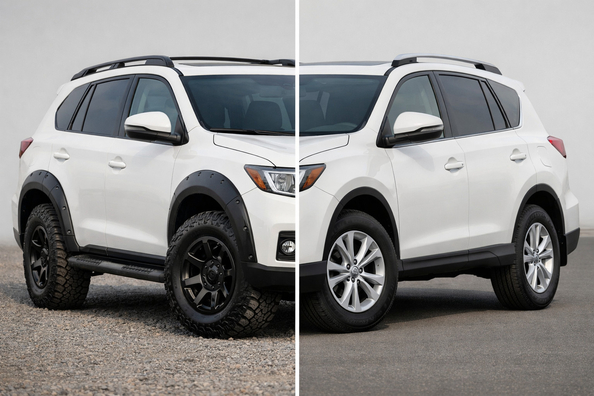
For a daily driver, the choice is usually simple: if the wheels and tires remain factory and nothing sticks out past the body, stock wheel arches are more practical. They don’t add seams, separate fasteners, or another area where you have to regularly wash out dirt and road salt.
Bushwackers make sense not on their own, but for a specific task: to provide extra wheel coverage, hide a wider tread, and reduce the spray of stones and winter slush. But along with that come installation, fitment checks, cleaning under the flare, and the risk of paint wear if the kit doesn’t sit perfectly.
A stock wheel arch is a body element that’s already matched to wheel geometry, clearances, and the factory use case. For city driving, highway runs, and a standard daily mileage, it’s the least troublesome option: there’s nothing to install, tighten, or remove for preventive maintenance.
A Bushwacker is a separate element fitted over the arch. Its advantage is that it can add roughly 25 to 76 mm of coverage depending on the kit and the vehicle. That’s why it’s useful when the wheel has become wider, the wheel offset has changed, or the vehicle often drives on gravel, snow, and mud.
So the core of the choice isn’t looks, but the question: do you need to solve a functional problem, or do you simply want a beefier appearance. For a daily driver, this is critical, because any decorative add-on without a real purpose quickly becomes annoying due to the upkeep.
Compare not by photos, but by five practical criteria: installation, noise, durability, practicality, and price.
| Option | Strengths | Weaknesses | Who it’s for |
|---|---|---|---|
| Stock arches | No extra installation, seams, or separate upkeep; predictable daily use; no extra cost | Don’t add coverage, don’t solve wheel poke, less effective at containing mud with wider tires | Those running factory wheels who want minimal hassle |
| Moderate-width Bushwackers | Add useful coverage, better at stopping stones and slush, often install without drastic modification | Require installation and fitment checks; dirt builds up underneath; possible paint rubbing | Those whose wheels poke slightly or who often drive on winter and muddy roads |
| Wide Bushwackers | Maximum coverage, appropriate for wider tires and more aggressive wheel geometry | More expensive, harder to choose correctly, can look out of place on a stock vehicle, sometimes require additional fitting | Those deliberately building a practical off-road or expedition daily vehicle |
DD Tuning expert comment: the most common mistake is buying wide arches for a completely stock vehicle without measuring actual wheel poke. The second typical issue is installing the kit without properly cleaning the edge first, then wondering why abrasive grit accumulates under the flare. If the vehicle is driven daily in winter, what matters is not only the width of the arch, but whether you will actually wash the space underneath it.
Stock arches. This is the most rational option for a vehicle that stays within the factory configuration. They require no time for installation, carry no risk of violating the accessory manufacturer’s warranty terms, and don’t create new areas where moisture and sand can accumulate. If the main goal is simply to drive every day, wash the vehicle as usual, and not monitor extra fasteners, the stock arch almost always wins.
Medium-width Bushwackers. This is a tool, not just decoration. They’re useful when you need to cover a wheel that sticks out slightly, or when the vehicle constantly catches stones and dirt along the sides. But you need to understand that even a simple kit can take from half an hour to several hours of work, and on some vehicles it also requires fitting. This is exactly where the line sits between “installed it and forgot it” and “installed it and now maintain it.”
Wide Bushwackers. They work best where the tire is truly wide in reality, not just on paper. They provide the most coverage, but also depend the most on the specific vehicle model, wheel offset, and installation cleanliness. On some vehicles you need to account for wheel travel, bump stops, and sometimes even small technical details like clearance to the exhaust. For a typical city vehicle, this is often overkill.
On noise, it’s worth being realistic: if the kit sits tight, there’s usually no dramatic difference. But if play appears, dirt gets under the edge, or rubbing starts, that’s no longer an acoustics issue—it’s an installation quality and ongoing care issue.
For city driving, parking garages, self-serve car washes, and factory wheels, stock arches are better. They don’t add extra routine, and the benefit of flares in that scenario is usually smaller than the future hassle.
For out-of-town trips, winter, gravel, and vehicles with wider tires, the logic changes. Here the extra coverage really works: less dirt flies onto the body side, it’s easier to manage a protruding tread, and fewer small stones hit the arch edge.
If the vehicle is a daily driver but no longer stock, the healthiest approach is not to buy maximum width “just in case,” but to choose the arch to match real wheel poke. Excess width is what most often creates the feeling that the accessory gets in the way more than it helps.
| Scenario | Best choice | Why |
|---|---|---|
| City, factory wheels and tires | Stock arches | No practical need for extra coverage, with a clear advantage in simplicity of use |
| Winter, de-icers, daily highway driving | Moderate-width Bushwackers | Add an extra barrier against slush and small stones, if you’re ready to wash underneath regularly |
| Wider tires or a wheel with more offset | Bushwackers matched to actual wheel poke | Help cover the tread and make the vehicle more practical, not just bulkier |
| Daily driving plus light off-pavement use | Narrow or medium Bushwackers | Balances benefit and upkeep without overloading the look |
| Completely stock vehicle, clean OEM-style appearance matters | Stock arches | Wide flares here more often add style than real usefulness |
A more expensive kit is justified not when you want it to look “more solid,” but when it actually solves a problem. If you have wider tires, wheel poke, lots of gravel, or winter slush, then it makes sense to look specifically at Bushwackers with proper geometry and sufficient coverage. In that case, you’re paying not only for the look, but also for function.
If the vehicle remains close to factory but you want a bit more protection and a cleaner contour, sometimes it’s smarter to go with wheel arch trims. This is a softer scenario, with less risk of overdoing the width and easier to keep a restrained, tidy look.
There’s also a third case: when the issue isn’t wheel poke, but the dirt behind the wheel. Then instead of expensive wide arches, it’s more rational to first look at mud flaps. For some daily drivers, they provide more benefit for less money. A budget guideline is this: basic flare kits already cost noticeably; painted versions are even more expensive, so without a clear task the extra spend often doesn’t pay off.
From a customer’s experience: the owner of a daily crossover initially wanted wide arches purely for looks, but after measuring it turned out the stock wheel barely protruded past the body. In the end, he skipped the maximum width, chose a more restrained solution, and kept his usual maintenance routine without constant disassembly and washing sand from under the flares. He’s happy not because the vehicle became “more aggressive,” but because he bought exactly as much accessory as he actually needed.
For a daily driver, stock arches are more practical in most cases: less upkeep, fewer risks, zero additional installation. Bushwackers are worth buying when there’s a real need for extra wheel coverage, protection from stones and dirt, or when the tire has already moved beyond factory logic.
The right choice here isn’t “what looks cooler,” but “what solves your task without unnecessary side hassles.” This material is based on real selection experience, hands-on practice, and real use cases, so the short takeaway is: for a standard daily vehicle—stock arches; for changed wheel geometry and tougher conditions—properly selected Bushwackers.
| ✔ | Stock fenders require no installation, fitment, or additional fasteners, so for a daily driver they are the least troublesome option. There are also no separate seams underneath that need regular washing out of dirt and salt. |
| ✔ | For cars on factory wheels, stock fenders are already matched to the body geometry and clearances, so they do not create unnecessary technical issues. They are more convenient for city driving, highway use, and normal operation. |
| ✔ | Bushwackers can provide noticeably more wheel coverage — roughly from 25 to 76 mm depending on the kit. This is useful if the tire has become wider or the wheel sticks out slightly beyond the body. |
| ✔ | In winter conditions, on gravel, and on dirty roads, Bushwackers better contain stones, slush, and dirt thrown onto the body side. For such scenarios, they offer real practical value, not just a change in appearance. |
| ✔ | Stock fenders do not require any extra spending, whereas Bushwackers may involve the cost of the kit, painting, and sometimes installation. For a standard daily car, this is a significant advantage in favor of the factory option. |
| ✘ | Bushwackers add another area that needs care: sand, salt, and dirt can collect underneath them. If they are not cleaned, this increases the risk of paint wear and abrasive abrasion. |
| ✘ | Installing Bushwackers is not always straightforward: on different cars, fitting, trimming, drilling, or additional wheel travel checks may be required. This is no longer a “install it and forget it” option. |
| ✘ | For a fully stock car, wide overlays are often unnecessary: they can look disproportionate and add more hassle than benefit. This is especially noticeable in city use without protruding wheels. |
| ✘ | You should not expect a big effect on noise from Bushwackers. In practice, noise depends more on the tires and the road, and problems usually arise from play or improper fitment of the kit. |
Shipping to EU
Wholesale and retail
Own warehouse
Опис продукту
Подарунки не надаються при оформленні покупки у кредит під 0,01% або при покупці частинами.