17.06.2026
223
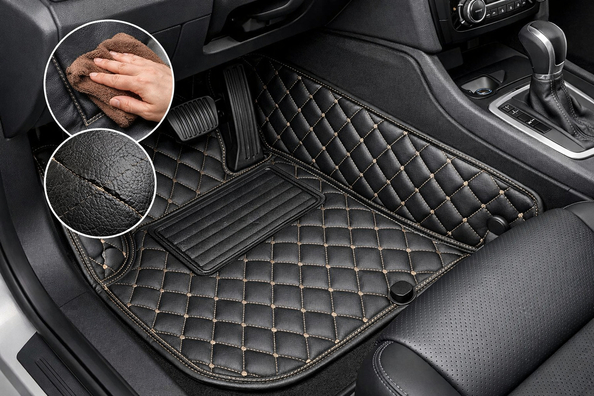
Eco-leather floor mats aren’t always convenient: in the city they’re liked for their neat look and easy cleaning, but in slush and wet snow they often start to annoy. Most issues come not from the material itself, but from poor shaping, weak fastening, and unrealistic expectations about winter practicality.
So you shouldn’t look only at the top layer. What matters is pattern accuracy, mounting points, a non-slip backing, a heel pad, and where the car is actually driven every day.
“Eco-leather” is a marketing name for different synthetic materials, so two similar-looking sets can differ in durability, odor, and how they behave in the cold. That’s why some owners praise these mats, while others replace them after just a few months.
The benefits of eco-leather show up in a drier urban routine, while the downsides appear when water, sand, road chemicals, and wet snow are constantly carried into the cabin. Add a universal shape or weak fasteners, and the problems get twice as bad.
DD Tuning expert comment: most often, people make mistakes when they choose mats by color and stitching but don’t уточнює the pattern and the fixation method. The second common mistake is buying a universal set instead of a vehicle-specific one and then putting up with shifting near the pedals. If the car drives in slush every day, it’s better to decide right away what matters more: looks or winter practicality.
| Symptom | Likely cause | What to do |
|---|---|---|
| The mat shifts under your foot | Weak fixation or universal shape | You need a vehicle-specific set with OEM mounts or a proper non-slip backing |
| The edge curls near the pedals | Inaccurate pattern or stiffening in frost | Check the fit in a warm cabin; if the shape doesn’t match, replacement is needed |
| Snow sticks or freezes on | The material doesn’t handle this winter routine well | Clean more often or switch to a separate winter set |
| The heel area wears through quickly | No heel pad or the top layer is too thin | Choose a reinforced driver’s area; cosmetics won’t save it |
| Squeaking appears along the edges | The mat doesn’t fit tightly and rubs against the floor or plastic | Check fit and fixation; the issue is solved by a different design |
| A strong smell lingers for a long time | Cheap material or glue | If it doesn’t go away after airing out, it makes sense to use the exchange option |
The best solution is the right design: a vehicle-specific shape, clips or other OEM fixation, a non-slip bottom, and sufficient rigidity. If the mat follows the floor precisely and doesn’t creep under the pedals, half of the everyday problems simply disappear.
For the driver, a heel pad is critical. This is where the load is highest, and without reinforcement, even a neat-looking set can fail earlier than expected.
Honest selection for your usage pattern helps, too. For a city car with regular cleaning, eco-leather makes sense; for daily winter mud, it’s more practical to have a different seasonal option. Care is simple: wipe with a damp cloth, use a mild cleaner, no abrasives and no harsh scrubbing.
Relying on a cheap universal set and hoping it will “settle in” almost never works. If the shape isn’t right from the start, you’ll only get more shifting and more inconvenience later.
Constantly adjusting the mat by hand or waiting for it to stop sliding on its own helps only temporarily. Aggressive brushing or harsh chemicals also won’t deliver proper results: you can ruin the appearance faster than you extend its lifespan.
And you shouldn’t expect a wipe or protectant to restore an already worn-through heel area. If the top layer is gone, it’s a replacement issue, not maintenance.
If the issue is only in the driver’s area and the set fits correctly, it makes sense to replace just that element or choose a version with a heel pad. But if the mat shifts, curls, or interferes near the pedals, partial fixes usually only delay a full replacement.
When the car is driven in slush every day, it’s logical to consider alternatives: rubber cabin mats or a comparison with EVA mats. And if you need a quick overview of the format’s strengths and weaknesses, it’s useful to keep this review of eco-leather mats on hand.
| Solution | When it works | When it’s not worth spending money |
|---|---|---|
| Vehicle-specific set with mounts and a proper backing | When you need a precise fit, a tidy interior, and easy daily cleaning | When your main routine is wet snow, lots of sand, and constant winter mud |
| Heel pad or reinforced driver’s area | When only the heel area wears out and the set’s shape is good | When the mat is already cracking in multiple places or sliding all over the floor |
| A second seasonal set for winter | When the car is used daily and conditions change sharply by season | When the car rarely sees slush and drives in a calm city routine year-round |
| Regular gentle cleaning | When you want to slow wear and prevent sand and road chemicals from building up | When the issue is already structural: poor shape, weak seams, no fixation |
| Cheap universal set | Only as a temporary option for very dry, low-demand use | For a daily car, an active driver’s area, and any serious winter |
From a customer’s experience: an urban crossover owner wanted one set for the whole year and initially chose eco-leather for the looks. After the first slushy winter, it became clear that the shape itself was good, but the material was inconvenient with wet snow. In the end, they kept the eco-leather set for the dry season and bought a more practical option for winter, and daily cleaning stopped being annoying.
Eco-leather floor mats are worth buying when you want a tidy interior, quick wipe-downs, and a precise vehicle-specific fit. Don’t expect maximum winter endurance in slush, deep snow, and heavy dirt—especially if the set is universal, without proper mounts and without a heel pad.
The key selection criterion here isn’t material advertising, but the combination of design, season, and your real driving routine. This material is based on real selection experience, hands-on practice, and real usage scenarios, so the takeaway is simple: for a neat urban routine, eco-leather can be a good purchase, but for harsh winters a more utilitarian format often wins.
| ✔ | They look neat in the cabin and are well suited for city driving, where there is no constant slush or wet snow. |
| ✔ | Easy to clean: for daily care, a damp wipe and a mild non-abrasive cleaner are usually enough. |
| ✔ | If the set is model-specific and has proper fastening, it fits snugly in place and does not interfere with the pedals. |
| ✔ | A heel pad or reinforced driver’s area really extends service life where the load is highest. |
| ✔ | For the dry season or calm city use, eco-leather can be a practical option without unnecessary hassle. |
| ✘ | In slush, wet snow, and winter mud, such mats often become inconvenient: snow sticks, freezes on, and dirt accumulates faster. |
| ✘ | Universal or poorly fitted sets may curl up, shift, and even interfere near the pedals. |
| ✘ | Without proper fastening, the mat slides on the floor, and on a wet surface this problem only gets worse. |
| ✘ | Cheap material or a weak top layer quickly wears through in the heel area, and care will no longer help here. |
Shipping to EU
Wholesale and retail
Own warehouse
Опис продукту
Подарунки не надаються при оформленні покупки у кредит під 0,01% або при покупці частинами.