24.08.2026
103
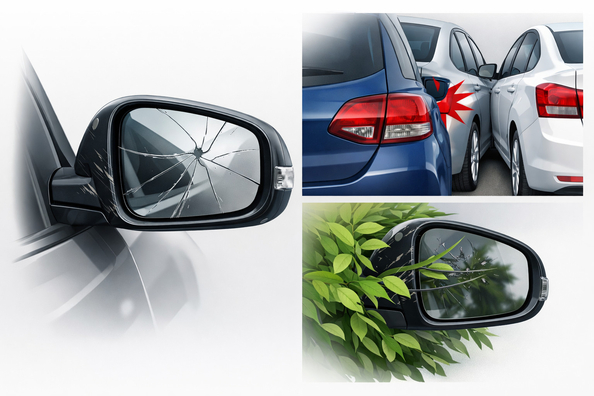

If your mirrors regularly rub against bushes, a garage wall, or a neighboring car in a tight courtyard, the issue is almost never “weak plastic,” but simply that there’s no width margin for maneuvering. At first it looks like minor scuffs on the cover, but after a few contacts you may get play, misalignment, mounting cracks, or folding malfunctions.
The key is not to confuse cosmetics with mechanics. A scratched outer cover is often solved with protection or by replacing the trim piece, but a mirror that sits crooked, vibrates, or won’t lock after folding already points to damage to the housing, tabs, or the assembly itself.
The mirror sticks out beyond the door’s width, so it’s the first to touch branches, gates, a wall, or a post. In a courtyard this happens at low speed, but even a light touch is enough to leave marks in the paint or shift the cover.
There’s a difference between two scenarios. Bushes and thin branches usually scratch the rear part of the cover and leave a fine web of scuffs. Tight parking, a narrow garage, or a hard hit against a wall more often breaks clips, tabs, or the housing, causing the mirror to sit unevenly even if the glass is intact.
Start with a simple inspection. If there are only thin arc-shaped scratches on the rear part of the cover, the gaps are even, and the mirror has no play, the cause is almost certainly regular contact with branches or a narrow passage. But if after one stronger touch the cover sits crooked, a gap appears, or the mirror starts vibrating, look for damaged clips or a cracked housing.
Next, check the folding function. On a clean, warm mirror, do one full fold/unfold cycle using the button. If the mechanism works in jerks, doesn’t reach the end position, or the mirror doesn’t click into the correct position after moving, the issue is no longer cosmetic. If there was frost beforehand, remove ice and snow first: these assemblies should not be forced.
Another marker is how it reacts to touch. A light wiggle by hand shouldn’t produce noticeable play. If the housing moves while the glass is intact, the usual culprits are internal tabs, clips, or mounts. If there’s no play and only the scuffs bother you, surface protection or replacing the outer part is enough.
DD Tuning expert comment: The most common mistake is ordering a decorative cover right after an impact without checking whether the housing is intact and whether there’s play at the base. The second typical mistake is installing any “looks-compatible” trim without considering equipment like Side Assist, cameras, or a turn signal repeater. If the mirror sits crooked or doesn’t lock, you should start not with décor but with diagnosing the assembly.
| Symptom | Likely cause | What to do |
|---|---|---|
| Minor scratches only on the outer cover | Contact with bushes, branches, narrow passage | Remove the obstacle or change the parking spot, protect the rear surface with clear film |
| The cover sits crooked, a gap appeared | Clips popped off or broke after an impact | Remove and check the mounts; if broken, replace the cover or housing rather than glue it |
| The mirror sits unevenly or vibrates while driving | Damaged housing, tabs, or main mount | Inspect the assembly; often more than just the cover needs replacement |
| Power folding works in jerks or doesn’t go all the way | Mechanism blockage, impact damage, or freezing | Remove ice, let the mechanism dry, run a fold cycle; no forceful pushing |
| The glass is intact, but after contact the mirror doesn’t lock | Internal tabs or mounts are damaged | Don’t waste money on just a trim piece; check the housing and mechanism |
| Even with cameras you still catch branches or a wall | Limited system view, dirt, low obstacles | Use cameras as assistance, but finish the maneuver with visual control |
The best results come not from one action but from a combination. First, remove the root cause: trim the bushes, change your line, or find a spot where the mirror doesn’t pass right next to an obstacle. Second, fold the mirrors right before entering a tight area or while parked—just don’t drive with mirrors folded.
For cosmetic protection, clear PPF film on the rear part of the cover is genuinely useful. It’s nearly invisible, takes the hit from sand, small branches, and everyday scuffs, and minor marks on quality film can diminish with heat. For local mirror protection, this is more practical than repainting covers after every season.
If the car has side cameras or parking assistants, they’re worth using in tight courtyards—but without self-deception. These systems are helpful at low speed, yet they don’t replace judging clearance with your own eyes, especially around branches, dirt, snow, and uneven walls.
Accessories make sense when the problem is still limited to the surface or the outer cover. If the original housing is intact and only the outer layer is affected, it’s logical to look at mirror caps as a way to refresh the look or cover signs of use. But if there’s play, misalignment, or the mirror won’t lock, you need to check the mirrors themselves or even the complete assembly.
Compatibility matters here. The same cover or cap may not fit due to different equipment: power folding, heating, turn signal repeater, blind-spot monitoring systems, side cameras. So choose an accessory only after you understand what’s damaged: the outer piece or the entire mechanism.
| Solution | When it works | When it’s not worth spending money |
|---|---|---|
| Fold mirrors in tight places | When the issue is a narrow driveway or tight parking | When the mechanism is already damaged or the mirror is frozen |
| Change the parking spot or remove branches | When damage repeats every day in the same place | When the mirror already has play and needs repair |
| Clear protective film | When the cover is intact and you need protection from scratches and scuffs | When the cover is cracked, clips are broken, or the housing is misaligned |
| Decorative covers or caps | When damage is cosmetic and equipment compatibility is confirmed | When the problem is in the mount, Side Assist, or cameras, and compatibility isn’t verified |
| Reset via fold/unfold cycle | When there was a glitch after blockage, manual folding, or a slight mechanism jam | When there’s already an internal crack, play, or impact damage |
| Replace the mirror assembly | When the housing, mounts, mechanism, or electrics are damaged | When there are only surface scuffs with no play or misalignment |
From a customer’s experience: After daily entry into a narrow courtyard, the person initially wanted just new covers because the glass stayed intact. During inspection it turned out that on one side the issue really was only a scuffed cover, while on the other side play had already appeared after contact with the wall. In the end, a combination worked: replacing the damaged element, protecting the intact side with film, and building the habit of folding mirrors before entering.
If your mirrors get damaged quickly from tight parking and bushes, don’t start with a random cap. First, distinguish surface scratches from a broken mount or mechanism, check folding operation, assess play, and only then choose protection, a cover, or a full assembly replacement.
In most cases, three things truly help: fewer contacts in tight spots, careful mirror folding where appropriate, and film surface protection. Decorative solutions make sense only when compatibility is confirmed and the issue is genuinely cosmetic. This material is based on real selection experience, hands-on practice, and real usage scenarios—not universal “for all cars” advice.
Shipping to EU
Wholesale and retail
Own warehouse
Опис продукту
Подарунки не надаються при оформленні покупки у кредит під 0,01% або при покупці частинами.