12.06.2026
139
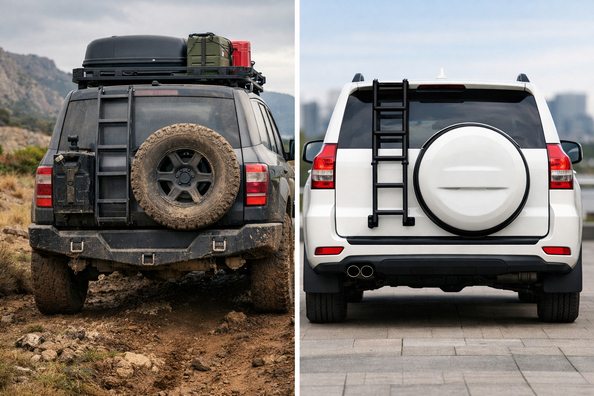
A fixed ladder on an SUV isn’t for everyone. It’s justified when the roof is truly in use: you regularly climb to a cargo platform, roof box, storage cases, tent, or you often wash and service a tall vehicle. But if you open the roof a few times per season, a permanent external ladder often adds more looks than real benefit.
What matters here is not only choosing the ladder type, but also honestly assessing your use case. Because the difference between a “useful tool” and “decoration with a risk of scratches and unwanted attention” usually comes down to how often you use it, how complex the installation is, and whether you’re willing to drill the body.
The main question is simple: do you need constant safe access to the roof, or can you sometimes make do with a side step, a tire, or a separate folding ladder. For an expedition roof rack, rooftop tent, or work equipment, a fixed ladder really saves time and effort. For a city vehicle without regular roof cargo, it’s often overkill.
The second point is the mounting method. Universal ladders usually require drilling, and that’s no longer just an accessory—it’s a modification of the body. No-drill solutions are better for preserving the paintwork, but they’re not available for every door design and not for every SUV.
| Option | Strengths | Weaknesses | Who it suits |
|---|---|---|---|
| Short universal, drill-on | Shorter length, 5 steps, low weight, decent access on moderately tall vehicles | Requires drilling, risk of installation errors, may be less convenient on a very tall roof | Those who regularly climb to the roof but don’t want an overly bulky setup |
| Medium universal, drill-on | 6 steps, more comfortable on tall SUVs, easier to reach a platform or roof box | Also requires drilling, needs a larger mounting area, slightly bulkier | Owners of tall vehicles with frequent roof access |
| No-drill clamp-on | Doesn’t damage the body, faster installation, lower risk for resale value | More often designed for vans; SUV compatibility is limited | Those for whom not drilling the body is critical and who have a compatible door design |
| More expensive vehicle-specific or system ladder | Better geometry, tighter fit, sometimes doesn’t block the camera, more comfortable steps | Higher price, not always no-drill, tied to a specific model or system | Those who truly live with a rack, platform, or rooftop tent |
| No fixed ladder | Zero body modification, no extra weight or attention, lowest cost | Less safety and convenience with frequent roof access | Those who access the roof rarely |
DD Tuning expert comment: The most common mistake is buying a ladder for looks and only then discovering the door doesn’t provide enough mounting area or the camera and spoiler interfere. The second typical issue is underestimating installation: without precise fitment, bushings, and anti-corrosion treatment, even a good ladder starts rubbing the paint, vibrating, and becoming annoying at speed.
This is the basic workhorse format for those who need a ladder regularly, but without excessive length. Typically it has 5 steps, a length of about 1180–1486 mm, a width of 344 mm, a weight of 7,25 kg, and a rated load up to 150 kg. Its strong point is the more compact geometry: easier to fit on lower or shorter rear doors.
The weak point is installation. Drilling is required, and for double-skin doors you also need the correct bushing and protection for the holes. If the roof is tall or has a massive platform, the top access point may be enough, but without much comfort margin.
The logic is the same, but for taller vehicles. Here you usually get 6 steps, a length of 1485–1786 mm, a width of about 340 mm, a weight of 7,87 kg, and the rated load is also up to 150 kg. On a tall SUV this format is noticeably more practical: you don’t have to stretch your body toward the roof as much.
The downside is higher requirements for the installation area: you need a longer and flatter mounting zone. If the rear door has complex contours or bolt-on equipment, this format is more likely to not fit properly without compromises.
This is a good approach when you don’t want to drill the body. Such solutions can weigh less than 9,1 kg, mount to the door edges, have non-slip steps, and multiple fixing points. Their main advantage is preserving the body and reducing the risk of hurting resale value.
But there’s an important limitation: no-drill designs are more often made for work vans rather than for every SUV. So the idea is right, but availability and compatibility depend on the specific door design far more than with standard universal ladders.
Here you’re paying not so much for the mere presence of steps, but for a tighter fit, better geometry, and fewer compromises. These solutions may feature strong steel, a slim profile, a mass around 7,7 kg, and the design can be thought out so it doesn’t block the camera or view. For frequent use, you feel this every day.
In the premium roof-access segment, you may also find extra conveniences: wider steps, a handrail, lighting, and better integration with a rooftop tent. But it only makes sense when the roof is used constantly. If not, the extra spend goes more into emotion than into real-world practicality.
For many owners, this is the most sensible choice. If you need roof access occasionally, it’s easier to use a side step, the tire, or a separate folding ladder. That way you don’t drill the body, you don’t add exterior hardware, and you don’t attract extra attention in parking lots.
The downside is obvious: with frequent roof loading it’s slower, less safe, and simply tiring. So this option is good not “to save money at any cost,” but specifically for infrequent use.
If you have an expedition rack, platform, storage cases, or a tent, and you climb up on nearly every trip, a fixed ladder makes sense. For a medium-height vehicle, a short universal ladder is often enough; for a tall one, a medium or vehicle-specific ladder is more comfortable. If your priority is a body without drilling, you need to look for a compatible no-drill solution—but don’t assume there’s one for every vehicle.
If the vehicle mostly drives in the city and the roof is used a few times per season, the best choice is often not to install an external ladder at all. This isn’t penny-pinching—it’s a sober approach: don’t buy an accessory that doesn’t match your scenario.
| Scenario | Best choice | Why |
|---|---|---|
| The roof is used almost weekly | Medium universal or vehicle-specific ladder | Easier to reach a tall roof, fewer extra movements and less risk of slipping |
| Mid-size SUV, roof rack, but without heavy loads | Short universal | Provides permanent access without excessive bulk |
| You don’t want to drill the body | No-drill ladder, if compatible | Lower risk for paint, holes, and resale value |
| City driving, rare trips, roof opened occasionally | No fixed ladder at all | No point keeping an external element on the vehicle that’s hardly used |
| Vehicle set up for a tent, platform, permanent travel kit | More expensive vehicle-specific or system solution | Better compatibility, convenience, and fewer compromises in daily use |
A more expensive ladder makes sense not when you simply want “better,” but when the cheaper option will actually get in the way: the vehicle is tall, the roof is used constantly, there’s a rack or platform, camera compatibility matters, and you want a clean look. In that case, look not at the ladder in isolation, but at the whole roof-access system: ladders for SUVs, roof racks and crossbars and side steps.
In practice, this is justified for those who frequently load gear, travel with a roof setup, or don’t want to put up with play, an awkward climbing angle, and constant tweaks after installation. If the roof is there “just in case,” a pricier solution rarely delivers proportional benefit.
From a customer’s experience: most often, those who are satisfied are the ones who started with a clear scenario—for example, regular access to a platform with storage boxes or to roof gear on trips. In such cases, people usually choose either a longer universal ladder or a vehicle-specific solution, because after a few outings it becomes clear: fast and safe roof access is worth more than the price difference. But with infrequent roof use, those same owners often skip a fixed ladder altogether and don’t regret it.
A fixed ladder for an SUV isn’t a must-have accessory—it’s a tool for a specific usage pattern. If the roof is used regularly, it truly provides faster and safer access. If not, in most cases it’s smarter to go without it or choose a temporary solution that doesn’t require drilling the body.
In short: for moderately tall vehicles, a short universal ladder will do; for tall and frequently loaded ones, a medium or vehicle-specific ladder is better; for those who don’t want to modify the body, it’s worth looking for a no-drill format if it’s compatible. This material is based on real selection experience, practical work, and real usage scenarios—not on the abstract idea that every SUV owner needs a ladder.
| ✔ | Provides quick and safe access to the roof when the cargo box, platform, roof box, or roof tent is used regularly. This is especially noticeable on tall SUVs, where without a ladder you have to stretch your body up to the roof. |
| ✔ | A fixed ladder saves time and effort during frequent loading and maintenance of gear. For those who climb onto the roof almost on every trip, it is more practical than a side step or a separate folding ladder. |
| ✔ | Model-specific and system solutions can fit the body better and not block the camera or visibility. This reduces small inconveniences in everyday use. |
| ✔ | Bodiless options keep the body free of holes and reduce the risk of issues with the car’s resale value. This is useful if you do not want to drill into the doors or cannot do so. |
| ✔ | With the right selection, a ladder makes working with roof equipment more convenient and reduces the risk of slipping while climbing. This is felt most on cars that are often used for travel or for carrying cargo on the roof. |
| ✘ | For occasional roof use, a fixed ladder is often excessive and does not pay off in convenience. In city use, it looks more like an unnecessary exterior element than a necessary one. |
| ✘ | Universal ladders often require drilling, which means interfering with the body. If the installation is done imprecisely, you can get looseness, paint rubbing, or corrosion problems. |
| ✘ | Not every door design is suitable for drilling-free solutions, especially on SUVs. Because of this, the choice may be limited by compatibility, not just by the desire not to drill the body. |
| ✘ | More expensive model-specific or system ladders make sense only with frequent use; otherwise, the extra cost does not bring proportional benefit. If the roof is opened only a few times per season, such a purchase seems unnecessary. |
| ✘ | A fixed ladder adds another exterior element to the car that may make noise or require additional adjustment. On the highway, the problem is more often not the shape itself, but weak clamping and looseness. |
Shipping to EU
Wholesale and retail
Own warehouse
Опис продукту
Подарунки не надаються при оформленні покупки у кредит під 0,01% або при покупці частинами.