12.06.2026
146
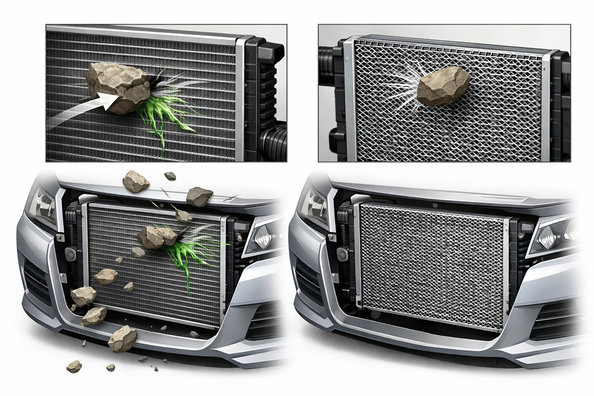

Stones puncture a radiator not because the radiator itself is “bad”, but because on many cars it sits almost immediately behind a large opening in the bumper and takes the hit from gravel, insects, and hard debris. An aluminum mesh can indeed reduce the risk, but only under three conditions: it’s airflow-friendly enough, installed correctly, and cleaned regularly.
It’s important not to mix up two different problems here. The first is mechanical damage to the fins or tubes from a stone. The second is overheating due to debris in the fan area, between the condenser and the radiator, or because of an overly fine clogged mesh. From the outside these often look similar, but the solutions are different.
The front cooling module isn’t just one radiator: at the front there’s often the A/C condenser, behind it the engine coolant radiator, and on some cars an intercooler as well. If the front end is open, small gravel and hard debris fly into this stack with almost no obstacles. On the highway, speed and impact energy do the damage; in the city, the issue is buildup of dirt, leaves, fluff, and insects that reduce airflow.
The mesh is needed not as “armor”, but as a coarse-particle filter. It helps when it stops stones before they reach the radiator. But if the mesh is too fine or hasn’t been washed for a long time, it starts restricting airflow itself—then instead of protection you get extra load on the fan and less temperature headroom.
DD Tuning expert comment: The most common mistake is installing a very fine decorative mesh and thinking the denser it is, the better. In practice, a more open mesh that’s easy to remove and wash works better. The second typical mistake is not checking the space between the condenser and radiator: outside everything is clean, but inside a dense “pad” of dirt has already built up.
| Symptom | Likely cause | What to do |
|---|---|---|
| Coolant level drops, there’s a sweetish smell | Leak from the radiator or its tubes | Cold inspection, pressure test, then repair or replace the unit |
| A wet spot on the radiator after driving on gravel | Localized stone impact | Don’t delay diagnosis; after repair, install protection |
| Temperature rises in traffic or with A/C on, no puddle | Dirty cooling stack or a high-resistance mesh | Clean the mesh; check the space between the condenser and radiator |
| The fan started coming on more often after mesh installation | Mesh is too fine or clogged | Wash it or replace with a more airflow-friendly one |
| Steam, overheating, sudden drop in fluid level | Major leak or severe airflow restriction | Stop, let it cool down, don’t drive far without diagnosis |
| Heater blows less warm, fluid level is dropping | Not enough coolant in the system | Find the leak source, not just top up antifreeze |
For turbo cars, vehicles with an intercooler, and a dense front stack, the approach should be more cautious: cooling headroom is usually smaller. After installing protection, it’s worth watching temperature behavior in hot weather, in traffic, and under load.
A bad idea is installing a very fine decorative mesh “so nothing gets through”. Yes, it catches more debris—but it also lets less air through. This is especially noticeable in summer, in the city, and on cars with limited cooling margin.
Emergency radiator sealers are a temporary option when you only need to reach a repair shop. For long-term use they don’t fix the cause of the damage. Likewise, there’s little benefit in washing only the outer surface if dirt is already packed between the heat exchangers.
A hood deflector shouldn’t be seen as a replacement for a mesh either. It can influence airflow over the front end and reduce insects on the hood edge, but it doesn’t cover the bumper opening or the radiator behind it.
If your car has a large lower bumper opening and the radiator sits close to the front, the first logical step is an aluminum mesh. It’s prevention against stones and coarse debris, not a way to “improve cooling”.
If you also want fewer insects and fine debris on the upper front edge, you can consider a hood deflector. But its role is secondary: it doesn’t replace protection right in front of the radiator.
Replacing components is needed when there’s already a leak, signs of old seepage, damaged tubes, crushed fins, or broken factory air guides. In that case, an accessory only makes sense after the repair—to reduce the chance of the problem repeating.
| Solution | When it works | When it’s not worth spending money |
|---|---|---|
| High-airflow aluminum mesh | When the front end is open and you need protection from gravel and debris | When the radiator is already leaking, or if an overly fine option is installed with no airflow margin |
| Regular washing of the mesh and front module | When the mesh is already installed and the car often drives on the highway | When the issue isn’t dirt, but an actual leak or mechanical damage |
| Cleaning between the condenser and radiator | When temperature rises without obvious fluid loss | When there’s a localized puncture and coolant is leaking out |
| Pressure test, radiator repair or replacement | When the fluid level drops, there’s odor, moisture, or overheating | When you’re trying to treat only the risk of a future impact without an actual fault |
| Hood deflector | When you need additional protection of the upper front edge from insects and some fine debris | When it’s bought instead of a mesh to protect the radiator itself |
| Stop-leak sealer | Only as a short emergency step to reach a service shop | When normal long-term use without repair is expected |
From a customer’s experience: after several highway trips through roadworks, the person wasn’t looking for “tuning”, but for a way not to replace the radiator again during the hot season. They chose a removable aluminum mesh with proper airflow, and after some time, during washing, it already had insects, fluff, and small stones on it. That’s what delivered a noticeable result: the debris stayed on the protection, not in the cooling stack.
An aluminum mesh really can save the radiator from some stone impacts—but only as prevention. It works when it’s airflow-friendly, installed correctly, and not clogged with dirt. If a leak already exists, the mesh won’t fix anything: you need a cold-engine inspection, a pressure test, and repair or replacement of the unit. This material is based on real selection experience, hands-on practice, and real-world use cases, and the main takeaway is simple: a more open, well-maintained mesh is better than a “sealed” guard that creates a new problem by itself.
| ✔ | An aluminum mesh really reduces the risk of radiator punctures from small stones and coarse debris, if it is installed in front of the heat exchangers and has sufficient airflow. |
| ✔ | It is especially useful for cars with a large bumper opening and a front cooling pack positioned close to the grille, where stones have a direct path to the fins. |
| ✔ | If insects, fluff, and small stones build up on the mesh after a highway drive, it means the protection is doing its job and taking the impact instead of the radiator. |
| ✔ | Unlike “solid” solutions, a proper mesh should not noticeably choke the airflow if it is cleaned regularly. |
| ✔ | Combined with cleaning the space between the condenser and the radiator, it provides a practical benefit and can reduce repeat damage after driving on gravel. |
| ✘ | A mesh that is too fine or clogged can create the problem itself: it worsens airflow, makes the fan turn on more often, and reduces temperature headroom. |
| ✘ | If the radiator already leaks or has a hole, the mesh will not fix this fault — inspection, pressure testing, and repair or replacement are needed. |
| ✘ | Without regular cleaning, the protection quickly loses its purpose, because dirt, insects, and fluff accumulate and block the airflow. |
| ✘ | Incorrect installation, especially when the mesh sits too close to the fins, speeds up dirt buildup and makes servicing more difficult. |
Shipping to EU
Wholesale and retail
Own warehouse
Опис продукту
Подарунки не надаються при оформленні покупки у кредит під 0,01% або при покупці частинами.