19.05.2026
400
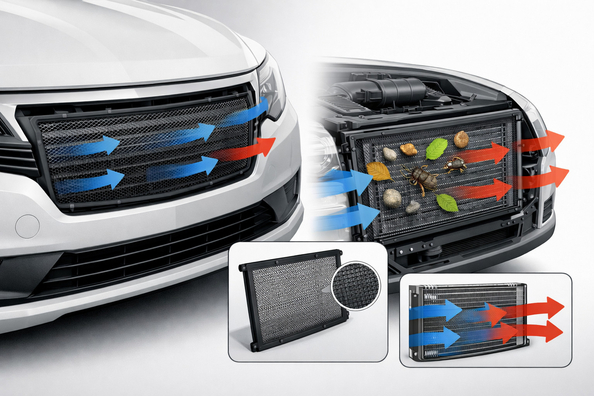

You can protect the grille and radiator, but the problem starts when protection turns into an obstacle to airflow. The safest approach is simple: don’t block the front end solidly, use a fairly open mesh, don’t press it against the radiator pack, and don’t interfere with the fan or active shutters.
If after installing a mesh or cover the temperature starts creeping up, don’t rush to blame the accessory itself. Very often it simply highlights an existing issue: dirt between heat exchangers, a weak fan, a broken shroud, low coolant level, or incorrect seasonal grille blocking.
Engine cooling depends on more than just the opening area in the bumper. What matters is how air enters the front end, passes through the condenser and radiator, and exits the engine bay. Any dense insert up front changes this channel: resistance increases, and part of the flow starts bypassing the heat exchangers or slowing down before reaching them.
A separate trap is that the upper grille isn’t always the main source of cooling air. On many cars the lower intake plays a big role too. That’s why a car may behave normally in winter or in light city driving, but start running hot in heat, in traffic, on the highway under load, or with the A/C on.
DD Tuning expert comment: The most common mistake is installing a very fine mesh “just in case” and mounting it right in front of the radiator with no gap. In cool weather it may not show up, but in heat, with the A/C on, or on the highway, the airflow margin drops sharply. The second typical mistake is pressure-washing the front end and bending the fins—after that, even the correct mesh won’t save you.
| Symptom | Likely cause | What to do |
|---|---|---|
| Temperature rises in traffic, especially with the A/C on | Weak or non-working fan, damaged shroud | Check fan activation, wiring, relay, and shroud condition; don’t start by replacing the mesh |
| Runs hot on the highway or uphill, but in the city it’s almost fine | Dense mesh, blocked lower air intake, dirty radiator stack | Inspect the effective flow area, clean the front end, and if needed change the protection design |
| The issue appeared immediately after installing a winter cover | Cover is used out of season or blocks too much | Remove the cover, check the car’s behavior, don’t use it in warm weather |
| The front looks clean outside, but the temperature still creeps up | Debris between the condenser and radiator | Carefully clean the stack with air or a gentle stream of water, without high pressure |
| Temperature is unstable, fluid level drops | Leak, air in the system, low coolant level | Find the cause of fluid loss, bleed the system, don’t mask the problem with accessories |
| There are errors or unusual noises behind the grille | Active shutters are jammed or the protection is installed too close | Check the mechanism, remove the obstruction, leave sufficient clearance |
An accessory makes sense when the cooling system is healthy and the task is specific: protect the radiator stack from stones, insects, and debris without losing airflow. If you’re planning to modify the front end, check the material on DIY grille tuning—it’s not only the mesh that matters, but also how it’s mounted.
Seasonal solutions can also be appropriate, but only in a narrow scenario. It’s worth considering a winter grille cover if the engine is underheating specifically in freezing weather—not as a permanent way to block the front end.
When the main risk is highway stones, insects, and dirt along the leading edge, sometimes pairing grille protection with a hood deflector also makes sense. It doesn’t replace a mesh in front of the radiator, but it can reduce the amount of debris that reaches the front-end area.
Parts replacement is needed when there’s a physical failure: a cracked fan shroud, a non-working fan, badly bent fins, a radiator leak, broken shutters, or missing factory air guides. In such cases, an accessory only masks symptoms.
| Solution | When it works | When it’s not worth spending money |
|---|---|---|
| Open mesh with proper clearance | When you need protection from stones and the cooling system is healthy | If the mesh will still have to be installed flush or it will block moving shutters |
| Cleaning the mesh, condenser, and radiator | When temperature rises due to dirt, insects, and fluff | If there’s a coolant leak, air in the system, or a faulty fan |
| Winter cover with partial blocking | In steady freezing conditions, when the engine takes a long time to reach operating temperature | In above-freezing weather, in traffic, in the mountains, under load, or when towing |
| Repair or replacement of the fan and shroud | When the car runs hot while stationary or in slow driving | If at speed the flow is already blocked by a dense insert up front |
| Restoring shutters, guides, and air seals | When the factory front-end aerodynamics are compromised | If the radiator stack itself is clogged with dirt and hasn’t been cleaned |
| Dense decorative insert or a solid screen | Almost never, except in very narrow winter scenarios and with temperature monitoring | For daily use in warm seasons, on the highway, or on cars with a tightly packed heat-exchanger stack |
From a customer’s experience: after installing a fine metal mesh on a crossover, the issue appeared only on the highway in heat with the A/C on. During inspection it turned out the mesh was installed almost flush to the condenser, and a layer of insects had already built up behind it. After cleaning the stack and switching to a more open mesh with clearance, the temperature returned to normal, and stone protection remained.
Grille and radiator protection without harming airflow is possible if you don’t turn the front end into a solid barrier. An open mesh, correct installation with clearance, a clean radiator stack, and a healthy factory cooling system are what work.
If the temperature rises, separate airflow restriction issues from faults in the fan, shutters, shroud, and the cooling system itself. This material is based on real selection experience, hands-on practice, and real use scenarios—not on the myth that any mesh is equally safe for any car.
| ✔ | An open mesh with a large free area can protect against stones, insects, and larger debris without severely blocking airflow. This is suitable for everyday driving if the cooling system is in good condition. |
| ✔ | Installing it with a gap between the mesh and the radiator pack reduces the risk that the guard will restrict airflow or interfere with active grille shutters. The article explicitly states that the mesh should not sit flush against the condenser or radiator. |
| ✔ | Regular cleaning of the front end, condenser, and radiator really helps, because insects, leaves, and fluff quickly clog even a proper mesh. The author recommends cleaning without high pressure so as not to bend the fins. |
| ✔ | A properly chosen winter cover can be useful in steady frost if the engine takes a long time to reach operating temperature. This is a seasonal solution, not a permanent grille block. |
| ✔ | If the problem is not the accessory but the fan, shroud, shutters, or coolant level, the article provides a clear diagnostic scheme. This helps avoid replacing the mesh blindly. |
| ✘ | A very fine or dense mesh can easily and sharply reduce airflow, especially in hot weather, with the кондиціонером or under load. It may catch not only debris, but the airflow itself. |
| ✘ | If the mesh is installed almost flush against the radiator, it works worse even when it is not too dense on its own. Without a technological gap, airflow drops noticeably. |
| ✘ | A full grille block for winter has a very narrow range of use and easily becomes harmful in warm weather, in traffic jams, or on the highway. In the article, this is described as a solution that is often used out of season. |
| ✘ | Dense protection may only highlight existing cooling system problems, such as a dirty radiator pack, a weak fan, or a low coolant level. In that case, the accessory does not address the root cause. |
Shipping to EU
Wholesale and retail
Own warehouse
Опис продукту
Подарунки не надаються при оформленні покупки у кредит під 0,01% або при покупці частинами.