
































































 Author: Radomskyi Maksym Vasyliovych
In short, a power tailgate wins when you often approach the car with your hands full, while manual opening is better where speed, simplicity, and predictable operation in cold, snow, or with a weak battery matter more. For everyday comfort, the real difference isn’t the option itself but your use case: a family city car, frequent shopping and a heavy tailgate, or short stops, a work routine, and minimal extra electronics.
Another important point: if the power tailgate is factory-installed, that’s one story. If you’re thinking about retrofitting, then alongside convenience come questions of installation, compatibility, setup, and future service.
What the choice is really about
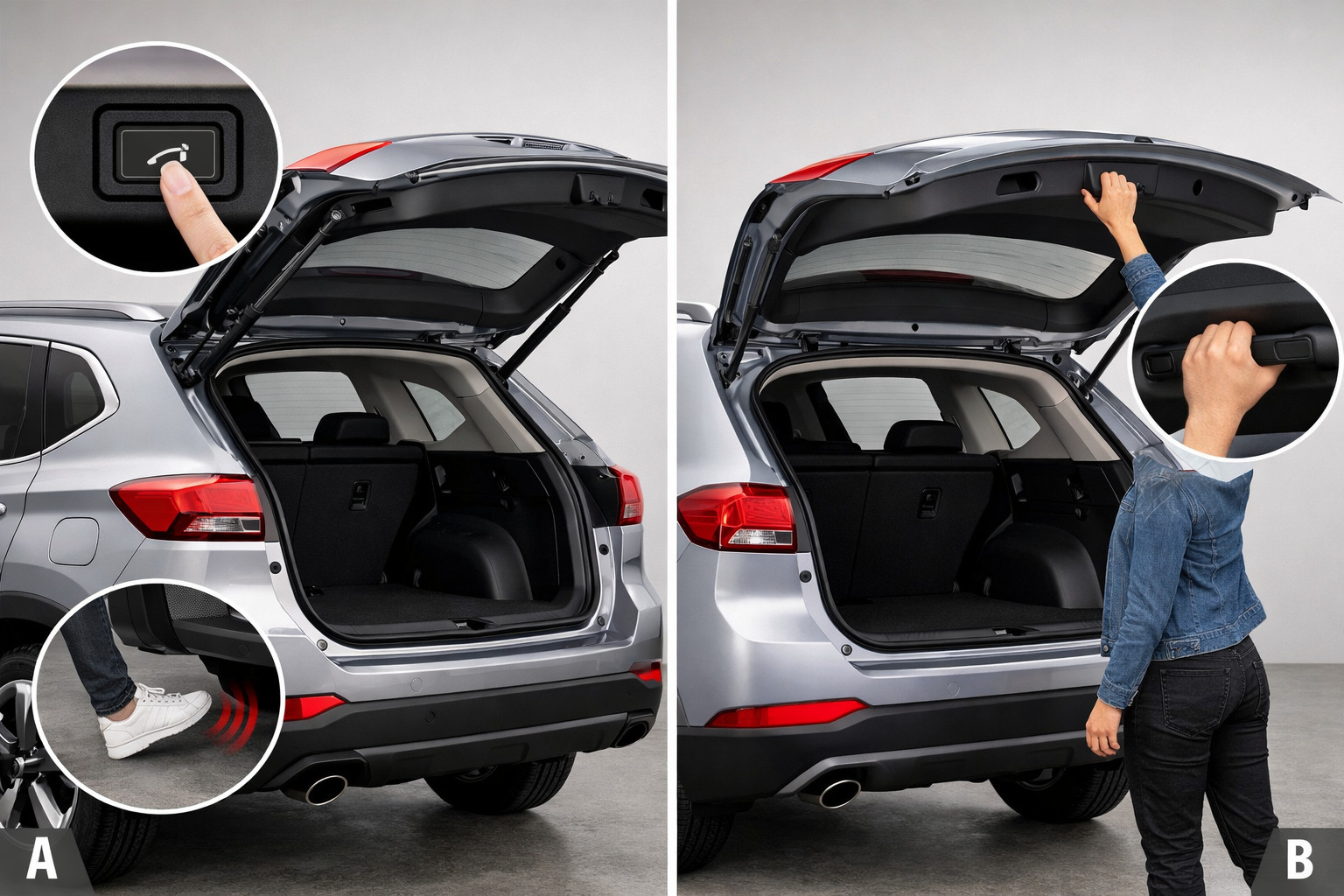
Essentially, you’re choosing between two usage logics. A power tailgate means less physical effort: press a button, approach with the key, or use a hands-free sensor, and the lid opens or closes on its own. Manual opening requires more involvement, but it gives quick access without waiting for the full cycle.
In everyday driving, it feels very straightforward. When the trunk is opened 2–4 times a day for bags, kids’ items, or tools, automation genuinely makes life easier. But when it’s opened often and briefly—say, at every stop—the manual option often turns out to be more convenient precisely because of its speed and simplicity.
Which criteria to compare by
- Installation. The manual setup is simpler: latch, struts, mechanics. A power tailgate—especially as a retrofit—requires compatible actuators, wiring, buttons, sometimes a soft-close unit, and subsequent adjustment.
- Noise. A power tailgate is almost always audible while operating: motor, latch, linkages. That’s normal, but loudness varies across systems. Manual opening is quieter if the latch and gas struts are in good condition.
- Durability. Manual opening has fewer components, so there are fewer potential failure points. But struts wear out too. With a power tailgate, durability depends more on kit quality, tailgate weight, correct installation, and how often the system is cycled back-to-back.
- Practicality. A power tailgate is useful when your hands are full, the lid is heavy, the vehicle is tall, or height memory matters in a low garage. Manual opening is more practical where you need fast access without a pause for the motorized cycle.
- Price. The manual option is cheaper both to buy and to potentially repair. A power tailgate costs more not only because of the kit itself, but also installation, possible calibration, and more complex diagnostics.
It’s also worth considering operating conditions. Some power tailgate systems have limits on repeated cycles with the engine off, are sensitive to ice, snow, vehicle tilt on a slope, and low voltage. So you shouldn’t compare in the abstract—compare for your weather, parking conditions, and usage frequency.
Quick comparison of the options (table)
| Option | Strengths | Weaknesses | Who it’s for |
|---|---|---|---|
| Power tailgate | Convenient with hands full, multiple opening methods, easier to handle a heavy lid, may have height memory | Slower cycle, higher price, dependence on the battery and system condition, more complex repairs | Family cars, urban crossovers, those who often load groceries, a stroller, or tools |
| Manual opening | Fast access, simple design, less electronics, more predictable in frost and with a weak battery | Less comfort, you have to lift/pull the lid by hand, inconvenient with dirty or heavy cargo | Those who open the trunk often and briefly, value simplicity, and don’t want extra expense |
DD Tuning expert comment: The most common mistake is to evaluate a power tailgate only as a nice feature, not as a system with its own limitations. If the trunk is opened many times in a row, what starts to annoy people isn’t a failure but the slow cycle itself and dependence on battery condition. Before choosing, it’s worth checking the basic tailgate mechanics, the latch, and the power supply—because a weak foundation makes any retrofit finicky.
Detailed breakdown of each option
Power tailgate
Its main advantage isn’t the wow factor, but repeatable everyday convenience. When you’re carrying bags, loading a stroller, taking out tools, or simply don’t want to touch a dirty lid with your hands, a power tailgate saves effort. Some systems offer multiple control points: a key fob button, an interior button, an external button, and sometimes hands-free opening near the rear bumper. Height adjustment is also available, which is useful in a low garage.
The downsides are practical too. A power tailgate is slower than manual opening, depends on the charge of the 12V battery, and can react to ice, snow, a vehicle leaning on a slope, or a series of repeated cycles without a pause. On different systems, thermal protection may trigger after a few consecutive openings, and after repairs or disconnecting the battery, re-initialization is sometimes needed. If you install such a unit aftermarket, the total price is the kit plus installation plus proper calibration.
Manual opening
Its strength is predictability. You simply open the trunk without waiting, without motor noise, and without relying on electronics. During short city stops, it’s often even more comfortable because the action is faster. In cold climates, with outdoor parking, and on cars with less-than-ideal batteries, the manual setup usually causes fewer headaches.
But simplicity has a cost in another sense—you do everything yourself. If the lid is heavy, the vehicle is tall, and your hands are full, convenience drops immediately. Also, manual opening isn’t forever: gas struts get tired, the latch and button wear, and the lid itself may require more effort over time. So it’s not “better overall,” it’s better for those who prioritize speed and a simple design.
Which option is better for different scenarios
For a family city car where the trunk constantly deals with groceries, backpacks, kids’ items, and your hands are often full, a power tailgate really delivers daily value. This is especially noticeable on crossovers with a heavy tailgate.
For a work routine with many short stops, manual opening is usually more rational. It’s faster, doesn’t make you wait, depends less on temperature, and doesn’t add extra load to the electrical system.
For regions with wet winters, icing, and frequent parking on uneven ground, the manual setup is safer in terms of expectations. A power tailgate can still make sense here—but only if you understand how it behaves in the cold and keep the battery and mechanics in good condition.
If the issue isn’t convenience but a heavy lid or a garage height limit, then a power tailgate has a practical—not decorative—advantage: you don’t have to pull the lid down by hand, and you can limit the opening height.
Use case and what to choose (table)
| Scenario | What to choose | Why |
|---|---|---|
| Daily shopping, kids’ items, hands constantly busy | Power tailgate | Less physical effort, easier to open and close a heavy lid |
| Courier or work short stops many times a day | Manual opening | Faster, simpler, no need to wait for the motor cycle |
| Car often parked outside in winter | Manual opening | Less sensitivity to ice, snow, low voltage, and tilt on a slope |
| Tall crossover with a heavy tailgate | Power tailgate | More convenient in daily use, especially for a shorter driver |
| Low garage or roof cargo | Power tailgate | Useful height memory, less risk of hitting the lid |
| Need minimal cost and maximum simplicity | Manual opening | Lower entry price and fewer potentially expensive components |
Common mistakes when choosing
- Buying a power tailgate only for the convenience feature without considering how often you actually use the trunk.
- Ignoring installation and compatibility when retrofitting: not every lid, latch, and electrical system accepts such a kit equally easily.
- Expecting equally stable operation in frost, wet snow, and on a slope, even though behavior depends on conditions.
- Not accounting for the condition of the battery, struts, and latch. A weak battery or tired mechanics often create symptoms that are mistakenly blamed on the actuator itself.
- Forcing the lid while the power tailgate is operating. For some systems, that’s a direct path to malfunction or component damage.
- Not thinking about future service. After repairing certain components, re-learning or calibration is sometimes required.
When the more expensive solution makes sense
Paying extra for a power tailgate is justified when you feel its benefit almost every day: a heavy lid, frequent loading, hands constantly full, family use, a low garage, or a desire not to touch a dirty surface. In such a scenario, the pricier solution isn’t a whim—it’s a real everyday облегчення.
If you’re considering a retrofit, first check out power tailgates, separately verify whether a power tailgate can be installed, and if the tailgate itself already has play, corrosion, or latch issues, also assess the condition of the assembly in the tailgates section.
If you open the trunk rarely, value instant access, and don’t want additional dependence on electrics, the more expensive option is unlikely to pay off in everyday comfort. In that case, it’s smarter to keep the manual setup and maintain the basic mechanics.
From a customer’s experience: the owner of a city crossover wasn’t looking for a “flashy” feature, but a way to use the trunk normally with bags and a stroller. In the end, he chose a power tailgate with height adjustment because he regularly parks in a low garage. What he appreciated most wasn’t automation itself, but the fact that he didn’t have to pull the lid down by hand every day.
Conclusion
For most urban scenarios, a power tailgate is indeed more comfortable: it works best when your hands are full, the lid is heavy, and the trunk is part of your daily routine. Manual opening wins in other conditions—when you need speed, a simple design, less dependence on the battery, and stability in cold weather and on uneven ground.
The best choice here isn’t universal—it’s scenario-based. This material is based on real selection experience, practical work, and real usage scenarios, so the main question isn’t “what costs more,” but “what will be more convenient in your daily routine.”
How it works
- Assess your usage scenario Think about how often you open the trunk and in what conditions it happens: family trips, shopping, children’s items, tools, or short work stops. If your hands are often full and the lid is heavy, an electric drive makes more sense; if you need quick access without delays, manual opening is better.
- Compare convenience and speed An electric drive reduces physical effort and is useful when you don’t want to touch a dirty lid or lift a heavy trunk. Manual opening is simpler and faster, especially when the trunk is opened often and for a short time.
- Check operating conditions Consider whether the car is parked outside in winter, whether there is ice, snow, a slope, or a weak battery. In such conditions, the manual setup is usually more predictable, while an electric drive depends more heavily on the condition of the power supply and the mechanism.
- Assess installation and costs If the electric drive is already installed from the factory, that is one thing. For retrofitting, consider compatibility, wiring, buttons, possible calibration, and more complicated service; the manual version is cheaper both to buy and to repair.
- Choose the option for your car For a city family car, a tall crossover, or a low garage, an electric drive provides real everyday convenience, including the ability to adjust the opening height. For work use, frequent short stops, and minimal electronics, manual opening will be more practical.
- Check the basic mechanics before deciding Before choosing, inspect the condition of the latch, struts, lid, and battery, because a weak base makes any system problematic. If you are thinking about retrofitting, first make sure the unit is in good condition and ready for such a load.
Pros and cons
The power drive is more convenient when your hands are full: you can open the trunk with a button or hands-free, without putting bags or children’s items on the ground. This is especially noticeable in family city use and on cars with a heavy lid.
You can adjust the opening height, which is useful in a low garage or where there is a risk of hitting the lid against the ceiling. This makes the option not just comfortable, but also practical for specific parking conditions.
Manual opening is simpler and faster during short stops, because you do not have to wait for the motor cycle. For work use or frequent short loading, this is often more convenient than automation.
The manual setup has less electronics and fewer failure points, so it is more predictable in frost, snow, and with a weak battery. This reduces the risk of unpleasant surprises in bad weather.
The power drive really makes everyday use easier if the trunk is often opened with groceries, a stroller, or tools. In such a scenario, the savings in effort are felt every day, not just as an extra option.
The electric drive is slower than manual opening, and with frequent short stops it can be more annoying than helpful. This is especially noticeable when the trunk needs to be opened many times a day.
The system depends on the condition of the 12-volt battery and may perform worse in ice, wet snow, on a slope, or after a series of repeated cycles. In other words, comfort strongly depends on the conditions rather than always working the same.
Retrofitting a power drive complicates everything: you need compatible components, installation, setup, and sometimes re-calibration after a repair or battery disconnect. This increases the cost and adds risks during use.
Manual opening is less convenient when the lid is heavy, the car is tall, or your hands are full, because you have to do everything yourself. In such scenarios, saving on automation starts to feel like inconvenience in everyday use.