28.09.2026
69
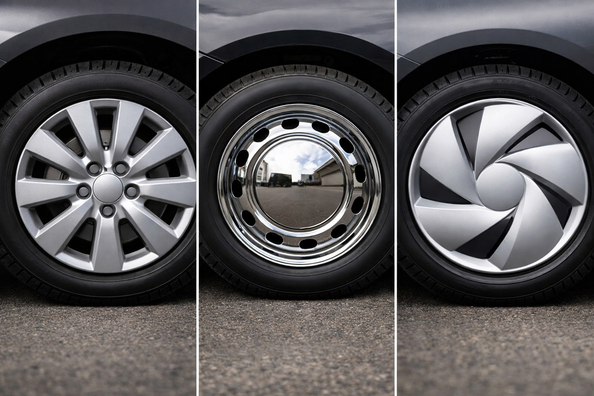
If you need a sensible balance of price, weight, and durability for a regular passenger car, most often it’s worth choosing a quality hubcap made of ABS or ASA plastic. Stainless steel makes sense where the car is used in harsher conditions and long service life and corrosion resistance matter. An aerodynamic hubcap is worth buying only when it’s definitely compatible with the wheel and the car really does a lot of highway driving, or it’s an EV.
The main mistake when choosing is looking only at appearance and diameter. In reality, what matters is the fit, the type of fastening, tendency to noise, winter behavior, day-to-day practicality, and whether the more expensive option pays for itself in your specific scenario.
It’s important to define terms right away. Plastic and stainless steel are primarily the material, while an aerodynamic hubcap is the shape and degree of wheel coverage. In practice, an aero hubcap is also often plastic, so the choice happens in two steps: first compatibility and driving pattern, then material and design.
For most city cars, a hubcap isn’t just for looks. It covers the fasteners, protects the assembly from dirt and moisture, and also takes minor contacts with curbs. But as soon as the fit is imprecise or the clips are weak, any benefit quickly disappears due to rattling, misalignment, and losing the hubcap on potholes.
| Option | Strengths | Weaknesses | Who it’s for |
|---|---|---|---|
| Quality plastic hubcap | Lightweight, inexpensive, doesn’t rust, quick to install, wide choice of designs | May crack from impacts, fade, rattle with weak clips | Most passenger-car owners for daily driving |
| Stainless steel or metal hubcap | Stiffer, holds shape better, handles harsh conditions well | Significantly heavier, more expensive, fewer options, not always justified | For tougher use, high mileage, commercial duty |
| Aerodynamic hubcap | Can slightly reduce air resistance and noise at speed | Effect is small, highly dependent on fit and the specific wheel, possible squeaks and scratches | For highway driving, EVs, and those choosing an OEM or precisely compatible solution |
DD Tuning expert comment: most often buyers don’t get the material wrong—they get the fit wrong. They buy a hubcap “of the same diameter” but don’t check the wheel shape, ring, and clips, and then end up with squeaking or a lost set after the first pothole. If you’re torn between two options, it’s more practical to choose the one that installs simpler and sits tighter on your specific wheel.
High-quality ABS or ASA plastic offers the best everyday balance. It’s light, isn’t affected by corrosion, costs moderately, and usually installs in a few minutes without tools. For a typical sedan, hatchback, or wagon, this is often more than enough.
The weak spot is aging and impacts. After a curb hit or in severe мороз, cheap plastic can crack, and worn clips start to rattle. That’s why, with plastic, it’s critical not only what the material is called, but the quality of molding, paint, and the fastening assembly itself.
Stainless steel or mixed metal designs make sense where the hubcap is expected to work for a long time in dirt, salt, frequent washes, or at high mileages. Metal is stiffer and holds its shape better after minor loads, but it’s much denser than plastic—so it’s heavier.
For a regular passenger car, this is often overkill. You pay more, get more mass, and don’t always gain practicality. Also, the market may sell different designs under the label “stainless steel,” so you should look not at the name, but at the actual material and fastening method.
An aero hubcap follows a different logic. Its value isn’t in strength, but in covering more of the wheel and reducing turbulence. On passenger cars, the gain is usually small, but on highways or on an EV it can be more noticeable than in the city with short trips.
The key word here is compatibility. OEM aero hubcaps are often tied to a specific wheel, and universal solutions work only when they fit tightly with no gaps. If the fit is poor, instead of benefits you get whistling, play, scratches on the wheel, or the risk of losing it at speed.
If the car is driven mostly in the city, parks near curbs, and hubcaps are seen as a practical consumable accessory, plastic is the most reasonable choice. It’s cheaper to replace, lighter, and doesn’t create unnecessary expectations.
If the car works hard, frequently sees salt, грязь, and bad roads, you can look toward a stiffer metal solution. But it’s important to honestly assess whether you’ll actually use its service life—or simply overpay for a heavier accessory.
If your main goal is slightly better efficiency at speed, then look only at aerodynamic hubcaps with proven fitment. For an EV or regular highway driving, that’s more logical than for a city car with short trips.
| Scenario | Best choice | Why |
|---|---|---|
| Daily city passenger car | Quality plastic hubcap | Best balance of weight, price, ease of installation and replacement |
| Winter, salt, frequent washes | Simple durable plastic or proven metal | Plastic is more practical as a consumable option; metal makes sense only in truly harsh conditions |
| Long highway trips | Aerodynamic hubcap with exact compatibility | At speed, the small aerodynamic effect is more noticeable |
| EV | OEM or well-fitted aero hubcap | Even a small drag reduction can add a useful bonus in efficiency and range |
| Commercial use, high mileage | Metal or aerodynamic, depending on the task | Here, the more expensive solution more often pays off either through durability or highway savings |
Paying extra is justified in three cases: when the car has high annual mileage, when it spends a lot of time on the highway, or when operating conditions are truly harsh. That’s when a metal hubcap can deliver longer service life, and an aerodynamic one can at least partly return the price difference through efficiency.
If you want to see practical options, it’s worth separately evaluating stainless-steel hubcaps; for the basic daily scenario—plastic hubcaps; and before ordering, it’s helpful to go through the selection checklist once again. If the car is driven mostly in the city and the hubcap is needed as a neat, inexpensive consumable item, the more expensive option often doesn’t deliver proportional benefits.
From a customer’s experience: a driver was looking for a set for a daily city car and initially wanted metal hubcaps “to last longer.” After comparing mileage, roads, and budget, he chose a quality plastic set with proper fit, because the difference in durability didn’t pay off in his usage. In the end, he was happy that the hubcaps don’t make noise, are easy to remove, and aren’t a pity to replace after a real curb contact.
For most passenger cars, the smartest choice is a quality plastic hubcap: it’s light, inexpensive, and practical enough. Stainless steel is justified where increased durability is needed in harsh conditions, and an aerodynamic hubcap is worth choosing only with precise compatibility and real highway mileage—or for an EV. This conclusion is based not on abstract promises, but on real selection experience, installation practice, and typical usage scenarios.
| ✔ | A high-quality plastic hubcap is best suited for everyday driving: it is lightweight, affordable, does not rust, and installs quickly without tools. For a city car, this provides a good balance of price, weight, and practicality. |
| ✔ | Stainless steel or a metal hubcap holds its shape better and withstands harsher operating conditions. It makes sense for cars with high mileage, frequent washes, salt, and dirt. |
| ✔ | An aerodynamic hubcap can slightly reduce air resistance and noise at speed. This is especially relevant for highway driving and EVs, where even a small effect has practical value. |
| ✔ | The article clearly breaks down the selection criteria: compatibility, mounting type, noise, durability, and cost-effectiveness. This helps avoid buying a hubcap based only on diameter or appearance. |
| ✘ | Plastic can crack from impacts and become more brittle in frost, and cheap versions also rattle with weak clips. So saving on material does not compensate for poor molding or mounting quality. |
| ✘ | Stainless steel is much heavier and more expensive, and for a regular passenger car its advantages often do not justify the extra cost. In many city scenarios, it is simply extra weight without a noticeable benefit. |
| ✘ | The effect of aerodynamic hubcaps is small and depends heavily on fit accuracy and the specific wheel. If compatibility is chosen poorly, you can get whistling, play, scratches, or even lose the hubcap at speed. |
| ✘ | The main risk when choosing is getting the fit wrong, even if the diameter is correct. In that case, the hubcap may make noise, sit crooked, or fly off after hitting a pothole. |
Shipping to EU
Wholesale and retail
Own warehouse
Опис продукту
Подарунки не надаються при оформленні покупки у кредит під 0,01% або при покупці частинами.