31.08.2026
62
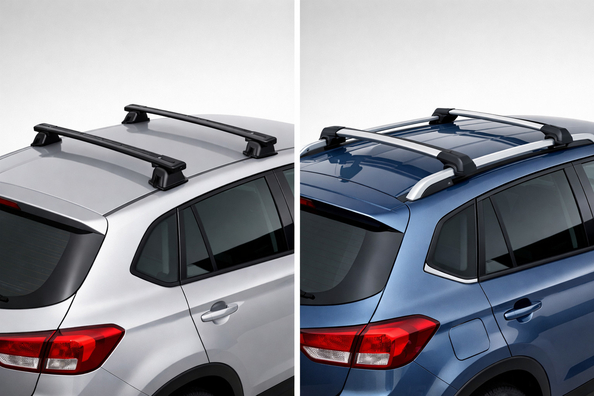
If your car has raised roof rails, in most cases it’s more cost-effective to choose a roof rack designed for them: fewer parts, easier installation, and the starting price is usually lower. If the roof is bare, that’s still a valid option, but the kit is more complex: you need a separate fitting kit, feet, and crossbars, so the final cost and the risk of a compatibility mistake are higher.
The main mistake with this kind of choice is looking only at the crossbars. You should compare the complete kit, the mounting type, noise level at speed, real load capacity, how easy it is to remove, and how often the rack will actually be used rather than just sitting on the roof.
The difference between these options isn’t only what the rack attaches to. For a bare roof, the system is usually built from three parts: a vehicle-specific fitting kit, feet, and crossbars. For raised rails, feet and crossbars are typically enough. That’s why rail-mounted solutions more often end up cheaper and quicker to install.
There’s another important detail: not all “rails” are the same. Raised rails with a gap between the rail and the roof, and flush (integrated) rails are different mounting types. If you don’t verify this before buying, you can end up with the wrong feet and unnecessary extra costs.
| Option | Strengths | Weaknesses | Who it’s for |
|---|---|---|---|
| Roof rack for a bare roof | Works for cars without factory rails; you can select a system for a specific model; there’s a choice of aerodynamic crossbars | More expensive kit; higher chance of selection errors; installation takes more time | Owners of sedans, hatchbacks, and crossovers without rails who truly need a roof rack |
| Roof rack for raised rails | Fewer components; simpler installation; often a lower starting price; easier to move and remove | You must clearly identify the rail type; not every system is equally good for heavy-duty scenarios | Those whose car already has raised rails and who want a practical kit without extra complexity |
DD Tuning expert comment: Most often people confuse raised rails with flush (integrated) rails and end up ordering the wrong feet. The second typical mistake is looking at the rack’s rating but not checking the vehicle roof limit. If you’re planning a roof box, bikes, or long cargo, first verify the mounting type, permissible weight, and the spacing between the crossbars.
Its advantage is that it solves the problem where there are no factory rails. But you pay for that with more complex selection. You need to match the body style, model year, the door opening shape, or factory mounting points if present. In an illustrative example, the complete bare-roof kit consisted of three parts and came to about $704.85.
In terms of noise, this option isn’t necessarily worse. If aerodynamic crossbars are used and everything is installed straight, the difference is often smaller than expected. But if you leave the crossbars on the car all the time without needing them, you’ll still get extra noise and added height.
Here the key advantage is simplicity. For raised rails you typically don’t need a separate fitting kit, and the starting price of the set is lower. In an illustrative example, the difference versus a bare roof was about $159.95, and in ready-made systems the gap started at about $144.
In practice, this is more convenient for those who install a rack seasonally: spring for bikes, summer for a roof box, and remove it in winter. On rails it’s also often easier to set the required distance between crossbars. For long loads, a common guideline is at least 600 mm between crossbars, and for most everyday scenarios it’s convenient to have around 700 mm.
But the word “rails” doesn’t guarantee universality. If the profile is non-standard or low, you may need different clamps. So even an option that looks simple shouldn’t be bought without verifying the rail type.
For occasional trips with a roof box or bike carriers, raised rails are almost always more convenient. Less fuss with installation, easier to remove after the season, and a lower chance of ordering the wrong parts. It’s a good scenario for family trips, skis, summer-house items, and hauling gear a few times a year.
A bare roof makes sense when there’s no other factory way to install a rack. If the vehicle has no rails, a correctly selected system fully covers the need: you can mount a roof box, bike carriers, or transport long items. You just need to accept upfront that selection is more technical here and “cheap and easy” is rarely the case.
For frequent highway driving, it’s not so much the roof type that matters as the crossbar shape. A more expensive aerodynamic system can be justified by less whistling, better accessory compatibility, and easier day-to-day use.
| Scenario | What to choose | Why |
|---|---|---|
| The car already has raised rails, and the rack is needed a few times a year | Roof rack for rails | Fewer parts, faster installation, usually a lower total price |
| Car without rails, need a roof box or bike carriers | Roof rack for a bare roof | This is the standard path for such cars; the key is accurate kit selection |
| Frequent highway trips | Whatever mounting type fits the car, but with aerodynamic crossbars | Noise is influenced more by crossbar profile and correct installation than by the roof type itself |
| Long loads or regular use | More often a roof rack for rails | Easier to set practical crossbar spacing and quicker to service the system |
| Minimum budget needed | If rails are present — a roof rack for rails | No need to buy a separate fitting kit for a bare roof |
Paying extra is justified not when you simply want “something better,” but when you have a specific scenario. Frequent highway trips, a regular roof box, multiple T-slot accessories, the need for quick removal and installation, locks, better aerodynamics — these are solid reasons to look at more expensive systems. If you only need a rack twice a year, it’s often better to put the difference not into the feet but into a useful accessory or the cargo module itself.
For cars without factory rails, it’s logical to start with a roof rack for a bare roof. If the car already has raised rails, it’s worth looking at rail-mounted systems. And when the task is mainly travel and lots of cargo volume, it’s often more practical to evaluate roof boxes right away rather than overpaying for a more complex base without need.
From a customer’s experience: the owner of a wagon with raised rails was looking for a kit for seasonal trips with a roof box and initially considered a more expensive low-profile system. After reviewing actual usage frequency, they chose standard aerodynamic crossbars for rails: the load capacity was sufficient, installation was simpler, and the budget remained for the box itself. In the end, the person got a quiet-on-the-highway setup without overpaying for features they don’t use daily.
In short: if raised rails are present, a rail-mounted roof rack is usually the better value. It’s simpler, more often cheaper, and less stressful to select. A bare roof isn’t a compromise — it’s simply a different mounting type where it’s more important not to make a mistake with the kit and to calculate the full price from the start.
The final choice should be based on your usage scenario: how often you install the rack, what you carry, whether highway quietness matters, and whether you need headroom for a roof box or bikes. This material is based on real selection experience, practice, and real-world use cases, so the main advice is simple: first verify the roof type and the vehicle limits, and only then compare brands and price.
| ✔ | For vehicles with raised roof rails, the roof rack is usually cheaper and easier to install, as it does not require a separate mounting kit. This is convenient if the system is needed not constantly, but a few times a year. |
| ✔ | Roof rails make it easier to remove and move the roof rack between seasons. For those who install a box or bike mounts occasionally, this saves time and reduces the risk of installation errors. |
| ✔ | A roof rack for a smooth roof provides a solution for cars without factory roof rails. With the right fit, it fully covers the need for a box, bike mount, or carrying long items. |
| ✔ | Noise at speed depends more on the shape of the crossbars and the quality of installation than on the roof type itself. So even a smooth-roof system can be fairly quiet if you choose aerodynamic crossbars and install them evenly. |
| ✔ | For long cargo and frequent use on roof rails, it is easier to set a practical distance between the crossbars and service the system faster. This makes it more convenient for regular trips and seasonal tasks. |
| ✘ | A smooth-roof kit is more difficult to choose: you need to check the body, model year, door opening shape, or factory mounting points separately. Because of this, there is a higher risk of compatibility mistakes and spending more money. |
| ✘ | Not all roof rails are the same, so even for the simpler option you need to identify their type precisely. If raised roof rails are confused with integrated ones, you may order the wrong feet. |
| ✘ | You need to calculate the full kit, not just the crossbars, because for a smooth roof the final price increases noticeably due to the installation kit and feet. In the example given, the difference with roof rails was about 145-160 dollars. |
| ✘ | Even if the system has a stated load reserve, you need to rely on the lower limit of the vehicle itself. Without this check, it is easy to exceed the permitted roof load. |
| ✘ | If you leave the crossbars on the car without need, there is extra noise, height, and load on the mounts. For those who use a roof rack rarely, this is a real drawback in everyday use. |
Shipping to EU
Wholesale and retail
Own warehouse
Опис продукту
Подарунки не надаються при оформленні покупки у кредит під 0,01% або при покупці частинами.