
07.09.2026
159
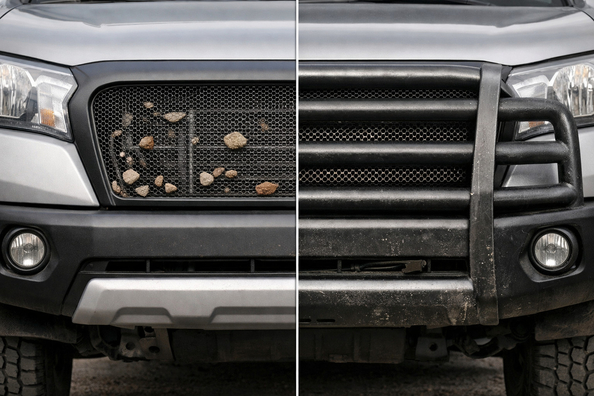
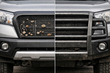
If the task is simple—catch stones, insects, leaves, and small road debris without ruining the factory airflow—a quality mesh made for a specific model usually wins. But if you need a rougher physical barrier in front of the vehicle’s nose, and you’re ready for more complicated installation, extra weight, and compatibility checks with the camera, sensors, and adaptive cruise control, then it makes sense to look at a reinforced metal grille or a guard.
There’s one key mistake here: people compare the name, not the design. Behind the words “grille,” “guard,” or “protection” can be very different products—from a thin model-specific mesh behind the factory grille to a heavy external steel system with separate brackets.
The choice boils down to a balance between three things: level of protection, impact on airflow, and installation complexity. A mesh sits closer to the radiator and does a better job catching smaller debris. A reinforced metal guard sits outside, holds up better to rough impact, but doesn’t always filter small stuff as well.
For most daily drivers that run in the city and on the highway and rarely see harsh conditions, a mesh is more practical. For heavy off-road use, service vehicles, or cars where the front end truly takes regular hard contact, a metal guard starts to make sense.
Installation. A model-specific mesh is often installed without drilling or cutting—using clips or brackets. A reinforced guard may require bumper removal, fitting work, sometimes relocating the camera and sensors, and even dealing with active grille shutters.
Airflow and practicality. A mesh that’s too dense or a poorly chosen universal option can reduce airflow. A guard doesn’t block the area with such fine openings, but any additional structure in front of the bumper makes access, washing, and inspecting components more difficult.
Noise and durability. Unwanted noises appear not because of the product type, but due to play, weak mounting, and poor geometry. In terms of service life, stainless solutions last longer; painted or coated steel also performs well, but handles chips and road salt worse.
Price. A mesh is usually cheaper both to buy and to install. A reinforced guard costs more due to the metal, brackets, more complex installation, and possible additional sensor kits.
| Option | Strengths | Weaknesses | Who it’s for |
|---|---|---|---|
| Model-specific mesh | Captures stones, insects, leaves well; often easier installation; lower risk of ruining the look and factory geometry | Needs to be kept clean; too fine a mesh can reduce airflow; weak universal options fit worse | City, highway, daily use, drivers who don’t need heavy-duty impact protection |
| Reinforced metal grille or guard | Stronger external barrier; better for harsher conditions; may have dedicated solutions for sensors | Higher price; more complex installation; possible conflicts with the camera, parking sensors, adaptive cruise control | Off-road scenarios, commercial vehicles, cars with a higher risk of impact debris up front |
DD Tuning expert comment: most often, the ones who make mistakes are those who buy a universal mesh “because it’s cheaper” and don’t look at the cell size and mounting method. The second common misstep is installing a heavy external guard on a car with a front camera or adaptive cruise without checking compatibility for the exact trim. If you’re unsure, check the mounting scheme first—not the design.
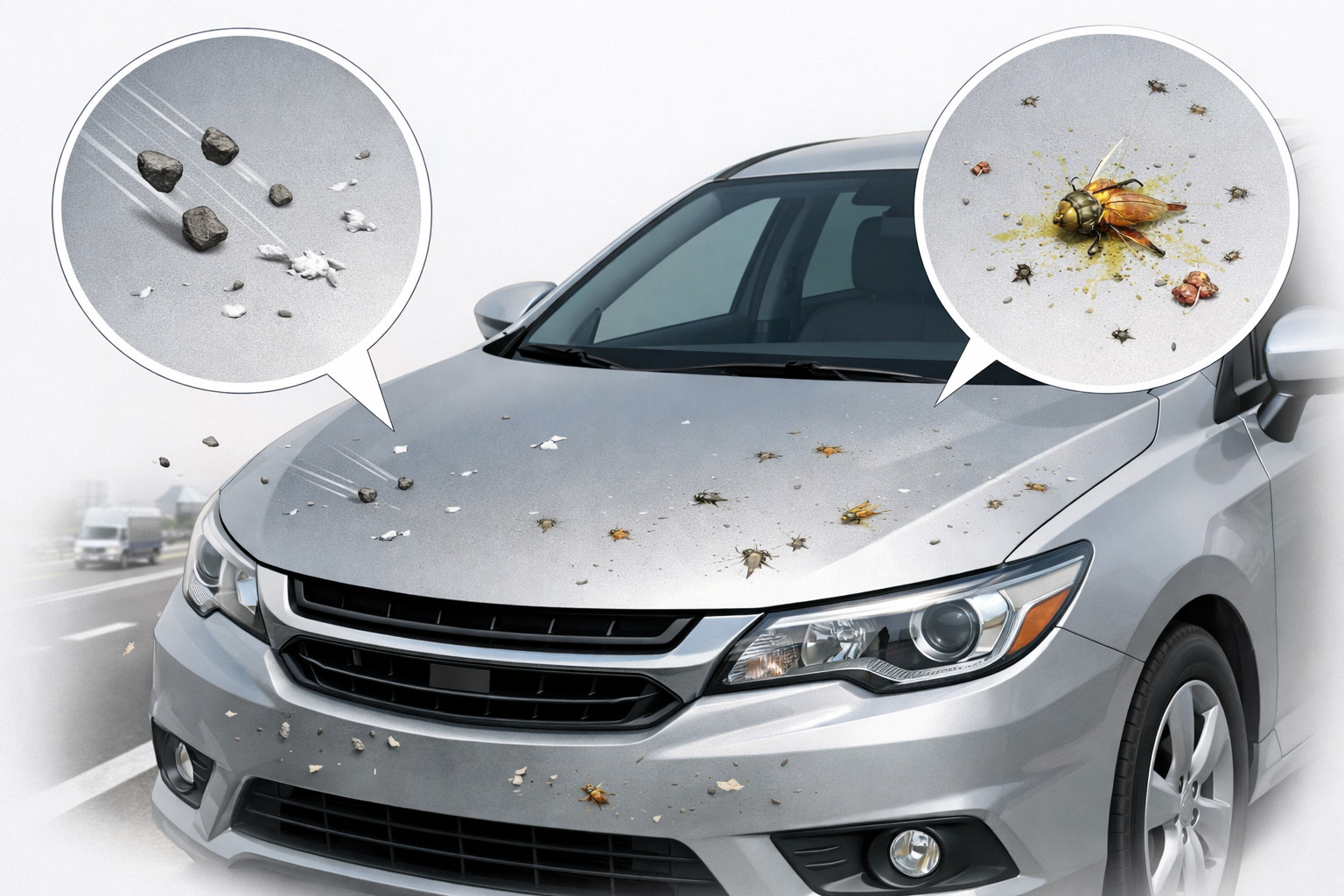
A good model-specific mesh wins because it works exactly as a filter in front of the radiator. It truly stops larger stones, insects, and leaves, and with the correct shape and reasonable cell size it doesn’t choke airflow the way a random universal insert can.
The strongest advantage is simplicity. If the product is made for a specific opening, it fits evenly, doesn’t scratch adjacent parts, and usually requires no cutting. The weak point is maintenance: after highway driving, poplar fluff season, or winter, the mesh must be cleaned—otherwise it becomes an airflow barrier itself.
This is no longer just protection from small debris—it’s a more heavy-duty external element. It handles rough contact to the front better, but you pay for it with weight, installation complexity, and questions about electronic compatibility.
On modern cars, the issue isn’t only the installation itself. The front camera, parking sensors, adaptive cruise control, and active grille shutters may require relocation or dedicated kits. That’s why this option should be chosen not “by eye,” but for the specific vehicle and its equipment.
For normal highway driving, city use, and out-of-town trips, a mesh is almost always enough. It covers the main everyday risk—stones and debris flying into the radiator—without overcomplicating the setup.
A reinforced guard wins where the vehicle often drives on bad roads, across gravel, construction sites, forest routes, or works in conditions where the front end regularly takes rough loads. But even in these scenarios, it’s worth weighing whether keeping the factory driver-assistance systems working correctly is more important.
| Scenario | Best choice | Why |
|---|---|---|
| City and highway every day | Model-specific mesh | Protects from typical debris without extra weight, complex installation, or interference with front-end systems |
| Frequent gravel driving | Mesh with rigid mounting or a reinforced grille depending on the vehicle | If the main risk is small flying debris, a mesh is enough; if there’s a risk of rough contact, you need a guard |
| Off-road or work-duty use | Reinforced metal grille or guard | Handles harsh conditions better and provides a stronger external barrier |
| Car with a camera, sensors, and adaptive cruise control | Preferably a model-specific mesh | Lower chance of electronic conflicts and expensive installation |
| Winter use with snow and ice | Any option only with regular cleaning | The problem isn’t only the product, but the buildup of snow, ice, and dirt that blocks airflow |
A more expensive option is justified not when you just want “something stronger,” but when there’s a real use case for it: frequent gravel, work trips, bad roads, risk of rough contact to the front end. In that case, it’s worth looking not only at radiator grilles, but also at more massive external solutions like bull bars and front bars.
If the car is driven mostly on asphalt, a more expensive heavy-duty setup often turns out to be an overpayment: it’s harder to install, heavier, and can bring related issues with sensors and the camera. In that case, it’s more logical to start with model-specific protection and sort out the selection nuances via the article about radiator grille tuning.
From a customer’s experience: the most common practical scenario is this—someone wanted protection from stones after a few radiator chips on the highway, but didn’t want to interfere with the car’s electronics. After comparing, they chose a model-specific mesh instead of a heavy guard, because installation turned out simpler, and for daily driving that level of protection was enough. The satisfaction isn’t in the “look,” but in the radiator collecting less debris and there being no extra questions for the factory systems.
If you need protection specifically from stones and debris in normal use, the better choice most often is a quality mesh made for a specific model. It offers the most reasonable balance of protection, preserved airflow, price, and installation simplicity.
A reinforced metal grille or guard is justified when the vehicle truly operates in tougher conditions and you knowingly accept more complex selection and installation. This material is based on real selection experience, hands-on practice, and real use cases: the main thing is not to buy “something stronger” at random, but to choose the design for your driving conditions and the specific vehicle’s equipment.
| ✔ | A high-quality model-specific mesh effectively blocks stones, insects, leaves, and small road debris, covering exactly the risks people face in everyday driving. |
| ✔ | A model-specific mesh is usually easier to install: it often goes in without drilling or cutting, on clips or brackets, so there is less chance of interfering with the car’s factory design. |
| ✔ | It is better suited for city and highway driving, as it provides noticeable protection without extra weight and without complications with cameras, sensors, or adaptive cruise control. |
| ✔ | A reinforced metal grille or guard creates a rougher external barrier and handles harsh conditions better, when the front end really takes hits from debris or operates on bad roads. |
| ✔ | For off-road, work, or gravel scenarios, such an option may be more appropriate, as it is designed for stronger physical contact at the front. |
| ✘ | The mesh needs to be cleaned regularly, otherwise after highway driving, winter, or pollen season it starts to let air through worse on its own. |
| ✘ | An overly dense cell pattern or a poorly chosen universal option can worsen radiator airflow, especially if selected without regard for a specific model. |
| ✘ | A reinforced guard is more expensive not only in itself, but also because of more complex installation, brackets, and possible additional sensor kits. |
| ✘ | It has a greater risk of compatibility issues with modern electronics: the camera, parking sensors, adaptive cruise control, and active shutters. |
Shipping to EU
Wholesale and retail
Own warehouse
Опис продукту
Подарунки не надаються при оформленні покупки у кредит під 0,01% або при покупці частинами.