15.09.2026
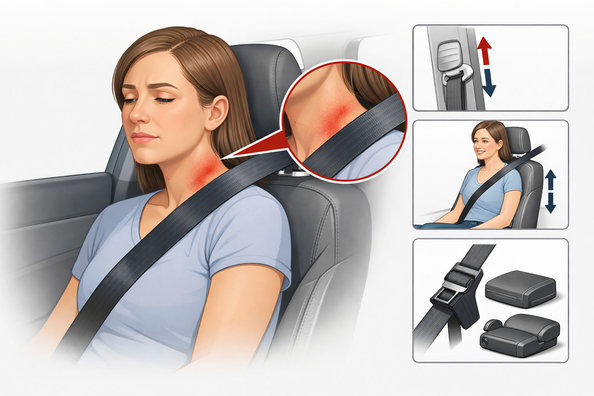
If the seat belt rubs against your neck, the problem is usually not the webbing itself, but its path relative to your height, seating position, and the seat. The shoulder strap should run between the neck and the shoulder and across the middle of the chest. If it rides up onto your neck, don’t loosen the belt or route it under your arm — first you need to fix the geometry.
In most cases, a step-by-step check helps: backrest angle, seat height, upper anchor point, and making sure the webbing isn’t twisted. And only if the belt already sits correctly but still chafes due to a stiff edge or sensitive skin does it make sense to think about a soft accessory.
Chafing appears when the shoulder strap runs too close to the neck or rests on the side of it. Most often this happens to shorter drivers and passengers, in cars with an unfavorable belt angle or with a limited adjustment range for the upper anchor.
The issue is made worse by a backrest that’s reclined too far, a low seating position, thick winter clothing, a stiff collar, and sensitive skin. A separate case is a belt that’s twisted, worn, or doesn’t retract smoothly: then it’s not only about comfort, but also about the condition of the system.
The key sign is simple: if after adjusting the backrest, seat height, and anchor point the strap still consistently rests on your neck, you’ve reached the limit of your car’s stock geometry for your height. If the position noticeably changes with one or two adjustments, the problem can be solved without complex modifications.
DD Tuning expert comment: the most common mistake is buying a clip right away or pulling the belt sideways without checking the seating position. In practice, you should first remove any twist, straighten the backrest, and find a working anchor height. A soft accessory only makes sense when the belt already runs correctly but still unpleasantly rubs against skin or clothing.
| Symptom | Likely cause | What to do |
|---|---|---|
| The belt constantly rests on the neck | Upper anchor set too high or geometry that doesn’t suit your height | Lower the upper point, raise the seat, set the backrest more upright |
| It chafes only with a jacket or a high collar | Clothing changes the contact angle and adds friction | Check the fit without outerwear, adjust the backrest and seat height |
| It feels fine at first, but after 15–20 minutes the belt creeps toward the neck | You slide during driving or the backrest is too reclined | Make your seating position tighter and more upright, check pelvis position in the seat |
| The belt presses with a narrow edge | The webbing is twisted | Pull the belt all the way out and straighten it without creases |
| The belt retracts reluctantly and lies unevenly | Wear, contamination, or a mechanism issue | Check the condition of the belt and guides; replace components if needed |
| It’s fine in the driver’s seat but chafes in the passenger seat | Different seating position or different seat setting | Adjust the seat and the upper point separately for that specific position |
What works is what changes the belt’s path itself, not what masks discomfort. The best order is: backrest not heavily reclined, seat at the correct height, upper anchor in the appropriate position, flat webbing without twists.
If after that the belt runs between the neck and shoulder but the edge still feels unpleasant, then you can reduce friction. For some people this is enough, especially for city driving or in summer when the skin is exposed.
Separately, it’s worth checking the technical condition: if the belt is worn, creased, or doesn’t retract well, no pad will make it normal. In that case, the right solution is not covers, but restoring proper OEM operation of the system.
A bad idea is to deliberately loosen the belt, route it under your arm, behind your back, or constantly pull it away from your neck with your hand. It removes the unpleasant feeling for a minute, but breaks proper contact with the chest and pelvis.
Clips that sharply pull the strap down or to the side are also questionable. They may give a short-term effect, but often create slack or change the belt position in the wrong place. The same applies to DIY guide modifications: sometimes people gain comfort, but it’s no longer a stock solution.
Soft pads aren’t all-powerful either. If the belt runs directly on the neck, a pad only makes the contact softer but doesn’t remove the root cause.
An accessory is appropriate when the geometry is already close to correct: the belt runs across the shoulder and chest, but the edge of the webbing chafes. In that scenario, you can look at seat belt covers and separately evaluate what a seat belt cover is for. Before buying, it’s useful to double-check the correct belt position so you don’t treat the symptom instead of the cause.
Replacing components is needed when the issue isn’t friction but a malfunction: twisting repeats, the webbing is damaged, the belt retracts poorly, the height adjuster doesn’t hold or sticks. Here, an accessory only distracts from the real failure.
| Solution | When it works | When it’s not worth spending money |
|---|---|---|
| Upper anchor adjustment | There’s enough height range, and you can move the belt off the neck onto the shoulder | You’re already at an extreme position and the path hardly changes |
| More upright backrest | The belt rides up to the neck due to a heavily reclined backrest | You already sit correctly, and the problem doesn’t change |
| Raise or slightly change seat height | You’re shorter, and the belt angle is too steep | The seat isn’t adjustable, or the new position worsens reach to the pedals and steering wheel |
| Soft seat belt cover | The belt sits correctly but irritates skin or collar | The strap runs on the neck and you expect the cover to change the geometry |
| Repair or replacement of OEM components | There’s wear, twisting, poor retraction, or a guide defect | The belt itself is fine, and the issue is only seating position and height |
| Clips and DIY position changes | May provide short subjective comfort | To get an effect, you have to pull the belt away from the chest, create slack, or change its stock routing |
From a customer’s experience: the most typical scenario is a shorter driver immediately looking for a pad because the belt scratches the neck in a summer T-shirt. After checking, it turns out the backrest is too reclined and the upper point isn’t set correctly. When the seating position is corrected and then a soft cover is added, the discomfort disappears without questionable modifications.
A seat belt rubs the neck mainly due to incorrect geometry: anchor height, seating position, backrest angle, or an unfortunate match between the car’s design and your height. So the correct order of actions is: first adjust the seat and belt, then check the condition of the system, and only after that use a soft accessory to reduce friction.
It’s not worth spending money on solutions that simply pull the strap away from the body or create slack. The rational approach is to keep correct belt fit and remove the real cause of discomfort. This material is based on real selection experience, practical work, and real-world usage scenarios.
Shipping to EU
Wholesale and retail
Own warehouse
Опис продукту
Подарунки не надаються при оформленні покупки у кредит під 0,01% або при покупці частинами.