29.08.2026
66
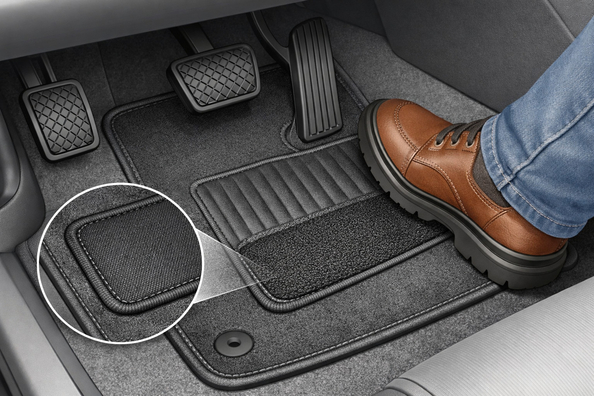
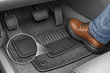
If the driver’s floor mat wears through quickly in the corner near the pedals, the problem is almost never just the material quality. In that spot your heel constantly rubs against the support, twists slightly while working the pedals, and sand, salt, and moisture act like an abrasive. The most practical approach is usually this: eliminate mat play, move the wear onto a replaceable heel pad, and don’t let dirt build up right under your heel.
To avoid wasting money blindly, first figure out what exactly is wearing out: only the mat surface, the mat also shifts, or the factory flooring under it is already scuffed. That determines whether a local fix is enough or you’ll have to replace the mat completely.
In the area near the pedals, the load isn’t spread across the whole mat. The driver’s heel stays almost in one spot, and your foot pivots around it as you move between the gas, brake, and clutch. Because of that, the material isn’t just pressed down—it gets worn away by constant localized friction.
Wear speeds up if the mat is soft, wet, or packed with sand. In winter and during the shoulder seasons it’s much more noticeable: wet grime and salt get into the fibers or texture, and the area under the right heel starts acting like sandpaper.
DD Tuning expert comment: The most common mistake is buying a new mat but keeping the same torn fasteners or play. The second typical mistake is installing a thick pad without checking pedal travel. If the wear area is stable and the mat lies firmly, a heel pad works well; if the mat moves around, you need to start with the fit, not with a patch.
| Symptom | Likely cause | What to do |
|---|---|---|
| Wears through exactly under the right heel, without shifting | Normal foot path, but constant localized friction | Install a heel pad or switch to a mat reinforced in that area |
| Wear goes diagonally or closer to the edge | The mat is shifting or doesn’t fit the shape | Check retainers, switch to a vehicle-specific mat |
| The material quickly becomes rough, damp, stiff | Sand, salt, water, wet cleaning without drying | Regularly wash out abrasives and dry the mat on both sides |
| Not only the working area is torn, but also the mounting holes | Constant play and movement on the floor | Replace the mat, restore proper fixation |
| The factory floor covering under the mat is already scuffed | The problem was ignored for a long time or the mat was unsuitable | Eliminate shifting, replace the mat, then protect the working area |
A heel pad is the best solution if the wear is localized and the mat itself is still in good shape. It transfers friction to a replaceable part that’s cheaper to swap than the whole set. For a daily driver with high mileage, this is often the smartest option even before a hole appears.
A vehicle-specific mat with OE-style fasteners is needed when the issue is not only wear but also shifting. If a mat made for your car sits tight and has no play, the heel contact zone becomes predictable and the wear becomes manageable.
Regular cleaning also works, but only as support. If every few days or at least once a week you remove sand and salt from the pedal area, the material wears slower. It’s important to dry both the top side and the underside.
A stiffer winter mat makes sense where there’s a lot of water, de-icing chemicals, and dirt. In those conditions, soft carpet often loses out, while denser polymer solutions last more calmly.
A self-adhesive patch may provide a short-term effect, but on a dusty, damp, or textured surface it often peels off. If the mat has already started sliding on the floor, the patch will simply move with it and won’t solve the root cause.
A second mat on top, a towel, or a flipped old mat is a bad idea. It doesn’t relieve the load properly and can create a pedal safety issue. It also makes little sense to replace only the mat set if the mounting holes are already torn out or the mat’s shape was poor to begin with.
It’s also not worth installing an overly thick heel pad. In the working area near the pedals you need a thin protective layer, not a tall pad that changes your foot angle.
Accessories should be chosen for a specific scenario, not simply “to make it tougher.”
Practically speaking, it makes sense to install a heel pad on a clean and dry base, preferably a thin one, with reliable fixation at several points. This DIY install typically takes about an hour. But if the mat is warped, curled, or already touches a pedal, you should start by replacing the mat itself.
| Solution | When it works | When it’s not worth spending money |
|---|---|---|
| Heel pad | Localized heel wear, the mat lies flat, fasteners are intact | The mat shifts, the edge curls, or the floor under it is already damaged |
| Vehicle-specific mat with OE-style fasteners | A universal mat doesn’t match the foot path or has play | If the only cause is abrasive dirt and the fit is already correct |
| Regular cleaning and drying | There’s a lot of sand, salt, moisture, but the material is still alive | On an already holed mat without additional protection |
| Stiffer winter mat | Wet season, de-icing chemicals, daily use | If the main issue isn’t moisture but poor fixation |
| Self-adhesive patch | Only as a temporary measure on a flat, well-degreased surface | For long service life, on a damp or textured mat |
| Second mat on top | Not a proper solution | Not worth it at all due to pedal risk and zero root-cause elimination |
From a customer’s experience: a driver was looking for a way not to replace the whole set because of a worn corner under the right heel. After checking, it turned out the mat was still intact, but the contact zone was stable and the mileage was high, so he installed a heel pad and at the same time eliminated play in the mounting. As a result, the mat itself stopped wearing through, and maintenance came down to routine cleaning of dirt from the working area.
If a mat wears out near the pedals, don’t start with random patches or a second mat on top. First check whether there’s any shifting, whether the fasteners are torn out, and whether your heel is working along the wrong path. Then choose the solution: a heel pad for localized wear, a vehicle-specific mat for a problematic fit, a stiffer material for the wet season.
This approach is based not on theory but on real-world selection experience, practical work, and real usage scenarios. That’s why the main principle is simple: remove the cause first, and only then reinforce the mat where it actually carries the load.
Shipping to EU
Wholesale and retail
Own warehouse
Опис продукту
Подарунки не надаються при оформленні покупки у кредит під 0,01% або при покупці частинами.