13.04.2026
201
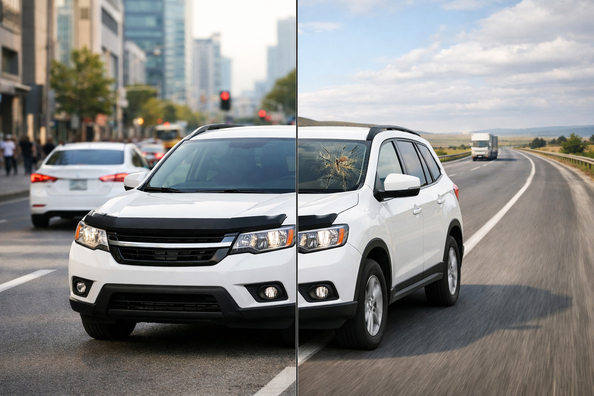

In short, a hood deflector is more justified on the highway than in the city. Its main effect appears at speed: it partially redirects the airflow with insects, fine debris, and some small stones upward, away from the leading edge of the hood and the windshield area. In city driving the gain is usually more modest, so a low-profile option—or skipping the accessory altogether—often makes more sense there.
The key is not to treat a deflector as complete chip protection. It’s always a compromise between shape, fit accuracy, noise at speed, ease of cleaning, and price. So you shouldn’t choose the “tallest” or the “most expensive,” but the type that matches your real driving route.
The idea is simple: where the car spends more time and what effect you actually need. If it’s intercity trips, night highway driving, lots of insects and gravel kicked up from wheels, a deflector has practical value. If the car is used mostly in the city, its benefit is noticeably smaller, because at lower speeds the accessory’s operating principle shows up less.
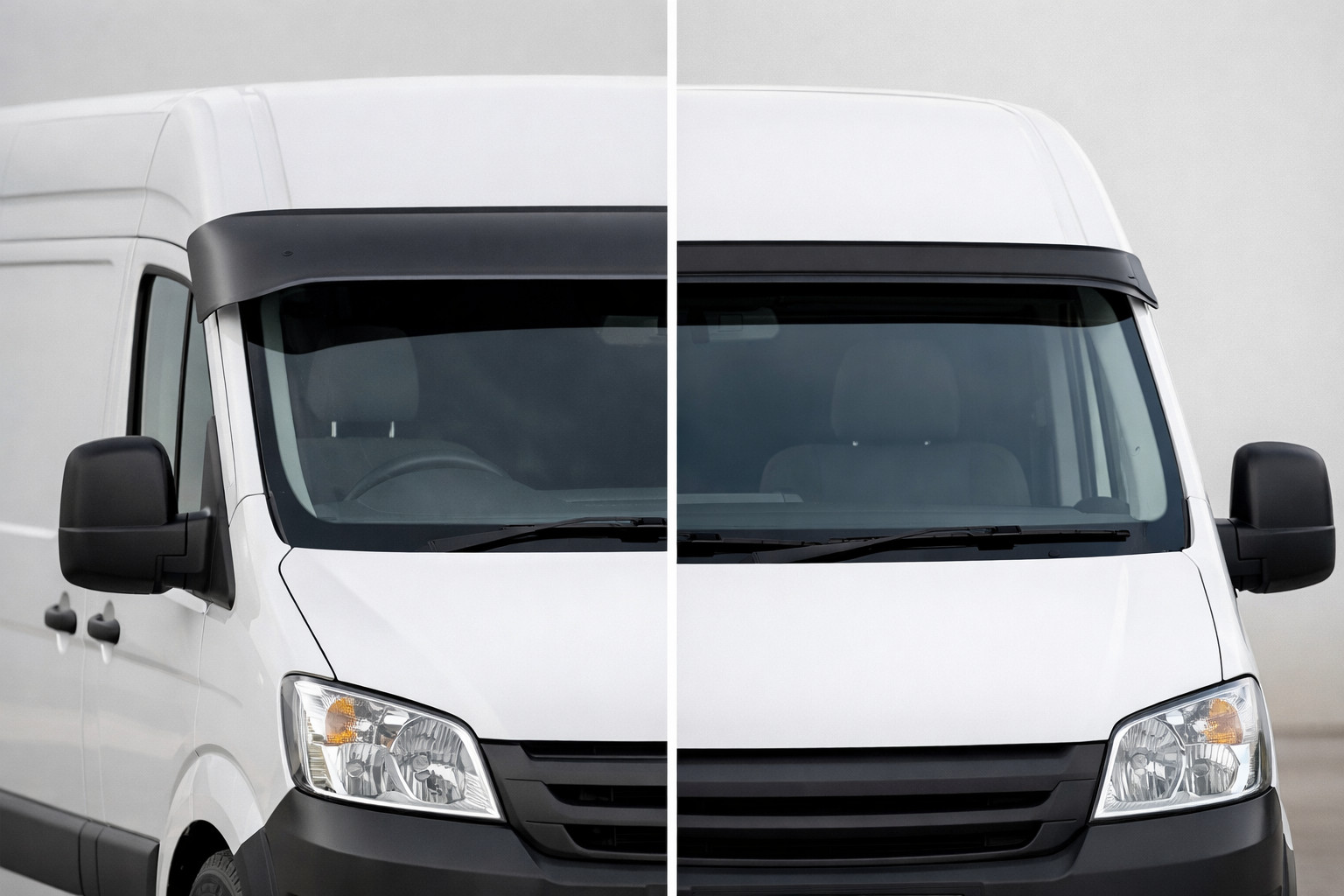
The second layer of the choice is the design type. A high-profile vehicle-specific deflector works better at speed because it lifts the airflow more. A low-profile one sits closer to the hood, changes the car’s look less, and protects the leading edge more than it truly “reshapes” the air. Universal solutions exist, but almost always involve more compromises in fit and noise.
| Option | Strengths | Weaknesses | Who it’s for |
|---|---|---|---|
| High-profile vehicle-specific | Redirects airflow upward better, more useful on the highway, often provides easier access for cleaning | More noticeable visually, more expensive; with a poor fit it may whistle or vibrate | Those who regularly drive between cities and want maximum benefit specifically at speed |
| Low-profile vehicle-specific | Sits tight, looks more subtle, better for protecting the hood’s leading edge | Influences the airflow less, so the highway benefit is more modest | Those who mostly drive in the city but want a neat, vehicle-specific accessory without extra bulk |
| Universal mesh or universal option | Can help when there’s no vehicle-specific solution or when adaptation is needed for a non-standard front end | Worse fit accuracy, more compromises in looks, noise, and durability; usually a shorter warranty | For rare models, commercial vehicles, or as a forced budget option |
DD Tuning expert comment: Most often, owners of purely city-driven cars make the mistake of installing a deflector expecting a big effect—and then don’t see a difference. The second typical issue is choosing a universal or body-incompatible option to save money: on the highway this is what most often causes whistling, vibration, and extra dirt around the mounting area.
This is the most logical choice for highway driving. These deflectors lift the airflow more noticeably, so they work better against insects and some fine debris. On some models there’s a gap above the hood, which makes cleaning easier. With proper kits, installation is drill-free—via factory points or tape. The downside is that this type reacts more strongly to an imprecise fit: if the geometry or mounting isn’t ideal, noise and micro-vibrations at speed are possible.
This is a compromise option for those who care about a tidy look and protection of the hood’s leading edge rather than maximum aerodynamic effect. It sits tighter, is less conspicuous, and usually suits a city car better. But in terms of actually redirecting the airflow, it helps less than a high-profile one. If you only drive on the highway occasionally and your main priority is a practical, not overly bulky accessory, this is often the most sensible format.
It’s best seen not as a better alternative, but as a backup scenario when no vehicle-specific solution exists. Universal mesh designs come for different hood-width ranges, but the problem is that width isn’t the whole geometry. Because of that, the fit is rarely as precise as with a vehicle-specific product. Add the shorter warranty on some of these solutions, and it becomes clear why they’re less desirable for highway use.
For service life, not only the brand matters but also the material. Acrylic handles sun exposure better and is less prone to fading, polycarbonate is more impact-resistant but scratches more often, and ABS works fine in everyday use if the product isn’t overheated and is made well. In other words, the extra money often isn’t for the name, but for better shaping, more stable material, and more accurate compatibility.
For city driving, a hood deflector is not a must-have accessory. If the car lives in traffic, parking lots, and short trips, its benefit is rarely strong enough to justify extra maintenance or a change in appearance. In that mode, people either install a low-profile vehicle-specific option or honestly drop the idea.
For mixed use, it depends on how often you go out on the highway. If you drive on the highway every weekend or a few times a month, a low-profile vehicle-specific option still makes sense; but if intercity mileage is regular, a high-profile one already looks more practical.
For постоянна highway use, especially during insect season, the high-profile vehicle-specific solution almost always makes the most sense. That’s where its main advantage is felt. If silence, minimal visual change, and zero risk of whistling are critical for you, there’s also an honest answer: sometimes it’s better to go without a deflector.
| Scenario | What’s best to choose | Why |
|---|---|---|
| Mostly city, short daily trips | Low-profile vehicle-specific or no deflector | At low speeds the gain is small, so there’s no point overpaying for a more aggressive design |
| City plus occasional highway trips | Low-profile vehicle-specific | Provides moderate leading-edge protection and doesn’t change the car’s look too much |
| Regular intercity trips | High-profile vehicle-specific | At speed it delivers the core function of redirecting airflow better |
| Frequent night driving or peak insect season | High-profile vehicle-specific | Here the difference in usefulness is more noticeable than in city driving |
| Rare car model or non-standard front end | Universal option only if there’s no vehicle-specific one | This is a forced compromise, not an equal replacement for precise vehicle-specific fit |
A more expensive deflector is justified not when you simply want “the best,” but when the car genuinely spends a lot of time on the highway. Then precise vehicle-specific fit, more stable mounting, better material, and a longer warranty make a noticeable difference: less chance of whistling, easier maintenance, and less risk that the accessory starts living its own life at speed.
To avoid overpaying blindly, it’s worth separately reviewing the pros and cons of a deflector, the hood deflectors section itself, and the comparison of high vs. low profile. If the car is almost always in the city, a more expensive solution often doesn’t provide enough additional benefit to pay off in real use.
From a customer’s experience: a crossover driver was looking for protection from insects and fine gravel because they drive between cities every week, but didn’t want a universal accessory with a compromise fit. After verifying the body, they chose a vehicle-specific high-profile option instead of a cheaper universal one. As a result, they got less insect buildup in the front area and had no issues with drilling or additional modifications.
On the highway, a hood deflector is more useful than in the city—and that’s the main takeaway. If you need maximum practical benefit at speed, look toward a high-profile vehicle-specific option. If the car is mostly urban, a low profile is often enough, or even the choice to install nothing at all.
This conclusion is based not on abstract promises, but on real selection experience, practice, and real use cases: where the car is driven, how the accessory is installed, what happens at speed, and whether it justifies its price in your specific driving pattern.
| ✔ | On the highway, the deflector really makes a more noticeable difference: it partially deflects insects, small debris, and some stones above the front edge of the hood and windshield. |
| ✔ | The model-specific version is usually installed without drilling, using factory mounting points or tape, if it is matched precisely to the body and model year of the car. |
| ✔ | The high-profile deflector works better at speed, so for regular intercity driving it is more practical than a low-profile one. |
| ✔ | The low-profile version is less noticeable from the outside and is better suited for a city car when you need neat protection of the front edge without a bulky structure. |
| ✔ | With the gap above the hood, the structure is usually easier to wash by hand, and proper model-specific fitment reduces the risk of whistling and vibrations. |
| ✘ | For city driving, the benefit is often small, because at low speeds the deflector’s operating principle is less noticeable. |
| ✘ | This is not full protection against chips, but only a partial redirection of the flow, so you should not expect complete absence of damage. |
| ✘ | High-profile models depend more on precise fitment: with poor installation, whistling, micro-vibrations, or highway noise may appear. |
| ✘ | Universal solutions often have a worse fit, more compromises in appearance and noise, and they are less desirable for highway use. |
Shipping to EU
Wholesale and retail
Own warehouse
Опис продукту
Подарунки не надаються при оформленні покупки у кредит під 0,01% або при покупці частинами.