20.08.2026
214
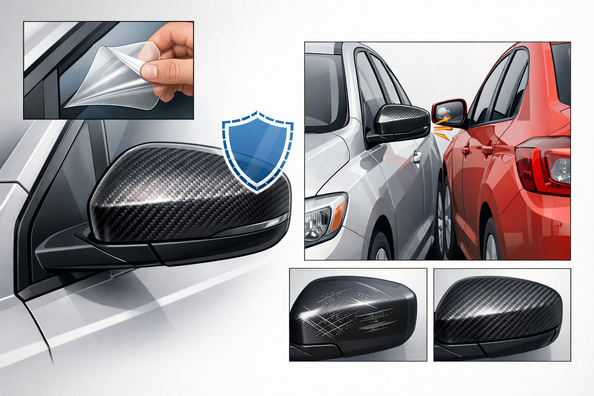

In tight yards, mirror caps suffer first because they’re one of the outermost points of the bodywork at the height of a wall, gate, post, or someone else’s mirror. The good news is that not every white scuff means repainting. The bad news: if the mark already catches a fingernail or the housing has shifted, polishing alone won’t solve it.
A sensible order of actions is: first distinguish transferred чужої paint from a deep scratch, then eliminate the actual cause of contact, and only after that invest in protection or replacement of the part. That’s exactly how you usually avoid paying twice.
In a narrow entry, the mirror often sticks out beyond the door’s width and is the first to touch an obstacle. This is especially noticeable when reversing: the body’s trajectory has already straightened out, but the mirror cap is still passing close to a wall or pillar. If you don’t fold the mirrors in advance, you may be short on width by literally a few centimeters.
The second reason is the design of the assembly itself. On cars without power folding, drivers fold the mirrors less often before a maneuver, and on gloss black caps even fine “spiderweb” marks from contact or washing are far more visible. If the cap is removable, the issue is easier to solve by replacement; if the folding mechanism is also damaged, the repair is a different story in complexity and price.
DD Tuning expert comment: The most common mistake is looking for a “stronger polish” when the mark is already deep or the cap has shifted. The second typical mistake is installing protection without eliminating the actual contact scenario in the yard. If contact repeats daily at the same point, first check the width margin with the mirrors folded, and only then choose film, a cover, or a new cap.
| Symptom | Likely cause | What to do |
|---|---|---|
| White or gray mark that partially comes off after washing | Transferred paint from another object or light contact | Carefully clean the surface, assess the clear coat after washing, don’t jump straight to aggressive polishing |
| Fine circular haze over the whole cap | Brush wash or harsh wiping | Stop using brush washes, do only gentle restoration, then add protection |
| One deeper line along the outer edge | Wall, pillar, gate, another mirror | Check the maneuver and entry point; if the mark is deep, move to touch-up paint or cap replacement |
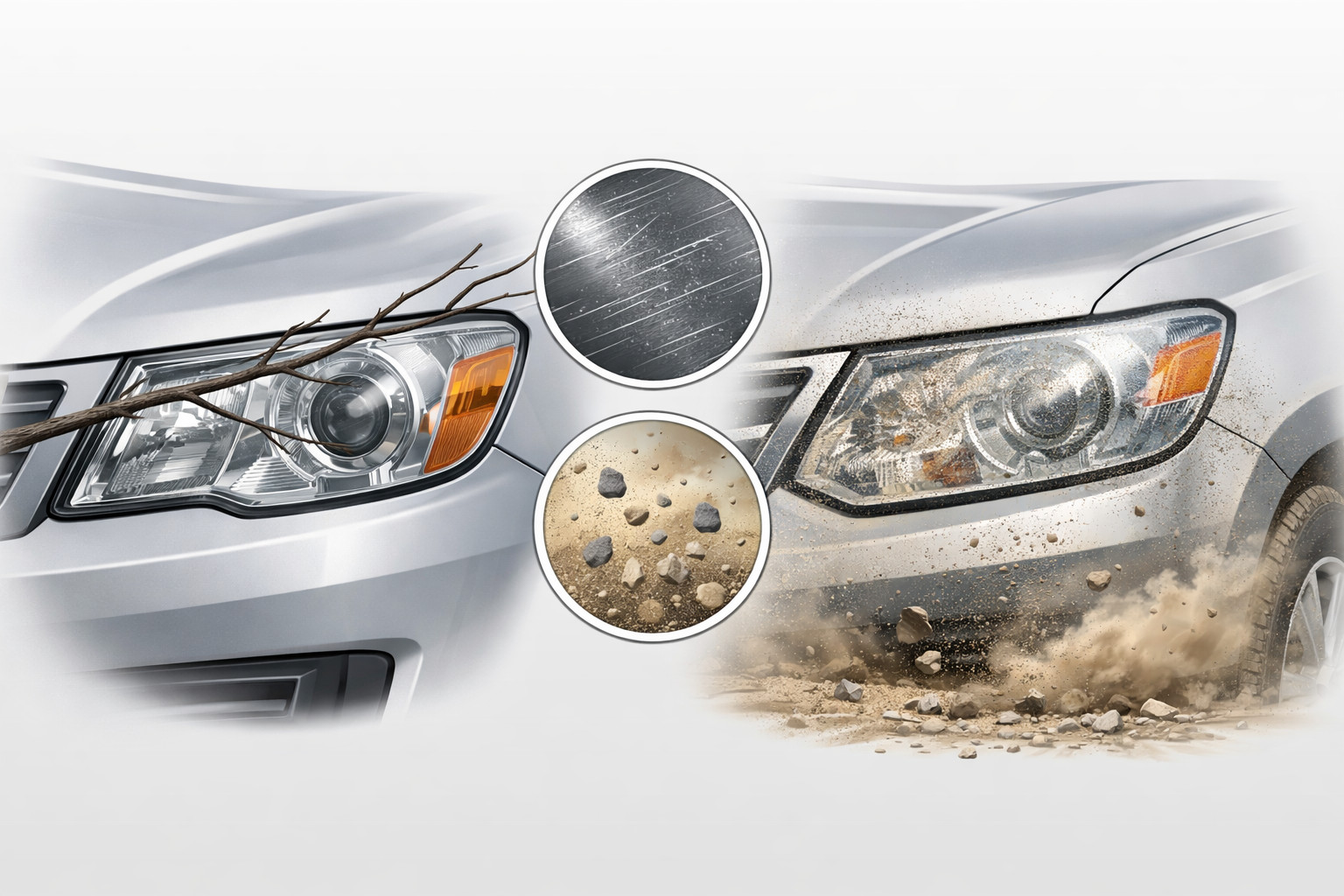
| Many thin longitudinal lines at the same height | Bushes, branches, mesh | Remove the постоянную obstacle or change your trajectory; for prevention, use a protective layer |
| The cap sits crooked, there’s play, the mirror folds worse | Damaged clips, housing, or mechanism | Don’t press or snap it in by force; check the fasteners; if needed, replace the cap or the assembly |
| Crack, chipped edge, plastic visible | Impact, not just a scuff | Don’t waste money on “magic” polishing—plan a repair or replacement right away |
The best approach is a combination of three things. First, fold the mirrors before entering a tight spot, not after the first touch. Second, set a consistent parking reference for yourself: wheel position, distance to the wall, stopping point. Third, protect the cap where the risk repeats every day.
For preventing minor scuffs, a model-specific protective film for the back of the mirror or the cap works well. It takes the brunt of light rubbing and small marks, and minor blemishes on quality film can become less noticeable with heat. If the car is parked in a very tight home garage and contact is likely while standing still, a soft mirror cover can sometimes be appropriate.
If your fingernail already catches, don’t spend months polishing the same spot. In that situation, either touch-up and локальный repair works, or replacing the cap if it’s modular and easier to renew than to restore the gloss without a trace.
If the factory cap is intact and the problem is постоянные minor touches, it makes sense to look at mirror covers as an outer layer that’s easier to обновить than working with the clear coat each time. When the damage has gone beyond cosmetics and there’s play, a cracked housing, or questions about the folding mechanism, you need not decorative solutions but mirrors or complete mirrors.
Replacing the cap makes sense when it’s removable, the clips are intact, and the whole assembly works normally. But if the mirror has heating, blind-spot monitoring, memory positions, or power folding, forcing disassembly without understanding the design can easily make the repair more expensive than it was at the start.
| Solution | When it works | When it’s not worth spending money |
|---|---|---|
| Fold the mirrors before entering | When the issue is being short by a few centimeters in a yard or garage | When contact happens even with the mirror folded, or it’s not the cap that’s hitting but the door or fender |
| Protective film | When there’s regular light rubbing, minor bushes, everyday scuffs | When a strong hit, dent, or deep impact against an obstacle is expected |
| Soft mirror cover | When the car is parked in a very tight home spot and the risk is the same every day | When the problem occurs while driving, not while parked |
| Gentle polishing | When the mark is superficial and your nail doesn’t catch | When there’s a deep scratch, crack, or chip |
| Touch-up paint or local repair | When the damage is deeper than a surface scuff but the cap is intact | When the cap is cracked, the clips have spread, or the housing is deformed |
| Replacing the cap or the whole mirror | When the part is modular, broken, or visually can no longer be restored properly | When there’s only transferred paint or light haze that can be fixed more simply |
From a customer’s experience: the daily issue was always the same—a narrow entry between a wall and a neighboring car, where the right mirror kept catching a slight touch. After checking, it turned out there was no deep scratch, but the entry trajectory repeated contact at the same point. The person started folding the mirror before the maneuver, added protection to the cap, and stopped wearing down the gloss with constant polishing.
In tight yards, there’s no single “magic” product that works. What works is the habit of folding mirrors before the maneuver, controlling your trajectory, and properly protecting the cap where light contact repeats constantly. And if the mark is already deep, it’s better to move straight to repair or replacement rather than hope polishing will hide everything.
This material is based on real подбор experience, practice, and real usage scenarios: tight yards, garages, daily parking, and typical damage to mirror caps. So the main advice is simple: first find the cause of contact, then choose protection—not the other way around.
Shipping to EU
Wholesale and retail
Own warehouse
Опис продукту
Подарунки не надаються при оформленні покупки у кредит під 0,01% або при покупці частинами.