21.09.2026
242
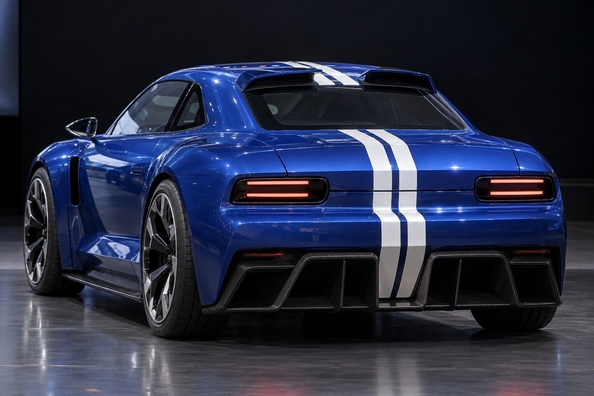

Renault 8 Gordini Concept is a two-seat electric coupe with a single 270 hp electric motor and rear-wheel drive, which Renault unveiled on 24 September 2026 at the closed Renault Carwalk event. The public will see the car at the Paris Motor Show on 12–18 October 2026. It is a one-off show car created in honor of the 1964 Renault 8 Gordini sedan: it will not go on sale, and after the show it will move to the future Renault Collections museum in Flins.
Contents
Renault is consistently reimagining its classic models in electric form. Before the “eight,” the brand presented the R17 restomod together with designer Ora Ïto and the Renault 5 Diamant concept, and now it has taken on the compact sports sedan from the sixties, which in France is still remembered as a “school desk” for an entire generation of racers.
The project was created from start to finish by Renault’s own designers: the brand announced an internal competition that received more than 300 sketches. The two best projects were built as 2:5 scale models, and the final one was chosen from them. Renault design director Alexandre Malval explains the idea like this: the team wanted to evoke emotion by combining the brand’s heritage with modernity. Stylistically, the authors were guided by café racer culture—minimal unnecessary details, clean lines, and everything centered on the driver.
The premiere is aimed specifically at Paris: at the 2026 Paris Motor Show Renault Group is bringing six new vehicles, four of them concept cars, and the Renault 8 Gordini Concept is one of them.
Renault has revealed only a few numbers—which is typical for a show car. Here is everything that appears in the official press release:
| Parameter | Renault 8 Gordini Concept (2026) | Renault 8 Gordini (1964) |
|---|---|---|
| Body type | 2-door two-seat coupe | 4-door sedan |
| Powertrain | electric motor, 270 hp | 1108 cm³ gasoline engine, 95 hp (according to Renault) |
| Drive | rear | rear, rear-mounted engine |
| Length / width / height | 4 120 / 1 880 / 1 270 mm | — |
| Wheels | 19 inches front, 20 inches rear | — |
| Color | Bleu de France with two white stripes | blue with two white stripes |
| Battery, range, weight | not announced | — |
Renault does not disclose battery capacity, range, acceleration performance, or weight. According to calculations by the American outlet Jalopnik, the concept is about 15 cm longer than the original “eight,” more than 30 cm wider, and 10 cm lower. A width of 1 880 mm for a car just over 4 meters long is rally-car proportion, not that of a city coupe.
The main reference to the original is the color. The body is painted in Bleu de France, a three-layer pearlescent paint with a blue-tinted base, and two white stripes run from the front bumper to the rear tailgate. Exterior designer Kévin Goncalves emphasizes: in 1964 the stripes were simply applied as decals, but here they are a structural element of the body, not stickers laid on top of it.
What else is worth noticing:
The cabin is made without large touchscreens. Across the full width of the dashboard runs a strip of brushed aluminum; on it are round digital displays in thick bezels, like instruments from the sixties, and a separate gauge styled like a stopwatch. Controls are handled via physical rotary switches, toggles, and buttons. The bucket seats feature blue corduroy inserts and blue seat belts; the trim is Alcantara and leather, the pedals are perforated aluminum, and an embossed “8” recalls the model’s name.
No. Renault directly calls the car a one-off concept car that will not be sold. Head of advanced design Romain Gauvin told Jalopnik that today it is only a concept, the brand does not see a future for it, and the goal was to celebrate the Gordini name. After the Paris Motor Show, the coupe will become an exhibit at the Renault Collections museum in Flins, which is expected to open to visitors in about 15 months.
There are no prices, production plans, or a “limited series”—and most likely they are not worth waiting for. At the same time, such show cars are Renault’s way of gauging public reaction: that is how the path of today’s production Renault 5 and Renault 4 once began.
Renault 8 was produced from 1962 to 1976—it was a compact four-door sedan with a rear-mounted engine. In 1964, the Gordini version appeared, named after engineer Amédée Gordini, whom in France they nicknamed the “wizard” for his ability to tune engines. Displacement remained the same—1108 cm³—but power almost doubled: Renault now cites 95 hp. Later, in the second half of the sixties, the “Gordini” received a 1255 cm³ engine producing about 100 hp and a five-speed gearbox instead of a four-speed.
The car was sold only in blue with two white stripes, and that combination became its calling card. In rallying, the “eight” won Tour de Corse and other rounds, and from 1966 there was the one-make Coupe Gordini series—one of the first in Europe. An affordable price and rear-wheel drive made the model a “training desk” for many French drivers, including Jean Ragnotti, whom Renault mentions in the press release.
You will not be able to buy the Renault 8 Gordini Concept, but the ideas it is built on—sporty badges, neat chrome on the body, and a rear spoiler—are easy to transfer to your own car. The closest in spirit among production successors is the Renault Clio V: for it there is an RS rear emblem and stainless-steel RS fender trims, a DPT spoiler in gloss black, and a full window surround that gives the same effect as a chrome line along the side. Everything for this model is collected in the Renault Clio V tuning section.
For other models of the brand, see Renault emblems and lettering, chrome moldings and window surrounds, or the entire Renault tuning catalog. If there is no model-specific spoiler for your car, a universal spoiler will work—it is selected by the width of the trunk lid.
We deliver via Nova Poshta throughout Ukraine.
Shipping to EU
Wholesale and retail
Own warehouse
Опис продукту
Подарунки не надаються при оформленні покупки у кредит під 0,01% або при покупці частинами.