
































































 Author: Radomskyi Maksym Vasyliovych
If you need a heel pad specifically for everyday driving, winter, mud, and easy maintenance, EVA more often wins. But if the mat in the heel area wears out very quickly, the car drives a lot, and the owner is consciously ready to put up with a harsher feel, more complicated installation, and a higher price, then it makes sense to look toward aluminum.
The main mistake in this choice is to look only at the material. In reality, what matters is installation, behavior in wet conditions, noise under your foot, the presence of an anti-slip surface, the lifespan in your exact use case, and how easy it is to wash and dry the mat afterward.
What this choice is really about
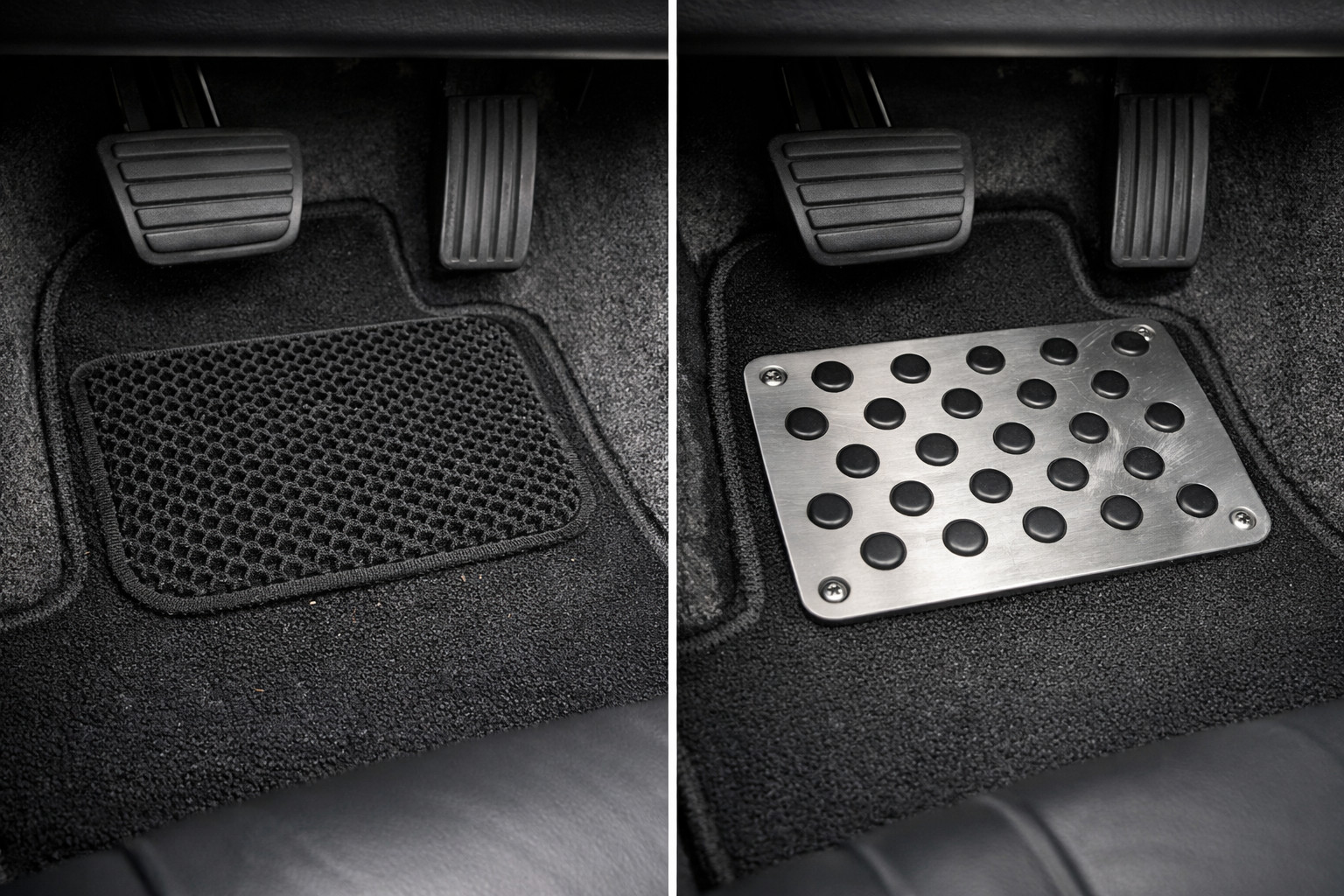
An EVA heel pad is a bet on practicality. It doesn’t fear water, dries quickly, tolerates frequent washing well, and usually doesn’t feel like a foreign hard patch under your heel. For a city car, this is often more important than maximum material rigidity.
An aluminum heel pad is a bet on rigid protection of a specific wear point. It’s appropriate where the load is truly high: high mileage, active pedal work, commercial use. But along with that come nuances: holes in the mat, fastening, possible noise, slipperiness without proper inserts, and the result depending on installation quality.
What criteria you should compare by
Installation. EVA is usually easier to install, but it’s critical to hit the actual heel trajectory. Aluminum more often requires holes and rigid fastening, so mistakes are costlier: if the plate is set crooked or misaligned, you’ll get less benefit and more inconvenience.
Noise and feel underfoot. EVA is quieter and softer in contact. The metal option can click or feel rougher, especially with hard-soled shoes and a surface without enough texture or rubber inserts.
Lifespan and practicality. Aluminum handles point abrasion better, but that doesn’t automatically make it the better choice for everyone. In dirt, water, and winter, EVA is often more convenient day to day: wash it, dry it, and keep going. For most daily trips, this tends to matter more than extra rigidity.
Price. EVA is usually noticeably cheaper. Aluminum only makes sense when you will actually use its strengths, not just overpay for looks.
Quick comparison of the options (table)
| Option | Strengths | Weaknesses | Who it’s for |
|---|---|---|---|
| EVA heel pad | Doesn’t absorb water, easy to wash, dries quickly, quieter in use, usually cheaper | Less rigid protection against point wear, a lot depends on installation accuracy | City driving, winter, family car, daily use without extreme wear |
| Aluminum heel pad | More rigid protection of the heel area, better handles aggressive localized load, more expressive appearance | More expensive, harder to install, can be noisy or slippery, potential issues with fasteners in wet conditions | High mileage, taxi, delivery, drivers whose mats wear out very fast |
DD Tuning expert comment: most often people don’t get the material wrong—they get the placement wrong. They install the heel pad symmetrically in the center of the mat, even though the real heel mark is offset. The second typical issue is choosing a metal plate without proper texture or inserts, which then causes noise and unpleasant slipping.
Detailed breakdown of each option
EVA heel pad
Its strong point is balance. The material is waterproof, isn’t afraid of moisture, dries quickly, and works well where the mat constantly deals with snow, wet shoes, and dirt. A ribbed or honeycomb surface helps not only with grip but also reduces the feeling of a slippery spot under the heel.
EVA’s weak point is not the material itself, but expectations. If a driver wears through the mat very aggressively and always in the same spot, aluminum will withstand that impact load longer. It’s also important to check mounting compatibility: being universal by material doesn’t mean the holes or fit will match every mat perfectly.
Aluminum heel pad
This option is justified when you need to protect the heel zone from wear as much as possible. Metal is more rigid, so in high-mileage scenarios it makes sense. Especially if the mat is expensive and its main issue is localized wear under the right foot.
But aluminum doesn’t forgive careless installation. Holes, self-tapping screws, rigid fixation, possible sealing concerns—all of this should be considered before buying. If the surface is smooth or the inserts are weak, the sole may slip; if the fastening is mediocre, in a wet environment you can get unpleasant little issues such as corrosion of metal elements.
Which option is better for different scenarios
For a typical city routine, short trips, family use, and seasonal slush underfoot, EVA is more practical. It’s cheaper to get into, easier to maintain, and doesn’t introduce extra nuances in the cabin.
Aluminum is better viewed not as “better overall,” but as a narrow solution for increased load. If the car works hard and the mats wear out regularly and quickly, the pricier option can pay off by extending the life of the contact area.
Use-case scenario and what’s best to choose (table)
| Scenario | What to choose | Why |
|---|---|---|
| City, daily trips, winter | EVA heel pad | Handles water, dirt, and frequent washing better; less chance of ending up with a noisy or slippery contact |
| Taxi, delivery, high daily mileage | Aluminum heel pad | More rigidly resists localized wear where the heel constantly works in one spot |
| Need a budget replacement without extra hassle | EVA heel pad | Lower cost and easier care deliver better everyday value |
| A sporty interior look matters | Aluminum heel pad | Creates a more rigid and visually expressive accent—if you don’t ignore surface safety |
Common mistakes when choosing
- Installing the heel pad not on the real heel mark. As a result, the wear happens next to the plate, not on it.
- Choosing aluminum just for the looks. If the car isn’t driven much, the overpayment doesn’t bring noticeable practical benefit.
- Not considering noise. For a quiet cabin and daily city driving, a rigid metal surface may be more irritating than expected.
- Ignoring the mounting type. Not every solution is equally convenient for a specific mat; sometimes the issue isn’t the heel pad, but how it sits on the base.
- Not thinking about winter and water. Holes and metal fasteners require a more careful approach than product photos suggest.
When the more expensive solution makes sense
Paying extra for an aluminum heel pad is justified not when you simply want “something more reliable,” but when there’s a specific problem: the mat wears out quickly in one spot, the car drives a lot, and the owner is ready for more meticulous installation. If these conditions aren’t there, a more practical result is often delivered by an EVA heel pad.
Before buying the expensive option, it’s useful to check when a heel pad is truly needed, and whether the task could be solved by choosing the right mat in the first place. If the cabin constantly lives in a wet mode, it’s also worth looking at how EVA mats are selected for a car model: sometimes a well-fitted base provides more benefit than an expensive overlay by itself.
From a customer’s experience: a driver was looking for an aluminum option because the previous mat wore through under the heel in less than a season. After inspection, it turned out the problem wasn’t only the wear, but also an incorrect foot support trajectory. In the end, he chose an EVA heel pad with precise placement along the heel mark and was satisfied, because he got quiet operation, easy care, and solid protection without unnecessary installation complexity.
Conclusion
For most drivers, an EVA heel pad will be more practical: it’s cheaper, quieter, easier to maintain, and fits real everyday use with water, dirt, and frequent cleaning better. Aluminum makes sense when the main goal is to protect the heel area as rigidly as possible under high mileage, and you consciously accept more complex installation and its side nuances.
The key to the right choice is not the material on its own, but your driving scenario, the heel contact point, and installation quality. This material is based on real selection experience, hands-on practice, and real use cases, so the main takeaway is simple: for an everyday daily car, EVA is most often enough, and aluminum is worth buying for a specific load, not “just in case.”
How it works
- Assess your driving scenario First, determine exactly how the car is used: daily city trips, winter, mud and frequent washing, or high daily mileage and heavy local wear under the heel. For everyday use, EVA is usually more practical, while for intensive use, aluminum may be needed.
- Check the actual wear point Do not choose a heel pad based on material alone — it is important where your heel actually rests while driving. If the pad is placed not on the real heel mark, the wear will go next to it, and it will be less useful.
- Compare installation and fastening EVA is usually easier to install, but it also needs a precise fit. The aluminum version often requires holes and rigid fastening, so before buying, it is worth assessing whether the mounting is compatible with your mat.
- Consider noise, slipping, and care EVA is quieter, softer in contact, does not fear water, and dries quickly. Aluminum can be noisy or slippery without proper texture or inserts, and it also requires more careful handling in wet conditions.
- Choose the solution for your mileage and budget If you need an affordable and practical replacement for everyday use, choose an EVA heel pad. If the mat wears out quickly in one spot, the car is driven a lot, and you are ready for a more complex installation, then there is a reason to choose the aluminum version.
Pros and cons
The EVA heel pad does not absorb water, dries quickly, and handles winter, dirt, and frequent washing more easily. For daily driving, this reduces the hassle of maintenance.
It is quieter and softer underfoot, so there is less chance of unpleasant noise or a hard feel under the heel. This is important for a city car and a quiet cabin.
EVA installation is usually simpler, and the price is lower than for the aluminum version. If you need a budget-friendly replacement without unnecessary complications, this is the more practical solution.
The aluminum heel pad handles localized wear in the heel area better. It makes sense for high mileage, taxis, or delivery, where the load is really heavy.
Aluminum gives a firmer and more expressive accent in the cabin. If appearance matters in addition to protection, this option may be appropriate.
EVA provides weaker protection against very aggressive localized wear if the heel is constantly working in one spot. In that scenario, aluminum will last longer.
For EVA, installation accuracy is important: if you do not hit the actual heel track, the heel pad will not provide the desired effect. The material’s versatility does not guarantee a perfect fit on any mat.
The aluminum heel pad is more expensive and more difficult to install, as it often requires holes and rigid fastening. Mistakes during installation are more costly here.
The metal version can be noisy, feel rougher, and even slip without proper texture or inserts. In a humid environment, there is also a risk of unpleasant mounting issues.