 Author: Radomskyi Maksym Vasyliovych
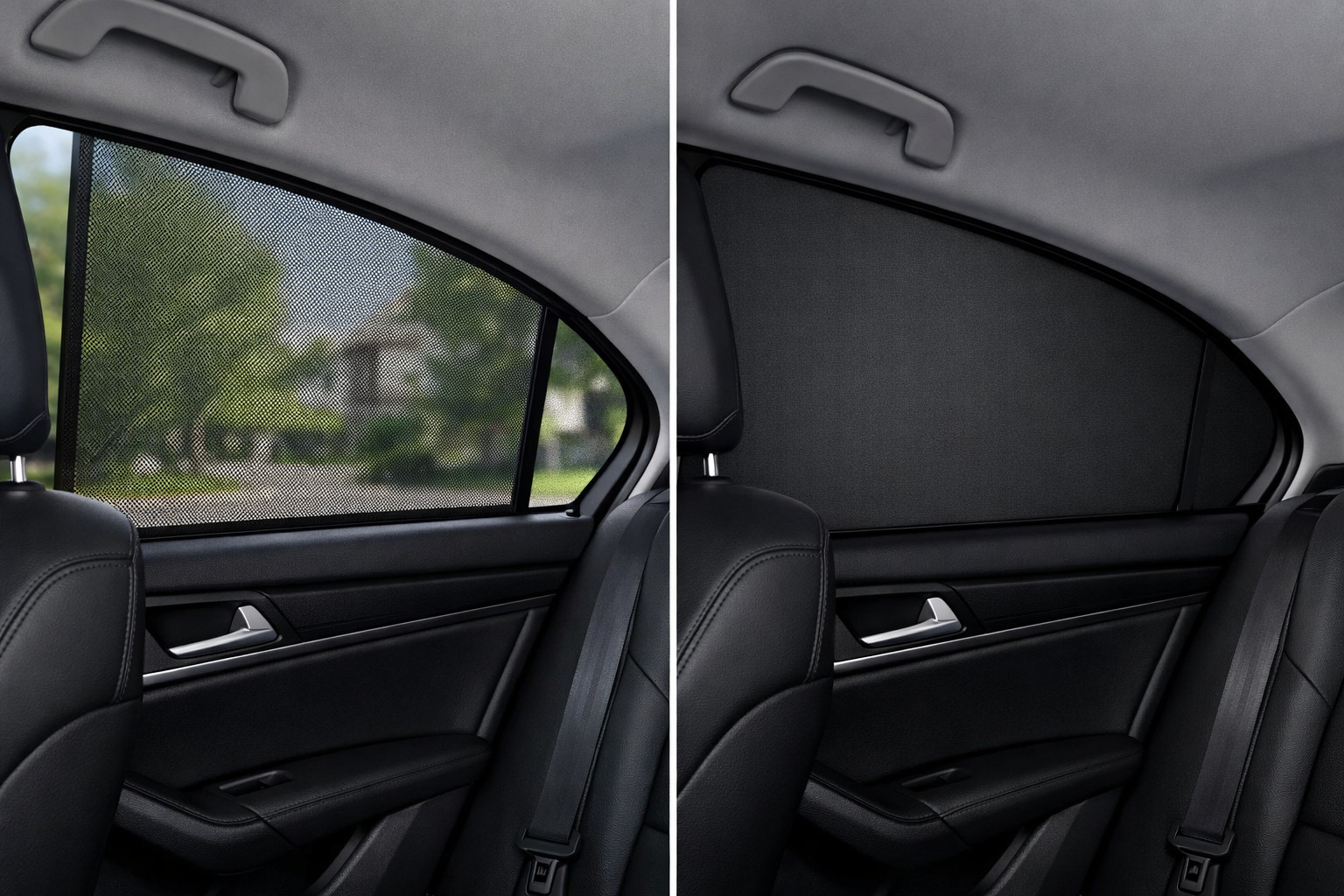
If the car drives around the city or on the highway every day, mesh sun shades are usually the better choice. They cut direct sunlight and glare, but don’t reduce visibility as much and don’t turn the cabin into a dark compartment. Solid shades win not while driving, but when parked—during sleep in the car, camping, and whenever you need privacy.
The key mistake is looking only at the material. In real use, the result is decided by a gap-free fit, the mounting method, behavior at speed, and whether you need to drive with the shade on or just survive the heat in a parking lot.
What the choice is really about
A mesh shade lets some light and air through, so it works better in everyday routes: city driving, kids in the back, short stops, airing out. A solid, opaque shade blocks almost all light, giving maximum shade, but it’s worse for driving because of reduced visibility.
Simply put: for daily driving you need balance; for parking you need maximum blackout. That’s why these two types don’t replace each other—they solve different tasks.
What criteria to compare by
- Installation: frame-mounted or vehicle-specific fit is more stable than suction cups and universal roller shades. The fewer gaps around the edges, the more noticeable the effect.
- Noise while driving: a poorly tensioned mesh can rustle or vibrate heavily on the highway; a well-fitted one is usually quieter.
- Durability: mechanisms, suction cups, and adhesive parts depend more on heat, dust, and frequent removal. Simple insert-type solutions are usually more stable in everyday use.
- Practicality: whether you can use the shade daily without taking it off for every trip, and whether passenger and driver visibility suffers.
- Price: a more expensive option only makes sense if you actually get a better fit, less noise, longer life, or full blackout for your scenarios.
There’s one more important criterion: legality. For windows that affect visibility while driving, solid blackout is almost always riskier than mesh, so local rules should be checked separately.
Quick comparison of options (table)
| Option | Strengths | Weaknesses | Who it’s for |
|---|---|---|---|
| Mesh shades | Better balance of shade, visibility, and ventilation; more convenient for daily use; less of a “closed-off cabin” feel | Won’t deliver complete darkness; the effect depends heavily on fabric density and edge gaps | For those who drive daily, carry kids, and want less glare without a sharp hit to visibility |
| Solid shades | Maximum shade, privacy, and blackout; better for parking, sleeping, and camping | Worse visibility; often excessive while driving; more legal concerns for certain windows | For those who often sleep in the car, leave it in the sun, or want to fully cover the cabin |
DD Tuning expert comment: most often people don’t get the material type wrong—they get the fit wrong. They buy a universal shade that’s “roughly the right size,” then are surprised by gaps, misalignment, and weak sun protection. If you need a shade every day, it’s better to look right away at stable mounting and a precise window-specific shape, not just how dark the fabric is.
Detailed breakdown of each option
Mesh shades
Their strength is that they don’t completely seal off the cabin. Fabric openness varies: denser models provide more shade and privacy, but let in less light. For daily driving this is usually a plus—sun hits less, passengers can still see outside, and the cabin doesn’t feel like a dark box.
Installation is critical here. If the shade is an insert type and closely follows the window frame, it works more steadily and quietly. If tension is weak or the edges leave large gaps, both the heat-blocking effect and acoustic comfort drop. That’s why two similar meshes in different cars can feel very different.
In terms of durability, mesh is often more practical for the daily “install and forget” cycle. But it won’t solve full blackout: in midday heat, light will still get through—especially around the edges and across large glass areas.
Solid shades
Solid material works where you need the maximum: sun protection, privacy, overnight stays, camping, long parking. If the goal is to truly darken the cabin, mesh can’t compete here. An opaque shade delivers exactly the effect people buy it for.
But while driving, this solution is often too restrictive. Visibility drops more, and safety and local regulation concerns become more pressing. For the front visibility zones, these shades are often simply inconvenient, even if they’re easy to mount.
In terms of practicality, solid options are best as a second-use scenario rather than a permanent mode. If you need to remove, fold, re-stick, or re-hang them often, everyday convenience suffers. That’s why they suit people who clearly know: the main task isn’t driving—it’s standing in the shade or blocking prying eyes.
Which option is better for different scenarios
For city life—school, office, daily family trips—the logic is simple: mesh gives enough protection without a sharp penalty to visibility. This is especially noticeable in the rear seats, where kids need both shade and the ability not to sit in darkness.
A solid shade wins in situations where you specifically need blackout: the car sits in the sun for hours, you need to rest, change clothes, sleep, or hide belongings from view. For that mode it’s far more justified than for everyday commuting.
A separate case is when you want more airflow. Here, a shade isn’t the main tool at all: it cuts sun, but it doesn’t replace a ventilation solution.
Use-case scenarios and what to choose (table)
| Scenario | Best choice | Why |
|---|---|---|
| Daily city driving | Mesh shades | Less glare and direct sun without heavily darkening the cabin |
| Kids or passengers in the rear seats | Mesh shades | Better balance of protection, outward visibility, and everyday convenience |
| Overnight stays, camping, long parking | Solid shades | You need not partial shade but near-complete darkness and privacy |
| The car is constantly parked in the sun | Solid shades | They cut the most light when visibility while driving isn’t the priority |
| Ventilation in rain or on the highway | Not a shade, but a separate window solution | Here it’s more important to control airflow than to darken the cabin |
Common mistakes when choosing
- Buying based on fabric photos instead of fit. Edge gaps ruin results faster than the difference between “a bit denser” and “a bit lighter” fabric.
- Choosing a solid solution for daily driving. It’s strong when parked, but on the move it often annoys more than it helps.
- Mixing up sun protection with ventilation. If you want to drive with the window slightly open without rain and turbulence, you need something else—not a different shade.
- Ignoring noise at speed. A poorly fixed mesh can rustle, shift, or vibrate heavily from airflow.
- Focusing only on the lowest price. A cheap universal solution often becomes tiresome faster in daily life if you constantly have to adjust or reinstall it.
When a pricier solution makes sense
Paying extra is justified when you’re buying better real-world use—not just “darker fabric.” That primarily means an accurate vehicle-specific fit, stable mounting, fewer gaps, quieter behavior at speed, and solid durability without constant re-sticking.
If the car carries your family every day, it’s better to look right away at vehicle-specific shades, and before buying, match your scenarios against the breakdown of shade types. And when the main complaint isn’t sun but ventilation, it’s more logical to spend the budget on window deflectors rather than a pricier opaque shade.
For overnight stays, camping, or long parking, a more expensive solution also makes sense, because privacy and full blackout are actually used. But if the car simply drives around the city every day, you often won’t recoup the difference between an expensive solid shade and a good mesh one in comfort.
From a customer’s experience: a driver was looking for the “darkest possible” option for the rear doors because the sun bothered a child. After discussing the daily route, it turned out the car drives in the city every day and there are no overnight stays, so they chose a dense, vehicle-specific mesh shade. As a result, the child felt more comfortable, and passengers didn’t ask to remove the shades due to the feeling of complete darkness.
Conclusion
For daily driving, mesh shades more often come out on top: they better balance shade, visibility, ventilation, and everyday convenience. Solid shades are stronger in specific scenarios—sleeping in a parking lot, camping, long periods parked under the sun, and privacy.
The key is not to mix up the tasks. If you need comfortable daily driving, focus on fit, noise, durability, and convenience. If you need maximum cabin blackout, then solid solutions are justified. This material is based on real selection experience, practical use, and real scenarios—not on the formula “the darker, the better.”
How it works
- Determine what you need the curtains for First, separate everyday driving from parking scenarios. For city driving, highways, and trips with passengers, a balance is usually needed, while for sleeping in the car, camping, or long-term parking, maximum darkening is needed.
- For everyday driving, choose mesh curtains Mesh curtains interfere less with visibility, reduce direct sunlight and glare, but do not make the cabin dark. This is a more practical option if the car is driven daily in the city or on the highway.
- Choose solid curtains for parking and privacy Solid curtains are appropriate where almost complete darkness is needed: for overnight stays, camping, long parking in the sun, or when you need to shield the cabin from prying eyes. While driving, they are usually less convenient because visibility is worse.
- Check the fit and mounting method Look not only at the material, but also at how the curtain fits the window. A frame or model-specific fit is more stable than suction cups and universal solutions, and fewer gaps along the edges mean a better result.
- Assess comfort on the road and durability While driving, silence, no rattling, and whether you’ll need to keep adjusting the curtain are important. A poorly tensioned mesh can rustle, and mechanisms, suction cups, and adhesive elements suffer more from heat, dust, and frequent removal.
- Match your choice with the rules and use case For windows that affect visibility while driving, solid darkening is riskier, so local regulations should be checked separately. If the main goal is not darkening but ventilation, it is better to look for another solution, such as window deflectors.
Pros and cons
Mesh sunshades do not create complete darkness, so in the midday heat, light still gets through. Because of this, they are less effective when near-total cabin darkening is needed.
Their effect depends heavily on the fit and any gaps around the edges. A universal sunshade without an exact fit can noticeably lose effectiveness.
Solid sunshades are less suitable while driving because they reduce visibility more. For front areas, this is especially inconvenient and may raise questions under local regulations.
In everyday use, solid options are often too rigid. If they need to be removed or reinstalled often, convenience drops noticeably.
Mesh sunshades are better suited for daily driving because they reduce direct sun and glare without making the cabin too dark. This is important in the city and on the highway, where visibility remains critical.
They offer a better balance between shade, ventilation, and outward visibility. For the rear row, this is practical because passengers are not sitting in complete darkness.
With a good fit, mesh sunshades work more quietly and remain more stable while driving. A model-specific or frame-mounted attachment reduces the risk of gaps and rustling at speed.
Solid sunshades work well where maximum darkening and privacy are needed. They are suitable for sleeping in the car, camping, and long stops in the sun.
For certain scenarios, a solid sunshade delivers a noticeable practical effect. If the car stays in the sun for hours or you need to hide items from prying eyes, this option works better than mesh.