 Author: Radomskyi Maksym Vasyliovych
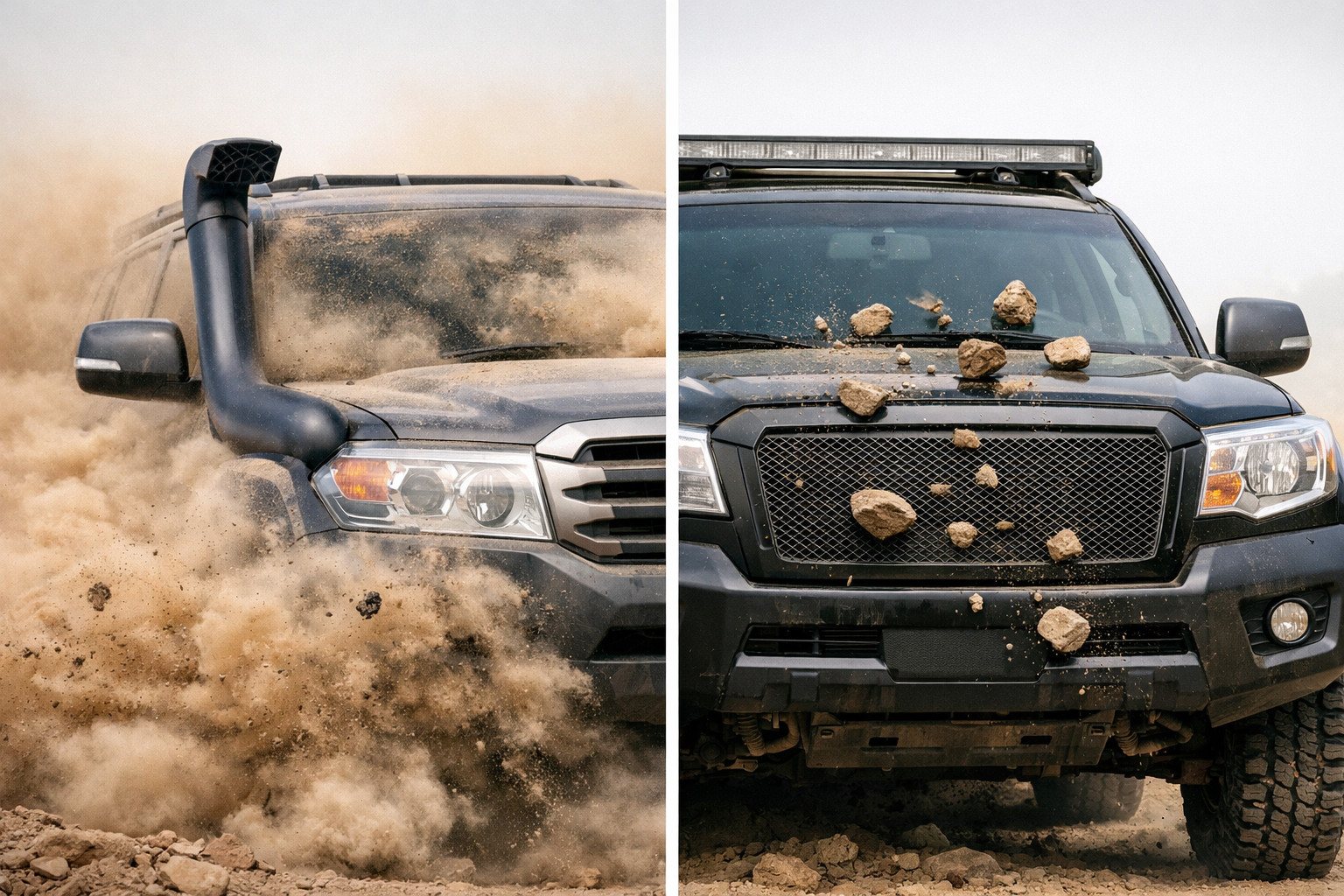
If dust in the intake bothers you, look toward a snorkel. If the main risk is gravel, stones, insects, and debris hitting the radiator or condenser, you need a mesh or a protective grille insert. These aren’t the same solutions: they work on different parts of the vehicle.
By “insert” here we mean specifically a protective insert or mesh in the grille. A solid winter cover is a separate option for frost and snow, and it is not considered a replacement for a snorkel or stone protection.
What the choice is really about
The idea is simple: a snorkel raises the air intake point higher and helps where the engine is swallowing dust, snow, or spray. A grille mesh works at the front of the body and takes the hits from small stones and dirt before they reach the radiator, intercooler, or condenser.
That’s why a mistake in defining the task is expensive. Buying a snorkel “against stones” means you won’t solve the radiator problem. Buying a decorative insert “against dust” means you won’t affect the air the engine actually breathes.
There’s a third point: the mere presence of a snorkel doesn’t make the system watertight. For dust it’s genuinely useful, but for water and deep wading it all comes down to installation quality, sealing, and the overall condition of the intake system.
What criteria to compare by
- Installation. A snorkel often requires cutting the fender or a panel and precise sealing. A mesh sometimes can be installed without removing the bumper, but on some vehicles you can’t avoid disassembly.
- Noise. A snorkel can add a slightly louder intake sound, sometimes a faint wind noise. A mesh usually doesn’t make noise by itself, but it can affect airflow if it’s too dense or clogged with dirt.
- Durability. With a snorkel, the durability gain is less dust in the intake pickup area and better air filter performance in harsh conditions. With a mesh, the benefit is different: fewer chances of damaging the radiator or condenser fins.
- Practicality. A snorkel is useful where dust is a regular occurrence. A mesh is practical for everyday highway use, but it needs cleaning from insects, leaves, ice, and wet snow.
- Price. A mesh is almost always cheaper both for the part and the labor. A snorkel is more expensive not only because of the kit, but also because of installation.
Also check compatibility. For vehicles with sensors, radars, and a tight front fascia, universal solutions often perform worse than vehicle-specific ones.
Quick comparison of options (table)
| Option | Strengths | Weaknesses | Who it’s for |
|---|---|---|---|
| Snorkel | Works better against intake dust, raises the air pickup higher, useful in convoy driving, on dirt roads, and on loose surfaces | Doesn’t protect the radiator from stones, more expensive, more complex to install, may add intake noise | Those who regularly drive in dust, snow, and spray and want to protect the intake specifically |
| Mesh or protective grille insert | Takes the hit from fine gravel, insects, and debris, cheaper, makes sense for city and highway use | Doesn’t solve intake dust, can restrict airflow if chosen poorly, requires cleaning | Those whose main risk is damage to the radiator, intercooler, or condenser |
| Solid winter cover | Can be useful in severe frost and heavy snow | Not protection against dust or stones, can harm cooling in warmer weather or under load | Those who drive in steady subzero winter conditions and understand the limitations of this solution |
DD Tuning expert comment: most often people confuse what exactly they want to protect. Someone says they want “less stuff flying in,” but doesn’t specify—into the intake or into the radiator. The second typical mistake is buying a universal mesh without considering sensors and cell density, then being surprised by poor fitment or excessive airflow blockage.
Detailed breakdown of each option
Snorkel
This is a solution for the engine’s air, not for frontal protection. It makes sense where the factory air intake draws dust from a lower, dirtier zone. In heavy dust, a pre-filter is sometimes added, but it’s only appropriate at low speed and requires regular cleaning, so it’s not a universal setup for everyday highway driving.
Snorkel installation is almost always more involved: you need to position the template accurately, cut the opening, and seal the connections. The body itself is usually durable and built for long service, but the value of the whole purchase is determined not by the plastic, but by the quality of the installation.
In terms of noise, a snorkel rarely becomes a real problem, but extra intake sound can sometimes be heard. If the vehicle is mainly for city and highway use and dusty trips are occasional, that compromise isn’t always justified.
Mesh or protective grille insert
Here, everything comes down to three things: open area, wire thickness, and fitment in the opening. A good mesh shouldn’t be too “closed.” As a reference, quality solutions may have an open area of around 77%, a cell size around 6.35 mm, and wire around 1.65 mm—but that’s not a magic standard, just a sensible balance between protection and airflow.
The main plus is real protection for heat exchangers against road debris. The main minus is that if you choose an insert that’s too dense, too thick, or poorly fitted, it will start to hinder airflow more than it helps. On vehicles with sensors, cameras, and radars, you need either cutouts or a ready-to-fit compatible kit.
For upkeep, a mesh is simpler than a snorkel, but it still needs attention: it should be washed and checked to make sure it hasn’t been clogged with insects, leaves, mud, or ice.
Solid winter cover
This is a narrow, specialized option, not a universal year-round cover. It’s appropriate in severe frost or heavy snow, when you need to limit excessive cold airflow. In mild weather, under load, or while towing, such a cover can become a cooling risk.
So if by “insert” you mean a winter cover, comparing it to a snorkel is incorrect. It’s a different task and a different season of use. For these products, staying within temperature limits matters: in warm weather, during a thaw, or under serious load, you shouldn’t leave them on.
Which option is better for different scenarios
For city driving, highways, trips behind trucks, and gravel roads, it’s almost always better to start with a grille mesh. It works exactly where debris hits the radiator and condenser, and the price is usually noticeably more reasonable.
For quarries, steppe routes, convoy driving, dry dirt roads, and long dusty stretches, it’s more correct to look at a snorkel. Here it protects the part that truly suffers first—the intake and the air filter.
If your use is mixed—dust plus stones—one element does not replace the other. In that case, the most logical combination is: a snorkel for the intake and a mesh for the front heat exchangers.
A solid winter cover only makes sense as a seasonal tool. It’s not “better” than a snorkel or mesh because it doesn’t solve the same problem.
Use scenario and what to choose (table)
| Scenario | What to choose | Why |
|---|---|---|
| Daily highway driving, gravel, insects, city mileage | Mesh or protective grille insert | Protects the radiator and condenser from direct debris, offers better value for money |
| Frequent dusty dirt roads, convoy driving | Snorkel | Raises the air intake point and works better specifically against intake dust |
| Long trips with both dust and stones | Snorkel plus mesh | Each element protects its own component; one does not replace the other |
| Severe frost, blizzard, winter highway | Solid winter cover, under seasonal conditions | Helps only as a temporary winter solution, but requires monitoring temperature and load |
| You only need the look | Decorative insert | Gives a visual effect, but you shouldn’t expect protection on the level of a mesh or the function of a snorkel |
Common mistakes when choosing
- Buying a snorkel for stones. It doesn’t cover the radiator and won’t save the fins from gravel.
- Confusing protective mesh with a decorative insert. A chrome or plastic insert may provide almost no real stone protection.
- Ignoring mesh density. The more “closed” the insert, the higher the risk of excessive airflow resistance—especially in heat or when the element gets dirty.
- Underestimating installation. For a snorkel, airtight sealing is critical; for a mesh, precise fitment and compatibility with sensors are key.
- Driving all the time with a winter cover. What’s useful in deep subzero temperatures can be harmful in milder weather; this is especially true under load and while towing.
- Assuming any raised air intake is a full snorkel. Some solutions look similar but don’t provide the required sealing.
When a more expensive solution makes sense
A more expensive solution makes sense when repairing the consequences will definitely cost more. If you have a vulnerable condenser, a tight front end, and lots of highway and gravel driving, it’s better to choose proper grille inserts with correct fitment for your specific vehicle rather than a universal decorative insert.
A snorkel is justified not when you want an “off-road” look, but when dusty routes repeat regularly. If you’re unsure whether your use case is really like that, it’s useful to first compare it with the article how to choose a snorkel. And if your main fear is stones at speed, it’s worth separately checking a comparison of mesh vs. a hood deflector.
Paying extra is also justified when the vehicle has sensors, a radar, a camera, or a complex grille shape. In such cases, a cheap universal part more often causes installation problems than it saves money.
From a customer’s experience: a crossover owner was looking for a snorkel after two highway trips because he was worried about the engine. After clarifying the scenario, it turned out there was almost no dust, but fine gravel constantly hit the front end. In the end, he installed a protective grille mesh, solved the stone issue, and didn’t overpay for a component that simply wasn’t needed for his driving.
Conclusion
In short: for intake dust, a snorkel is better; for stones and debris hitting the radiator, a mesh or protective grille insert. A solid winter cover is a separate item and is needed only for a narrow winter scenario.
Don’t choose by looks or by the part’s name—choose based on what component you want to protect, how complex an installation you’re willing to accept, and whether the solution will create new limitations in noise, maintenance, and cooling. This material is based on real selection experience, hands-on practice, and real use cases—not abstract promises.
How it works
- Determine what exactly needs protection First understand the main risk: dust in the intake, or stones, insects, and debris in the radiator. The choice depends on this — a snorkel works for the intake, while a mesh or protective grille insert is for the front heat exchangers.
- Assess your driving scenario For dusty dirt roads, convoys, steppe routes, and recurring dust, a snorkel makes more sense. For city driving, highways, gravel, and everyday trips, a grille mesh is a better fit.
- Check compatibility and installation complexity A snorkel often requires cutting the fender or panel and a sealed installation. A mesh may be easier to fit, but on vehicles with sensors, radars, or a complex front end, it is important to choose a model-specific solution, not a universal one.
- Choose a solution without unnecessarily restricting airflow The mesh must be open enough not to choke cooling, and the snorkel must be properly sealed, otherwise it will not do its job. If you need protection from both dust and stones, these two elements do not replace each other.
- Do not confuse the winter cover with stone protection A solid winter cover is only needed in severe frost or heavy snow and is not a substitute for either a snorkel or a mesh. In warmer weather or under load, it is better not to leave it on.
- Choose the more expensive option only if truly needed If dust and stones are present at the same time, it makes sense to combine a snorkel and a mesh. If the main problem is only one, do not overpay for a solution that does not protect the needed component.
Pros and cons
A snorkel really does better protect the intake itself: it raises the air intake point higher and helps where the problem is dust, snow, or splashes. For regular dusty trips, it’s more practical than any grille cover.
A mesh or grille guard effectively takes on small stones, insects, and debris before they reach the radiator, intercooler, or condenser. It’s a logical choice for the city, the highway, and daily drives on gravel.
Mesh is usually cheaper both to buy and to install, so for protecting the front of the car it often gives better value for money. It’s also easier to maintain than a snorkel.
For mixed conditions — when there is both dust and stones — the article advises not to choose just one, but to combine a snorkel and mesh. That way each solution covers its own area without replacing the other.
A solid winter cover makes sense in severe frost and heavy snow, when you need to limit excessive cold airflow. For its seasonal purpose, it can be useful if you do not confuse it with stone protection or dust protection.
A snorkel does not solve the problem of stones in the radiator: it does not protect the radiator or condenser fins from gravel. If the main risk is from the front, this will be the wrong purchase.
Installing a snorkel is more complex and often requires cutting the fender or panel and very good sealing. That is why it is not always practical to install one for occasional trips.
Mesh can worsen airflow if it is too dense, too thick, or dirty. It needs to be cleaned regularly from insects, leaves, mud, and ice.
A solid winter cover is not a universal solution: in warmer weather or under load, it can harm cooling. It cannot be left on the car all the time without considering temperature and driving mode.