

27.04.2026
215
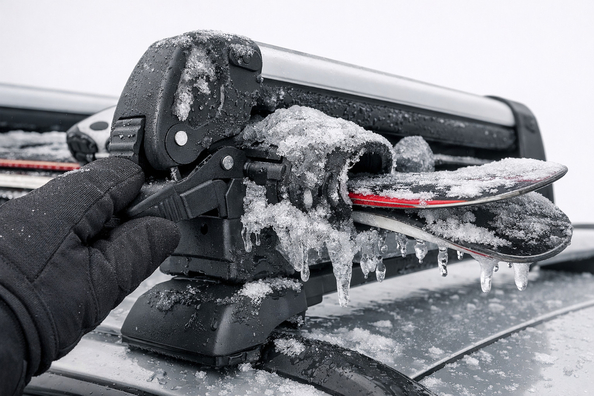
When a ski rack won’t open in winter, the cause is usually not the cold itself, but ice, dirt, road salt, or a misaligned mechanism. With the same symptom, the scenarios differ: the key may not go in, may not turn, or may turn without any result — and each case has its own solution.
What really works is not force, but the right sequence: remove the ice, relieve tension on the latch, dry the assembly, and then service it with the correct lubricant. For the lock — dry lube or graphite; for plastic — silicone; for metal hinges — lithium grease, but not in the lock cylinder.
The issue is triggered by the “got wet — froze” cycle. After a drive through slush, water gets into the lock cylinder, under the latch, or into the hinges, and then turns into ice while parked. Open ski racks suffer faster because the mechanism is constantly exposed to snow and salt. In a roof box the gear is better protected, but the lock and joints can still freeze without maintenance.
If the key won’t go in or goes in tightly, the most likely cause is ice or dirt in the cylinder. If it goes in but turns in jerks, suspect freezing or a clogged core. If the key turns normally but the rack doesn’t open, check for misalignment, pressure from the skis, or a seized latch tongue.
A practical test: warm the key in your hand or in the cabin, then make a few short movements without force. If it gets better, the cause is almost certainly ice. If a light push down on the cover, or unloading the skis, makes the latch release, it was under tension. If in a warm, dry place it still feels tight, it’s dirt, corrosion, or wear. When only one side fails, the problem is usually local rather than in the whole system.
DD Tuning expert comment: most often the lock is damaged not by frost, but by trying to “force it” or by flooding it with a thick all-purpose spray. The first time it may help, but then dirt sticks even faster. In winter assemblies it’s better to separate maintenance: lock — dry, plastic — silicone, metal hinges — separately.
| Symptom | Likely cause | What to do |
|---|---|---|
| Key won’t go in or goes in halfway | Ice or dirt in the lock cylinder | Remove snow outside, use a de-icer or a warm key; after opening, dry and apply dry lube |
| Key goes in but won’t turn | Frozen or clogged core | Don’t force it; warm it locally, then clean and treat with graphite or dry lube |
| Key turns but the clamp won’t open | Cover misalignment, pressure from skis, seized latch tongue | Lightly press or unload the assembly, remove ice from the latch, check that the gear is positioned evenly |
| One side works, the other doesn’t | Local moisture or uneven icing | Inspect the problem side separately, clean the channel, dry it, and compare both sides’ movement without load |
| After thawing, the mechanism is still tight | Corrosion or wear | Full cleaning, correct lubrication by material; if the symptom remains — replace the lock cylinder or the assembly |
In the moment, a combination of three actions works: de-ice locally, relieve the load on the latch, and don’t jerk the key. For ice in the lock — an aerosol de-icer or a warm key. For the latch — warm air and manual ice removal. For misalignment — a light push on the cover or unloading the skis while opening.
Long-term, a service routine helps: once a month check the mechanism’s movement, twice a year do lock preventive maintenance, after driving through slush rinse off dirt and let the assembly dry. If you don’t need the rack daily, removing it for the season also reduces the chance of seizing.
Boiling water and very hot water give a short effect, but then moisture gets deeper and freezes again. Force is harmful too: it’s easy to break the key, the cylinder, or the button. The “spray everything with one product” approach also works poorly: if there’s already salt and dirt in the lock, surface treatment won’t remove the cause.
A bad habit is leaving a wet rack on the car for weeks and not moving the mechanism. After such pauses, even a healthy assembly starts opening in jerks.
If you often drive in wet snow, an open ski rack is convenient, but its mechanism is constantly exposed to the weather. For better protection from water and salt, it makes sense to look at roof boxes. And if you need to understand which transport format is more practical for your trips, it’s worth comparing a roof box and a roof rack.
Replacing parts is justified when the lock binds even after thawing and cleaning, there’s play, corrosion, or jerking without frost. If the issue appears only after slush, proper preventive care, drying, and regular checks are usually enough.
| Solution | When it works | When it’s not worth spending money |
|---|---|---|
| Aerosol de-icer | When the problem is ice and access to the lock is still possible | If the mechanism is worn or the latch is misaligned |
| Dry lube or graphite for the lock | To prevent re-freezing and after cleaning the lock cylinder | If you apply it to a dirty lock and expect an instant fix |
| Silicone lubricant for plastic | When plastic guides, seals, or the button are sticking | If the problem is inside the core or on a corroded metal hinge |
| Lithium grease for metal | When external metal pins and hinges move tightly after cleaning | If you put it into the lock or on top of dirt |
| Replacing the lock cylinder or the assembly | When binding, play, or corrosion remains after drying and maintenance | If the assembly simply froze once after a trip |
| Switching to a box | When you often drive in slush and want less exposed moisture on the mechanism | If the main cause is a long-neglected lock with no maintenance |
From a customer’s experience: after several trips in wet snow, the rack still locked, but in the morning in the parking lot the key no longer wanted to turn properly. After cleaning, drying, and switching to dry lube for the lock, the problem disappeared. For longer winter trips, the owner switched to a closed transport format because the open mechanism had to be cleaned from slush too often.
When the rack ices up and won’t open, don’t start with force. First, distinguish ice in the cylinder from dirt, misalignment, or actual wear. The working scheme is simple: de-ice locally, relieve tension on the latch, dry the assembly, and then maintain it with the right products.
If the problem repeats only after slush, cleaning, drying, and dry lock preventive care are usually enough. If the assembly binds even after proper thawing, that’s already a signal for repair or replacement. This material is based on real selection experience, hands-on practice, and real-world winter use scenarios.
Shipping to EU
Wholesale and retail
Own warehouse
Опис продукту
Подарунки не надаються при оформленні покупки у кредит під 0,01% або при покупці частинами.