25.03.2026
281
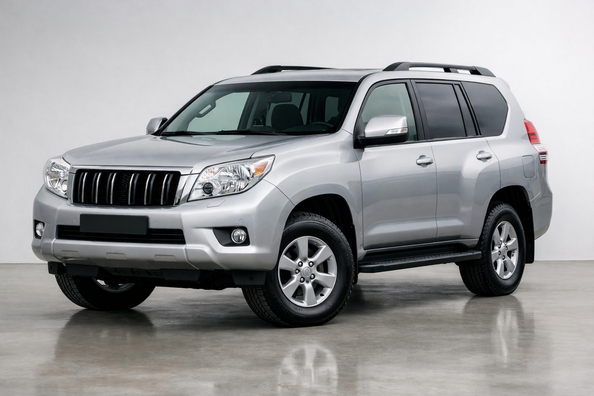

Toyota Land Cruiser Prado 150 (J150) is usually understood as the generation sold in the 2009–2023 period (depending on market and trim). If you’re looking specifically at the previous generation (Prado 120), the logic is simple: paying extra for “newer” only makes sense when you understand exactly what changes in engines, transfer case, electronics, and the cost of typical repairs.
In this review — practical pointers by years/generations, the real engines with displacement and power output, dimensions and luggage space, plus “what’s good/what’s risky” tables with an emphasis on whether it makes sense to choose a Prado 150 instead of a 120 (or vice versa).
Prado 150 is a body-on-frame (ladder-frame) SUV primarily chosen for pulling power, durability, and the capability of its 4WD systems. Compared with crossovers it’s heavier, but it delivers exactly the kind of use case where you regularly need low range, locking/limited-slip functions, and predictable behavior off-road and while towing.
Reviews often emphasize that the Prado 150 platform is “reworked but proven”: in general descriptions it’s linked to the technical philosophy of previous Land Cruiser models. For the buyer this means: many assemblies have well-known longevity, but the specific risks are still tied to the engine and model year.
If you want to double-check which Prado 150 fits you by trim/year, a helpful reference is this подборка page: Toyota Land Cruiser Prado 150.
Within the “Prado 150 2009–2023” topic, it’s important not to rely only on the numbers in an ad. The same “Prado 150” can differ by engine (2.8/3.0 diesel, 4.0 petrol) and by how emissions systems and control logic are implemented.
For Prado 150 it’s typical that markets offer both diesel versions (with different generations of fuel system and DPF/EGR control) and petrol V6s. Because of this, the question “is the previous generation worth it” most often comes down to a comparison: are you ready for the risks of a specific Prado 150 diesel, or do you want simpler diagnostics/repairs (often — at the cost of an older vehicle age in a Prado 120).
Below are the real engines most commonly found in the Prado 150 (J150) within 2009–2023, and their key parameters based on brochures/materials for specific versions.
| Component | Parameter | Value (for specific brochures/versions) |
|---|---|---|
| Prado 150 diesel | Engine / displacement | 1KD-FTV, 2982 cm³ |
| 1KD-FTV | Power | 127 kW at 3400 rpm |
| 1KD-FTV | Torque | 410 N·m at 1600–2800 rpm |
| 1KD-FTV | Fuel consumption (combined) | 8,3 l/100 km |
| Prado 150 diesel | Engine / displacement | 1GD-FTV, 2755 cm³ |
| 1GD-FTV | Power | 130 kW at 3400 rpm |
| 1GD-FTV | Torque (automatic) | 450 N·m at 1600–2400 rpm |
| 1GD-FTV | Torque (manual) | 420 N·m at 1400–2600 rpm |
| 1GD-FTV | Fuel consumption (combined, automatic) | 8,0 l/100 km |
| 1GD-FTV | Fuel consumption (combined, manual) | 7,9 l/100 km |
| Prado 150 petrol | Engine / displacement | 1GR-FE, 3956 cm³ |
| 1GR-FE | Power | 207 kW at 5600 rpm |
| 1GR-FE | Torque | 381 N·m at 4400 rpm |
| 1GR-FE | Fuel consumption (combined, automatic) | 11,6 l/100 km |
As for 4WD and the transfer case, the logic is: in many versions the Prado 150 has full-time 4WD with a dual range transfer case. As an example, the 2013 brochure lists high 1,000:1 and low 2,566:1, as well as a Torsen Limited Slip Differential in the center (and the corresponding differential ratios).
The practical takeaway for buying: the “engine vs engine” choice is often more important than “150 vs 120”, because the cost of diesel repairs (DPF/EGR/injectors/sensors) can outweigh the price difference between generations.
Prado 150 doesn’t try to be compact: its dimensions create the feel of a large vehicle, while off-road ability is supported by geometry and ground clearance. As a reference in the 2016 brochure materials: length 4930 mm, width 1885 mm, height 1890 mm, wheelbase 2790 mm.
Ground clearance and angles are one of the reasons people choose Prado for regions with “no guarantees” roads. The 2016 brochure lists running clearance 220 mm, approach angle 32°, departure angle 25°, and brake over angle 22°.
| Parameter | Value (reference from 2016 brochure) | Why it matters when choosing |
|---|---|---|
| Length / width / height | 4930 / 1885 / 1890 mm | Parking planning, assessing access in courtyards and tight parking lots |
| Wheelbase | 2790 mm | High-speed stability and behavior over undulations; also affects comfort |
| Running clearance | 220 mm | Real “buffer” for curbs, ruts, and uneven dirt surfaces |
| Approach / departure angle | 32° / 25° | Ability to climb/descend embankments without excessive scraping |
| Brake over angle | 22° | Important over deep holes/dips under the wheels during braking |
If you compare the 150 to the previous generation, the geometry and “body-on-frame” feel will be similar in character, but specific figures vary by configuration and year. So when choosing a specific vehicle, it’s worth verifying the parameters that matter for your routes (curbs/ruts/slopes) rather than relying only on general feedback.
In the Prado 150, the cabin layout and seating position suit the “often family + trips” format well. For safety, the 2016 brochure notes 7 SRS airbags, including full-length side curtains.
Separately on the practical side of the 7-seat configuration: according to review materials, the 3rd row has limitations in access and comfort, and the trunk depends heavily on whether all seats are in use. So when choosing “for the family”, realistically assess your scenario: how often the vehicle is driven with rows up/down, not just “how many seats on paper”.
It’s also important that comfort can differ between versions due to suspension/settings, so when buying used you should definitely listen to how it works over small bumps and bigger “dips”, rather than drawing conclusions from photos or the seller’s description alone.
Prado 150 usually fits well into a “back-and-forth city + highway + occasional dirt” routine. But reviews point out the contrast between city driving and climbing/descending: the transmission and control logic can feel “harsher” when you often drive slowly with frequent shifts, or when descending and the vehicle readily holds gears.
Another practical point is listening for air leaks/unusual symptoms on the diesel. For 1GD-FTV, scenarios are described where dust can affect MAF operation and trigger limp home mode depending on trim/version. For the owner this means: if your region is dusty, timely cleaning/indicator-based diagnostics and reacting to “flat spots” or unstable pull are important.
For towing, the 2016 brochure materials specify: braked 2500 kg; unbraked 750 kg. At the same time, other figures may appear in reviews (for example, up to 3000 kg braked), so for your vehicle check the factory document for your specific towbar/market configuration.
To keep the “Prado 150 or the previous generation” decision from being emotional, let’s split the strengths/weaknesses by an owner’s logic: what benefits you in daily driving, and what most often becomes costly over time.
| Category | Pros (typical for Prado 150) | Cons/risks (depends on engine and years) |
|---|---|---|
| Pulling power & dynamics | High diesel torque across a wide rev range: for 1KD-FTV 410 N·m (1600–2800), for 1GD-FTV 450 N·m (automatic, 1600–2400) | Diesel operation strongly depends on intake/sensor condition and system cleanliness; when issues occur, electronics may limit power |
| Off-road capability | Running clearance 220 mm, approach/departure angles 32°/25°, low range and full-time 4WD | In dusty/muddy conditions, regular intake and sensor servicing is essential, otherwise indirect costs increase |
| Comfort | According to reviews — good insulation from drivetrain noises; in a moderate driving style it’s easier to travel without fatigue | With hard acceleration/climbs, noise and load become more noticeable; on some versions the suspension can feel “stiff” over rough surfaces |
| Safety | For the 2016 brochure: 7 SRS airbags, including full-length side curtains | As with any used car: it’s important to check accident repair history/open service campaigns |
| Cost of ownership (diesel) | Running costs can be predictable if the diesel was serviced correctly and not “killed” by regularly skipping regenerations/maintenance | Key risks depend on the engine: for 1KD-FTV, issues are described related to piston cracking/failure in certain years and injector risks; for 1GD-FTV — DPF scenarios (including ECU reflash in service campaigns) and the impact of dust on the MAF |
| Family use & luggage space | In a 5-seat or “part cargo” configuration, trunk volume is adequate for travel | In 7-seat mode, the 3rd row reduces usable volume to figures like 120 l (per a review), which can be critical for real transport scenarios |
From an owner’s perspective, the practical pluses of Prado 150 are strong low-end pull, straightforward off-road geometry, and a wide choice of genuine accessories. The practical minuses are the differences in diesel risk profiles (and therefore repair costs), plus 3rd-row limitations and the trunk’s dependence on how many seats are actually in use.
Prado 150 takes accessories well, and it’s not only about looks. Most often, owners logically invest in protection and off-road tools, plus travel convenience.
A typical direction is heavy-duty components and protection: in Toyota Genuine Accessories lists for Prado 2016 you’ll find, for example, an Alloy Bull Bar with Driving Lights, Front Weathershields, as well as solutions like a Towball and Trailer Wiring Harness. It’s convenient to cross-check more details on the accessory line-up in the trim materials: Prado 150.
A second direction is rails/roof cargo solutions for expeditions: the mentioned brochure includes roof racks and a heavy duty roof tray. This is more practical than stuffing everything into the cabin, especially when the vehicle often runs with the 3rd row in use.
Third is the towbar/trailer electrics and the logistics of wiring. If you plan frequent trips with a trailer/camper, assess right away whether the factory solution matches your task, and align it with the real towing capabilities of your configuration (so you don’t hit limits in the registration/technical documents).
Separately: before any remaps/chip tuning for the diesel, keep in mind that the service risks described for Prado 150 are tied to how the emissions system and the fuel/intake side operate. In other words, “adding power” without a proper engineering approach is exactly the route that increases the chance of regeneration and injector/sensor issues depending on the engine. To assess typical service nuances, it’s useful to look at materials on issues/campaigns for the 150-series: Land Cruiser Prado 150.
Choosing the previous generation (Prado 120) makes sense if your priority is avoiding certain “engine-related” risks of Prado 150 diesels and you’re ready to invest time into finding a well-cared-for 120 (because an older vehicle is also mileage-and-wear math).
If you need a body-on-frame SUV with максимально practical off-asphalt capability and a comfortable family-trip format, Prado 150 (J150) 2009–2023 is often more rational — but only with the right engine and model year choice. For Prado 150 it’s critical: check the condition of the diesel/intake and emissions systems (EGR/DPF), service history and whether campaigns were completed; then “150 vs 120” won’t be a design argument, but a question of predictable costs for a specific car.
Practical verdict: if you find a Prado 150 with a clear service history and a transparent mileage/maintenance schedule for diesel components, Prado 150 is usually the more logical option than the previous generation. If the history is vague or the seller avoids the emissions/injectors/diagnostic error topic, it’s better not to “take their word for it” and compare with a Prado 120 based on the real technical condition of the конкретних vehicles.
Choose Prado 150 options within your budget
| ✔ | Prado 150 (J150) delivers strong pulling power thanks to diesel engines with high torque across a wide rev range, as well as a low-range gearbox and permanent 4WD. |
| ✔ | The off-road geometry (running clearance 220 mm, approach/departure angles 32°/25°) is practical for routes with curbs, ruts, and dirt slopes. |
| ✔ | There is a clear choice by configuration: the article lists specific engine options (1KD-FTV, 1GD-FTV, 1GR-FE) and their parameters, so it is easier to compare risks between vehicles. |
| ✔ | 7 SRS airbags (according to the 2016 brochure, including full-length side curtain airbags) are an additional argument in favor of this generation in terms of basic safety. |
| ✘ | The main risks and potential costs are strongly tied to a specific diesel and its condition: scenarios involving DPF/EGR/injectors/sensors are mentioned, as well as the impact of dust on intake operation. |
| ✘ | The 3rd row in the 7-seat configuration can be inconvenient to access and significantly reduces usable trunk space (the article gives an example of around 120 l), which often affects real-world hauling scenarios. |
| ✘ | The price differs not only between the 150 and 120 generations, but also between specific years/individual Prado 150 examples, so without checking the service history you can overpay for hidden issues. |
Shipping to EU
Wholesale and retail
Own warehouse
Опис продукту
Подарунки не надаються при оформленні покупки у кредит під 0,01% або при покупці частинами.