20.04.2026
340
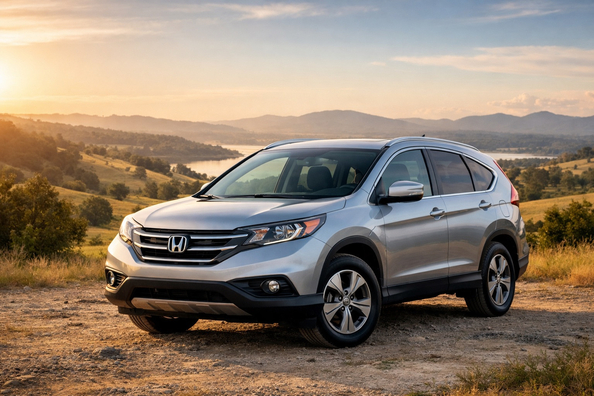

Honda CR-V 2012–2016 — the fourth generation (RM body), a 5-door family crossover people choose not for thrills or showing off, but for space, predictable road manners, and sensible practicality.
If you’re looking for a Honda CR-V 2012–2016 review without the fluff, three things matter here: different markets got different engines and gearboxes, ground clearance is moderate (this isn’t a “jeep”), and this generation’s strong side is everyday usability and strong resale value.
In 2012–2016, the Honda CR-V belongs to the 4th generation (RM). It’s a compact C-SUV with a unibody construction, designed for daily family use: city, highway, trips with kids, luggage, and a moderate winter.
An important year-by-year detail: in 2015 most markets received an update (facelift). Along with the cosmetics, technical highlights often changed: in Europe, other diesel versions appeared (1.6 i-DTEC) and in some trims a 9-speed automatic, while in North America — an updated 2.4 and a CVT. That’s why the question “which CR-V is better: 2014 or 2015” always comes down to the exact engine, transmission, and the car’s origin.
| Parameter | Honda CR-V 2012–2016 (4th generation, RM) |
|---|---|
| Body type | Crossover (SUV), 5 doors |
| Seating capacity | 5 seats |
| Drivetrain | Front-wheel drive or part-time AWD (Real Time AWD on some versions) |
| Main engines |
|
| Transmissions |
|
| Ground clearance | Usually in the range of about 160–170 mm. The figure depends on drivetrain, market, and wheels; on 2WD it’s often lower |
| Trunk | European measurements are often quoted as 589 L with the second row in its normal position; maximum with the seats folded to the roof can reach roughly 1669 L (measurement method matters) |
| Dimensions | A class “middle ground”: width about 1820 mm, height about 1680–1685 mm. Length and wheelbase can vary by source and market; wheelbase reference — about 2620 mm |
If you need “exact Honda CR-V 2012–2016 specs”, don’t try to force everything into one set of numbers: some cars in Ukraine are imports from the USA/Canada (2.4 petrol, different transmission tuning and trims), while others are European (2.0 petrol or diesels). That affects the transmission, equipment, and small parameters.
This generation CR-V suits those who drive in traffic daily and don’t want to fight the seating position and visibility. The high seating and sensible cabin geometry make it comfortable for short trips and the dense “home–school–store” routine. The downside is that it’s no longer a “crossover that fits any parking spot”: in tight courtyards you feel the size, and parking sensors and a camera (depending on version) are genuinely useful, not just for show.
On the highway, the CR-V wins not with “sharpness” but with stability and predictability. The 2.4 petrol on American cars usually feels more torquey in everyday overtakes, while the 2.0 petrol in Europe is calmer. Diesels make sense for those who drive a lot and know how to live with diesel routines (fuel quality, warm-ups, soot, DPF).
It’s one of those crossovers where five people are comfortable, not just “squeezed in”. The flat rear floor and sensible bench geometry help with child seats and long trips alike. The trunk is a strong point: the shape is practical, the opening is wide, and the 60/40 split-folding backrests make the car genuinely suitable for a stroller, suitcases, and everyday hauling.
| Pros | Cons |
|---|---|
| Spacious cabin for 5 people | No 7-seat version in this generation for most markets |
| Trunk with a practical shape and convenient second-row folding | Ground clearance isn’t “off-road”: take it easy on rough tracks |
| Predictable road manners, comfortable driving position | Not about driving excitement; handling is more relaxed |
| 2WD and AWD versions for different climates/roads | AWD adds service points and costs if neglected |
| Wide choice of engines depending on market | The real engine+gearbox combo depends heavily on the car’s origin; you must check each specific vehicle |
For the Honda CR-V 2012–2016, “tuning” makes sense when it adds usefulness. Blowing the budget on decorative items is a weak idea: this car is valued as a tool, not a show car.
What brings practical value: protecting the body and interior, keeping the trunk organized, and adding travel convenience. If you carry a stroller, bikes, or vacation gear, roof infrastructure becomes the logical accessory — roof rails for a cargo box or crossbars. For city and highway driving, especially in the shoulder seasons, mud flaps are useful to reduce sandblasting on the sills and lower door edges.
What’s more about looks: trims, decor, and “body kits” only make sense if you truly need a specific effect and understand that it adds neither ground clearance nor durability. In real life, the best results come from simple things: protection, organization, roof solutions, small ergonomic upgrades.
It’s easier to choose a set for your use case on the accessories for Honda CR-V 2012–2016 page — it’s more convenient there to filter solutions by body and tasks.
Honda CR-V 2012–2016 is a strong choice if you need a 5-seat family crossover with a large trunk, a comfortable seating position, and predictable handling. It works well for the city, the highway, trips with kids, and a moderate winter.
It’s not for you if you want real off-roading, 7 seats, or a “hot” character. For most owners, the smartest route is not to play with decorative tuning, but to cover practical needs with the right accessories for the CR-V 2012–2016.
Shipping to EU
Wholesale and retail
Own warehouse
Опис продукту
Подарунки не надаються при оформленні покупки у кредит під 0,01% або при покупці частинами.