
27.06.2026
336
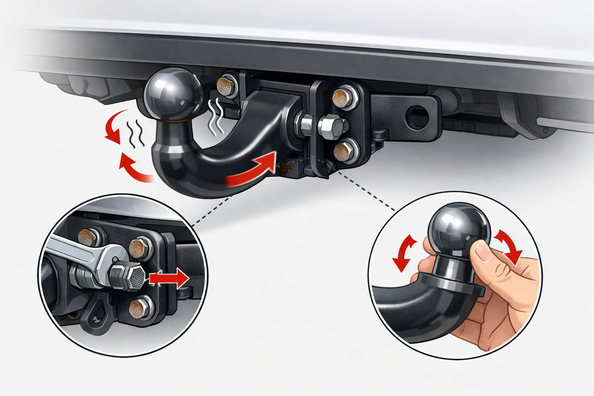
In most cases, a tow hitch knock or play doesn’t mean you need to replace the whole assembly. Most often the noise comes from play in the shank inside the receiver, an overly loose trailer coupler on the ball, the hitch contacting the exhaust, or wear in the pin hole. So the first task isn’t to buy a new kit, but to understand exactly where the extra movement is.
The check doesn’t take long: inspect the fasteners, the ball and coupler, the exhaust clearance, and the receiver itself. If the cause is local, adjustment, the right anti-rattle solution, or replacing one worn part is often enough.
A tow hitch works under changing loads: pulling away, braking, potholes, body twist, and trailer oscillation constantly load the assembly in different directions. Because of this, even a small manufacturing clearance can start to sound like a knock, especially on small bumps or when switching between drive and coast.
It’s important to understand that the source of the noise may not be the hitch itself. If you have a receiver-style system, the insert often has play in the square tube. If the noise appears only with the trailer attached, suspicion falls on the coupler on the ball. If the ringing or knocking changes between a cold and a warm vehicle, check exhaust clearance: after hitch installation the pipe or hangers sometimes begin to touch the structure.
DD Tuning expert comment: The most common mistake is buying a new hitch right away, when the play is actually in the receiver insert or the trailer coupler itself. The second common mistake is grabbing the first “universal” clamp without checking the receiver size, space near the bumper, and compatibility with the specific design. If the assembly already has an oval hole or cracks, a clamp will muffle the noise but won’t eliminate the problem.
| Symptom | Likely cause | What to do |
|---|---|---|
| Knocking on small bumps without a trailer | Shank play in the receiver or play in the accessory itself | Remove the accessory, check the receiver and platform hinges separately; if needed, install an anti-rattle pin or clamp matched to your size |
| Impact when pulling away and braking with a trailer | Misadjusted or worn coupler on the ball | Check the coupler clamping force; if adjustment no longer helps, replace the coupler or the worn part |
| Ringing or dull knock that changes between cold and warm vehicle | Exhaust contacting the hitch | Check clearance on a cold vehicle, the condition of the rubber hangers, and the pipe position; restore the gap without replacing the hitch |
| Metal play can be felt by hand near the pin | Worn pin or elongated pin hole | Inspect the hole and the pin; if the hole is oval, plan to replace the worn part, not just tighten it |
| The whole assembly visibly moves relative to the body | Loose hitch fasteners | Check the bolts and tighten only to the torque specified for your kit |
| Noise only with a bike rack or platform | Play in the accessory hinges, not in the hitch itself | Check the accessory locks, hinges, and latches separately; don’t “fix” it by replacing the hitch |
If you’re choosing a new assembly or want to confirm the design type, see tow hitches. To understand which format fits your needs, the article why you need a tow hitch is useful. And if the noise appears together with a platform or bike carrier, consider the nuances from the article about hitch-mounted racks — there, the problem is often in the accessory, not the vehicle’s hitch assembly.
It makes sense to buy an accessory when the hitch itself is intact, the pin hole isn’t worn out, and the noise source is clearly the receiver clearance. Replacing an element makes sense when the cause is local: the coupler, the pin, or the exhaust rubber hangers.
It’s not worth spending money on clamps if there are cracks, deformation after an impact, a noticeably oval hole, or an issue with the body mounting points. In that case you don’t need an accessory — you need repair or replacement of the damaged assembly.
| Solution | When it works | When it’s not worth spending money |
|---|---|---|
| Anti-rattle pin | There is shank play in the receiver, the shank is hollow, the hole isn’t worn out, and the size is selected correctly | The hole is already oval; the issue is in the coupler or in accessory hinges |
| Anti-rattle clamp | You need to press the shank against the receiver wall, there is space for installation, and the bumper geometry doesn’t interfere | There’s nothing to clamp onto, the design is incompatible, or a weight distribution system is used |
| Coupler adjustment | The play is small, adjustment is still available, and the latch has simply loosened | The coupler no longer holds the ball even after adjustment or sits with a large gap |
| Exhaust position correction | There are contact marks; the noise depends on temperature or body load | The knock comes from the receiver or ball assembly, and the exhaust doesn’t touch anything |
| Tightening fasteners | The bolts have loosened, but the threads and mounting seats are intact | There is bracket deformation, cracks, or impact damage |
| Replacing the hitch or the worn module | There are cracks, heavy wear, oval holes, deformation, or damaged mountings | The issue is only insert clearance or the exhaust, which can be fixed cheaper and faster |
From a customer’s experience: a typical situation is someone arrives thinking the hitch has “broken,” because on potholes they hear a dull metallic knock. After inspection it turns out the hitch on the body is solid, and the noise comes from the receiver insert and a slightly shifted exhaust. After a properly selected anti-rattle solution and correcting exhaust clearance, replacing the entire hitch wasn’t necessary.
A tow hitch knock or play almost always needs to be broken down by components: receiver, shank, ball coupler, fasteners, and exhaust. If you consistently check where the movement is, it becomes clear whether a clamp, adjustment, tightening, or replacement of a worn part is needed. This material is based on real selection experience, diagnostic practice, and real use scenarios — not generic “just in case” advice.
Shipping to EU
Wholesale and retail
Own warehouse
Опис продукту
Подарунки не надаються при оформленні покупки у кредит під 0,01% або при покупці частинами.