12.06.2026
170
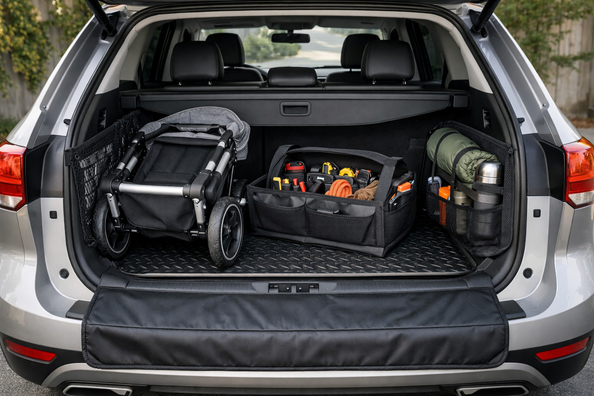
This upgrade plan is for anyone who regularly throws a stroller, a toolbox, backpacks, rubber boots, or sports gear into the trunk and doesn’t want to clean the entire carpeted lining every time. The goal here isn’t looks, but three things: contain dirt and moisture, stop cargo from sliding, and create clear, practical order.
The right sequence matters more than the budget. First you need a washable base with a raised lip, then you secure the items, and only after that an organizer or extra zoning; if you start with nice boxes and covers, the trunk will still end up dirty and inconvenient.
In this scenario, the upgrades should solve not one, but several everyday problems at once. A stroller brings wet wheels, sand, and small debris into the trunk. Tools add weight, sharp edges, and the risk that everything will slide across the floor on the first turn. Gear is often damp, bulky, and irregularly shaped, so without separation, clean and dirty items quickly get mixed together.
The second task is not to lose access to the trunk itself. If your car has an underfloor compartment, a cargo well, or a third row of seats, any upgrade has to account for that. In a wagon, minivan, or crossover with a large cargo opening you can fit a bigger organizer, but in a hatchback or a car with a short trunk, an overly deep box will simply eat up usable space.
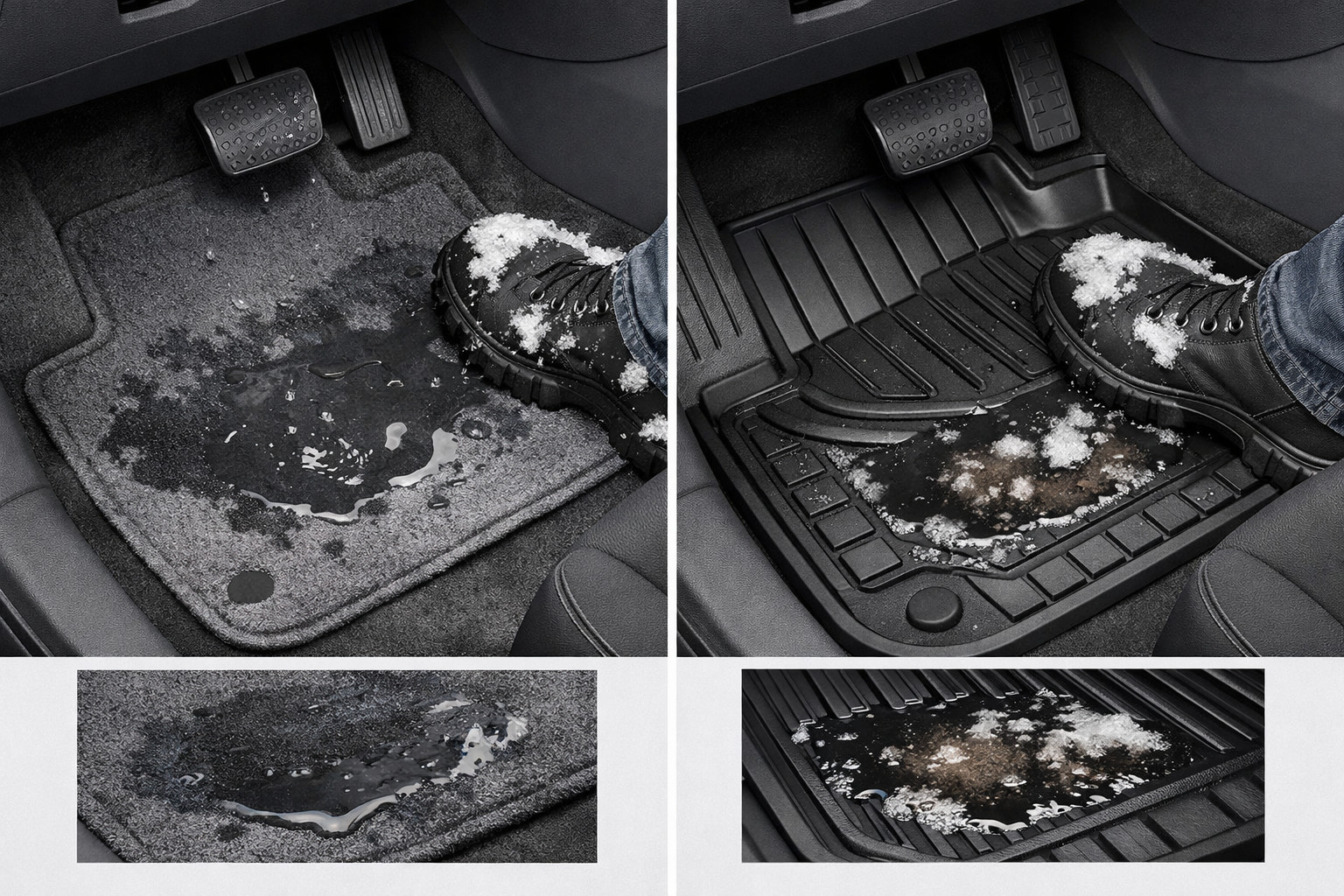
The first step is a molded trunk mat or tray with a raised edge. This is what takes the water, dirt, slushy snow residue, grease from tools, and sand from the stroller. The key is not just covering the floor, but getting a surface you can pull out, rinse off, and quickly put back.
Right after that, give your items at least basic retention: a net for light soft items, cargo stops, or straps to the factory hooks. The mat alone won’t stop a toolbox or plastic bin, so without step two the trunk may be cleaner, but it won’t be quieter or more convenient.
| Upgrade | Why it’s needed | Who it really benefits |
|---|---|---|
| Molded mat or tray with a raised lip | Holds water, sand, and dirt, preventing it from soaking into the factory lining | Anyone who carries a stroller, work tools, fishing, camping, or winter gear |
| Net, cargo stops, or straps to factory hooks | Reduces sliding of boxes, bags, and small totes | Those who always have small items or light soft bags riding in the trunk |
| Organizer with rigid compartments | Separates clean from dirty; gathers small tools, gloves, car care products | Those who carry lots of small stuff and don’t want everything piled together |
| Seatback protection or a dedicated solution for a deep well | Covers areas that often get dirty when folding a stroller or loading long items | Owners of minivans and large crossovers where the third row or cargo well is used активно |
| Trunk divider | Provides more rigid zoning in a large cargo area | Only for those who truly carry mixed cargo and are willing to live with reduced access and cabin transformation flexibility |
DD Tuning expert comment: The most common mistake is this: people start with a cheap universal mat or a big soft box, and only then discover the edges don’t cover the dirty zones and the organizer itself slides on the floor. For this scenario, it’s better to first check the trunk shape, access to the underfloor compartment, and whether factory hooks are present, and only then choose the retention method and organizer size. If you carry heavy tools, a net by itself won’t solve the problem.
The second stage is an organizer, but not just any one. It makes sense to choose a model that folds flat, has at least 3–4 compartments, and doesn’t block daily access to the stroller or spare wheel. Its role isn’t to “make it look nice,” but to keep gloves, a pump, tie-downs, small tools, a first-aid kit, wipes, and dirty small items separate.
If the main load is tools, a combination of a rigid or semi-rigid organizer, a non-slip base, and straps works best. If it’s a child’s stroller, it’s more important to keep the central area open and avoid an overly deep box that will get in the way of daily folding and unloading.
Textile liners, decorative covers, soft inserts, and other “neat” solutions work more for the feeling of order than for real dirt control. They’re appropriate once the basic function is already covered: the floor is protected, small items are secured, and you want to reduce visual clutter. But if after a trip the trunk just needs a quick rinse, decorative items usually lose to a washable tray.
Most often, people waste money on universal mats that need trimming. In practice they often leave corners exposed, curl up, or slip. The second common mistake is buying a net and expecting it to hold a metal toolbox or a tool set: for heavy, sharp items it’s a weak solution.
Another miss is overpaying for looks. An expensive accessory doesn’t automatically fit the trunk better, and a large organizer without proper mounting can slide around the floor no less than a cheap one. Niche dividers are also often bought without real need, and then people find it harder to access underfloor compartments or fully fold the seats.
| Scenario | Install first | Can be postponed | Optional |
|---|---|---|---|
| Daily stroller | Tray with a raised lip, quick retention for small bags | Compact folding organizer | Rigid trunk divider |
| Tools and work small items | Mat, cargo stops or straps, rigid container | Under-seat or side storage for small tools | Decorative trims |
| Sports, fishing, camping | Tray, basic retention, separate zone for wet items | Folding organizer or additional seatback protection | Soft textile solutions for the floor |
| Large family vehicle with a third row | Protection for the floor and the area behind the seats | A dedicated solution for a deep niche or well | Any accessory that gets in the way of quickly transforming the cabin |
More expensive solutions are justified when the scenario repeats daily: a child’s stroller after outdoors, wet gear, work tools, trips out of town. In that case, a vehicle-specific trunk mat usually pays back the price difference with better coverage and easier cleaning. If you have lots of small items constantly shifting around the trunk, it makes sense to choose not a random bag but an organizer with proper sections that you won’t mind folding up and removing when you need the full volume.
Another case is when the problem is no longer mess, but lack of space. If dirty or bulky gear is constantly taking away usable trunk volume, then it’s worth looking at a roof box. It’s a more expensive step, but it’s logical only after the trunk floor is protected and the interior space is already organized without unnecessary clutter.
From a customer’s experience: a typical request in this scenario looks like this: in a crossover, a stroller, a pump, a bag with kids’ items, and a small tool kit ride daily, and the trunk is constantly full of sand. First they tried to get by with a universal mat and a soft bag, but the bag slid and the mat edges didn’t cover the dirty zones. After switching to a tray with a raised lip, retention to factory points, and a compact organizer, order started to hold without daily reshuffling.
For a cleaner trunk in this scenario, you don’t need to start with the most expensive items. The working sequence is simple: first a washable base with a raised lip, then cargo retention, then an organizer, and only after that additional or niche solutions. That’s how you best keep dirt, moisture, and chaos from a stroller, tools, and gear under control.
The material is based on real selection experience, hands-on practice, and real-world usage scenarios: what goes in first, what actually helps every day, and what often turns out to be unnecessary or bought for the wrong scenario.
| ✔ | A molded tray or mat with raised edges really holds water, sand, and dirt, so the factory lining doesn’t need to be washed out after a stroller or wet gear every time. |
| ✔ | Fasteners, straps, or a net reduce boxes and bags sliding around in turns, which is especially useful for a tool box and small items. |
| ✔ | An organizer with rigid compartments helps separate clean and dirty items and keeps all the small stuff from ending up piled up in the trunk. |
| ✔ | For large vehicles with a third row or a deep нишe, separate seatback protection and well solutions let you cover the areas that get dirtiest during loading. |
| ✔ | If the cargo is truly mixed and often recurring, a step-by-step approach — base, securing, then an organizer — gives a more controlled and practical result than buying random accessories. |
| ✘ | Universal mats that need trimming often leave open corners or curl up, so they do not fully solve the dirt problem. |
| ✘ | The net itself holds heavy or sharp cargo weakly, so it is not enough for a metal box or a tool set. |
| ✘ | A large or overly deep organizer can eat up usable space and interfere with daily access to the stroller, spare wheel, or folding seats. |
| ✘ | A trunk divider limits access and interior transformation, so it is suitable only for truly mixed cargo, not as a universal solution. |
Shipping to EU
Wholesale and retail
Own warehouse
Опис продукту
Подарунки не надаються при оформленні покупки у кредит під 0,01% або при покупці частинами.