31.07.2026
165
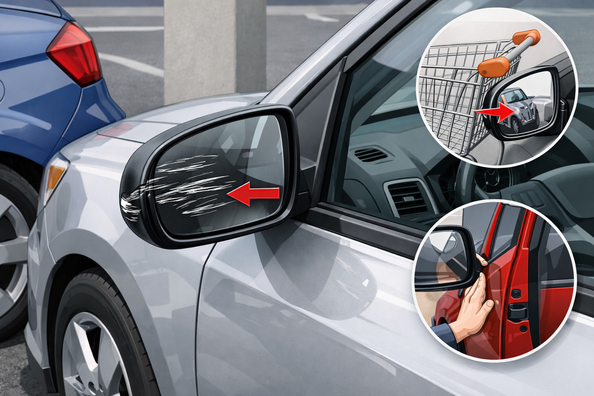

If your mirror regularly gets scratched in a parking lot, the problem is almost never “weak clear coat.” Usually it’s a combination of a tight space, a protruding mirror housing, and incorrect or incomplete folding. So you shouldn’t be fixing the mark on the plastic itself, but the scenario in which the mirror keeps ending up in the contact zone.
Three things work best: fold the mirrors before entering a tight spot, check that the hinge travels fully without jerks, and protect the outer part of the mirror with film or a cover if the contact is light but recurring. If the scratch is already deep, polishing often only hides the defect, and it’s more practical to replace an individual element.
The side mirror is often one of the widest points of the car. In a tight parking space or narrow passage, it’s the first to meet a wall, post, gate, the edge of another car, or even rough plaster. If the parking trajectory repeats every day, scratches build up in the exact same spot.
The second common story is a mirror that seems to fold, but not all the way. In winter it’s blocked by ice; in the in-between seasons, dirt in the hinge; over time, wear in the mechanism or misalignment after forced folding. As a result, the driver counts on one overall width but actually gets a larger one.
DD Tuning expert comment: The most common mistake is immediately looking for polishing or a decorative cover without checking whether the mirror actually folds symmetrically on both sides. The second typical mistake is lubricating the hinge with a random spray: after a short effect, dirt sticks even more, and the assembly starts moving with jerks again.
| Symptom | Likely cause | What to do |
|---|---|---|
| Scratches constantly on the outer edge of the cap | Tight spot or an entry line that’s too close | Fold mirrors before the maneuver, change the approach angle, don’t squeeze the car into a questionable gap |
| One mirror sticks out more when folded | Dirt, ice, a dry hinge, or misalignment after an impact | Compare folding angles, clean the mechanism, and if needed take the assembly for service diagnostics |
| Mirror squeaks, moves in jerks | Hinge or sliding surface is running dry | Don’t force it by hand; do proper cleaning and lubrication, and if it doesn’t help—prepare to replace the assembly |
| After frost, auto-fold doesn’t trigger or doesn’t reach the end | Ice is blocking the mechanism | Don’t force the actuator, let the ice melt, check operation in a warm environment |
| Mark runs along the lower part of the mirror | Contact isn’t with a side wall but with a curb, bollard, or a protrusion below window level | Identify the contact point, use a lower viewing angle or someone’s guidance during the first check |
| Deep groove down to plastic or primer | The impact is no longer minor, but recurring and hard | Don’t count on polishing; consider replacing the cap, the glass, or the entire mirror |
Fold the mirrors before starting the maneuver. This is the simplest way to move the mirror out of the risk zone. On some cars, power folding works only under certain conditions, so it’s important to know the logic of your specific vehicle rather than relying on “it’ll probably fold on its own.”
Check whether the mechanism reaches the end. If there’s squeaking, jerking, delay, or one side folds differently, the cause is already technical. Cleaning and proper hinge lubrication help here—not rough manual wiggling.
Protect the light-contact area with film. If the spot is tight but the hits are light and sliding, thick protective film on the mirror cap often takes the scuffs and saves the paint. It won’t increase the clearance, but it will reduce the consequences.
Change the parking scenario itself. If contact is likely, you need to stop earlier and correct the position—not “squeeze through” blindly. In repeat locations, the habit and line you take often matter more than any cosmetic fix.
If only the outer cap is affected and the mechanism works normally, mirror covers are appropriate. They make sense as a way to hide an already scuffed surface or to take light sliding contact, but not as a cure for a spot that’s simply too narrow.
When the damage has already reached the glass, housing, or internal mounts, it’s worth looking more broadly at mirrors. And if the mirror folds crooked, won’t hold position, the heating doesn’t work, or the actuator is failing, it’s logical to evaluate complete mirror assemblies right away rather than patching the unit with small fixes.
Replacing an individual cap or glass element is often more cost-effective than fighting deep marks for a long time—especially if the scratch is already down to the plastic, the edge is dented, and the defect is visible every time you get into the car.
| Solution | When it works | When it’s not worth spending money |
|---|---|---|
| Fold mirrors before a tight entry | When the issue repeats in the same narrow spot and the mechanism is healthy | When contact is on the lower part of the housing or the mirror still doesn’t fold all the way |
| Cleaning and proper hinge lubrication | When there are squeaks, jerks, incomplete folding, seasonal sticking after dirt or cold | When the actuator is already worn, the housing is cracked, or the geometry is off after an impact |
| Protective film on the mirror cap | When scratches are light, sliding, and recurring | When the spot is too narrow and the contact is hard rather than superficial |
| Mirror covers | When you need to cover a scuffed outer part after eliminating the cause of contact | When people expect the accessory alone to solve a clearance/width problem |
| Polishing | When it’s a light scuff without deep damage to the layer | When there’s a groove down to plastic or primer, or the edge is already deformed |
| Replacing an individual cap or glass | When only one element is damaged and the electrics and folding are still working | When the assembly has play, folds crooked, or has several faults at once |
| Replacing the complete mirror assembly | When there are issues with the actuator, mounting, heating, and geometry at the same time | When the problem was only the parking habit or a minor scuff on the cap |
From a customer’s experience: in an underground garage, the right mirror constantly caught the edge of a wall, even though the driver was sure it was only because the spot was tight. After checking, it turned out the right hinge was folding the mirror slightly less than the left, and the cap had already accumulated small marks from repeated contact. After cleaning the mechanism, getting into the habit of folding mirrors before entry, and protecting the outer part, new scratches disappeared.
Constant scratches on mirrors almost always have a specific cause: either the space is too tight for a normal entry, or the mirror no longer folds the way it should. So the right sequence is simple: identify the contact point, check hinge operation, remove the root cause, and only then decide on film, a cover, a cap, or a full replacement.
This material is based on real selection experience, hands-on practice, and real-world usage scenarios. That’s why the takeaway here is free of myths: an accessory is useful when it complements the right solution, not when it masks a clearance issue or a faulty mechanism.
Shipping to EU
Wholesale and retail
Own warehouse
Опис продукту
Подарунки не надаються при оформленні покупки у кредит під 0,01% або при покупці частинами.