03.05.2026
1147
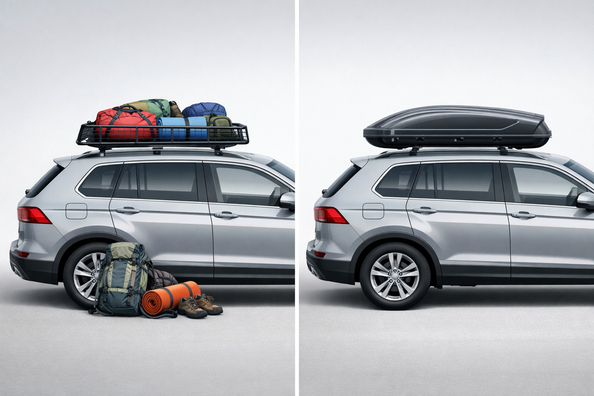
The mistake here is usually not that you bought “the wrong roof rack”, but that you mixed up two different use cases. A roof basket is better when you need to carry large, rigid, dirty, or awkwardly shaped cargo and want quick access to it. A roof box is better when dryness, a lock, lower noise, and stable highway behavior matter.
The problem appears when the choice is made only by price, liters, or looks. Then a basket gets installed for regular long trips with items that must stay dry, while a box is bought for cargo that doesn’t fit by shape, interferes with the sunroof or tailgate, or eats up too much of the allowable roof load.
A basket and a roof box occupy the same spot on the roof, but they work differently. A basket is an open platform: it’s flexible for cargo shape, but leaves your stuff exposed to rain, dust, and airflow. A box is closed and more aerodynamic, but it has rigid internal dimensions, more own weight, and depends more on roof length and crossbar position.
Because of this, people often compare things that aren’t comparable. For camping gear, jerry cans, a spare wheel, firewood, or dirty equipment, a basket really is more practical. For suitcases, kids’ items, skis, snowboards, and long highway trips, the logic shifts to the box.
Start not with the catalog, but with a list of what you actually carry. If it’s bags, clothing, a stroller, winter gear, electronics, or anything that must stay dry, you need a closed format. If it’s jerry cans, oddly shaped crates, a spare wheel, dirty camping gear, or cargo you need to load/unload constantly and access quickly, a basket is the more logical choice.
Next, check the route. If trips are mostly urban or short suburban drives, the basket’s drawbacks are less critical. If you do a lot of highway driving, side winds, and speeds where noise becomes annoying, the choice often shifts toward a box—or even toward removing the system after each trip.
The third check is the numbers. Measure the cargo, the crossbar spread, and the allowable roof load. From that limit, subtract the weight of the crossbars and the accessory itself. For example, with a 75 kg roof limit, after crossbars and the box or basket, the remaining payload capacity can be much smaller than it seems.
DD Tuning expert comment: the most common mistake is looking only at volume or price and not accounting for the system’s own weight. The second typical story is buying a long box for a short roof, then after installation realizing the tailgate won’t open. With baskets, it’s the opposite extreme: people buy them for weekly highway runs and expect silence and dry cargo, even though an open format can’t provide that.
| Symptom | Likely cause | What to do |
|---|---|---|
| A whistle or hum appears after 80–90 km/h | Open basket, poor cargo placement, noisy crossbars | Redistribute the load, check a wind deflector, remove the system after the trip; for regular highway use switch to a box |
| Items are wet, dusty, or covered in insects | Open transport type | For one-off trips use waterproof bags; for an ongoing scenario choose a roof box |
| The tailgate or sunroof won’t open | Box is too large or shifted too far back; poor crossbar spread | Measure the clearance, move the crossbars forward, or choose a shorter box |
| The car feels sluggish, fuel consumption noticeably increased | Accessory is permanently on the roof, overweight, lots of highway driving | Remove the system when it’s not needed; reconsider the weight and the accessory type |
| It’s inconvenient to secure the load or it won’t fit by shape | For a box, the cargo is too rigid/oversize; for a basket, there are too many small items | For oversize and dirty cargo—basket with tie-down straps; for small and valuable items—box |
The best approach is a simple rule: choose not by the accessory name, but by the nature of the cargo. A basket is justified when the items are rigid, large, dirty, or non-standard in shape. A box is justified when the priority is protection from water, dust, other people’s hands, and extra noise.
The second real solution is buying by geometry, not by pretty volume numbers. For a box, internal length, interior height, and tailgate clearance are critical. For a basket, what matters is usable floor area, side rail height, and convenient tie-down points—not just external dimensions.
Third: don’t keep the system on the roof when you don’t need it. At speed, even an empty accessory hurts more than it seems. If you use it a few times a year, removing it after the trip often brings more benefit than any attempts to “dampen” noise with small tweaks.
If you carry jerry cans, firewood, a spare wheel, wet or dirty equipment, it makes sense to look specifically at a roof basket. Its strong side is flexibility and quick access, not silence or rain protection.
If you need dry suitcases, kids’ items, skis, snowboards, or regular long-distance trips, it’s more logical to choose a roof box. It’s heavier and more expensive, but better suited for highway driving, winter, and scenarios where you can’t get items wet.
Sometimes you don’t need to change the accessory itself, but the base it mounts to. If the crossbar spread is insufficient, the mounts are weak, or the whole system is noisy even before loading, it’s worth checking roof crossbars. They often determine whether the box will fit properly and whether the basket will stay stable over bumps.
| Solution | When it works | When it’s not worth spending money |
|---|---|---|
| Roof basket | Oversize, rigid, dirty cargo; frequent loading/unloading; outdoor trips | Regular long trips with items that must stay dry and locked |
| Roof box | Highway driving, winter, suitcases, gear, skis, need protection from water and theft | When cargo doesn’t fit by shape, the roof is short, and the tailgate conflicts with the box |
| Waterproof bags in a basket | One-off trips when you need a basket but must protect some items from rain | As a permanent replacement for a box for family trips and highway use |
| Repositioning or replacing crossbars | When the problem is crossbar spread, mounting compatibility, or incorrect box position | If the transport scenario itself is wrong and you simply need a different accessory type |
| Removing the accessory after the trip | When the system isn’t used daily and noise/fuel consumption are annoying | If the accessory is genuinely needed in constant working use |
From a customer’s experience: a person was looking for a solution for weekly trips out of town with suitcases, kids’ items, and a stroller, and initially wanted a basket because it’s cheaper and simpler. After measuring the roof and considering the route, it turned out most mileage was on the highway and the items had to stay dry, so they chose a mid-size box instead of a basket. In the end, the main benefit wasn’t volume, but not having to dry luggage after rain and put up with extra noise.
A roof basket is better not because it’s cheaper or “more off-road”, but when the cargo is dirty, rigid, large, or awkwardly shaped. A roof box is better not because it looks neater, but when you often drive far, fast, in winter, or carry items that must stay dry and protected.
Before buying, measure not only the roof but also your real use case: what you carry, how often, at what speed, and whether you need to open the tailgate without compromises. That’s what separates a good choice from a mistake.
| ✔ | A roof basket is convenient for large, rigid, or awkwardly shaped cargo: jerry cans, spare tires, firewood, or dirty gear. Its open design gives quick access to items during stops. |
| ✔ | A roof box protects items better from rain, dust, and unauthorized access because it has a closed design and a lock. It is practical for suitcases, children’s items, skis, and snowboards. |
| ✔ | For regular highway trips, a roof box behaves more quietly: the article directly mentions less noise and better vehicle stability at speed. This matters on routes with frequent 80+ km/h driving. |
| ✔ | When the system is not needed every day, it can be removed after the trip, reducing noise and fuel consumption. This is especially suitable for occasional nature trips or seasonal use. |
| ✔ | The article emphasizes checking roof geometry and compatibility with crossbars, which helps avoid conflicts with the trunk lid or sunroof. This is a practical advantage, since the choice can be matched to a specific car rather than just the volume. |
| ✘ | An open basket does not protect items from rain, dust, or insects, so it is a poor choice for dry luggage. If you need a safe trip with items that must stay dry, this is a weak solution. |
| ✘ | On the highway, the basket is noisier, and after 80–90 km/h it becomes noticeable. For frequent long trips, this background noise quickly becomes annoying. |
| ✘ | A roof box strictly limits cargo by its internal dimensions, so not every bulky or awkward item will fit inside. This creates a problem with non-standard cargo or long items. |
| ✘ | Both the basket and the box add weight to the roof, and the box is described in the article as heavier than the basket. Because of this, the actual remaining load capacity may turn out to be smaller than expected, especially with a 75 kg roof limit. |
Shipping to EU
Wholesale and retail
Own warehouse
Опис продукту
Подарунки не надаються при оформленні покупки у кредит під 0,01% або при покупці частинами.