14.06.2026
671
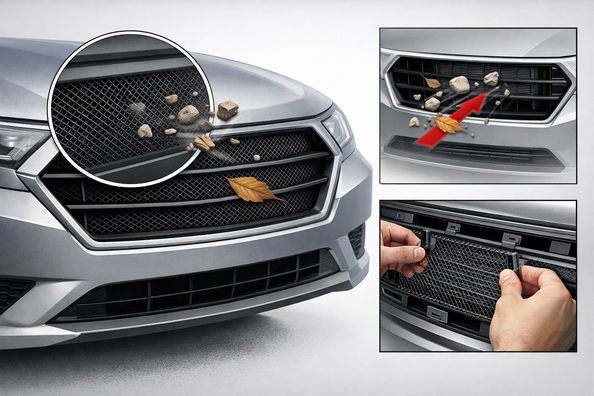

Stones, gravel, leaves, and large insects fly into the front bumper openings not just into the grille itself, but дальше—into the A/C condenser and radiator. The worst scenario here isn’t the lack of protection, but a crudely screwed-on mesh on the outside: it ruins the look right away, and if it also restricts airflow, you can end up with a new problem instead of the old one.
The neatest solution is usually one: a thin black mesh hidden behind the factory grille, without вмешання in the sensor area and without completely blocking the opening. But it doesn’t work the same on every car, so it’s important to first understand what exactly needs protection and where the line is between useful protection and unnecessary restriction of cooling.
On many cars, the front end is designed with large open air intakes. Behind them, it’s often not the main radiator but the A/C condenser—a thin, low-mounted unit that’s vulnerable to impacts from small stones. So even small gravel or hard debris can hit it directly.
The factory grille usually solves styling and airflow, but it doesn’t provide a full barrier against fine road debris. That’s why owners look for a compromise: add protection without turning the front end into a DIY add-on that’s visible from several meters away.
First, shine a flashlight through the upper and lower grilles. If most debris and impact marks collect at the bottom, there’s no point covering the entire front end—working with the lower opening is enough. If the condenser fins are already bent, there are oily traces, or visible punctures, a mesh won’t “cure” the problem: first you need to assess the condition of the unit.
Next, check the depth behind the factory grille. If there’s some space between the front grille and the heat exchanger, a hidden install is realistic and looks tidy. If the condenser sits almost flush, a crude external guard will be noticeable, and a dense internal one is risky for cooling.
Separately, locate the sensor zone. If you have an emblem with a radar, a module in the center of the grille, or a front camera, these areas must not be covered. Another simple reference point is how the car is used: if it often drives in heat, in traffic, under load, or with a trailer, any airflow restriction must be chosen especially carefully.
DD Tuning expert comment: Most mistakes happen when people try to cover the entire opening with the finest possible mesh and press it closer to the condenser. Visually it rarely looks factory, and in operation you end up with less cooling headroom. It’s better to choose a black mesh matched to the opening shape, hide it behind the factory grille, and avoid the sensor and emblem areas.
| Symptom | Likely cause | What to do |
|---|---|---|
| Lots of leaves, insects, and fine gravel on the condenser | Large open opening without fine protection | Install a hidden mesh behind the factory grille, preferably only in the vulnerable area |
| The front end looks out of place after installation | The mesh is installed on the outside or the fasteners are visible | Move the mesh inside, use black material, and trim it neatly to the outline |
| Fans come on more often after the modification | Mesh openings are too small or airflow is blocked solid | Reduce the covered area, choose a less dense mesh, or remove it from part of the opening |
| Driver-assistance errors appear | Radar/camera area or an emblem with a sensor is blocked | Completely clear that area; if needed, check calibration after changes to the front end |
| Stones still reach the heat exchanger | Mesh openings are too large or the wrong part of the grille is covered | Check the impact trajectory and cover the specific opening directly in front of the condenser |
| The mesh rattles or sags | Weak mounting, material not stiff enough | Mount it on a frame or rigid points, not random edge zip ties |
What works is what doesn’t contradict the logic of the factory design: a black mesh hidden behind the OEM grille, with normal airflow and without blocking sensors. In practice, people most often use not a solid sheet but a fine cell size—around 3×6 mm or so, as long as the mesh itself isn’t too thick. It already stops stones, leaves, and large insects, but doesn’t turn the opening into a solid wall.
The second point is clearance from the heat exchanger. When the mesh isn’t pressed right up against the fins but sits closer to the factory grille, it looks neater and is easier to clean. Local protection of the most vulnerable section works well, rather than blindly covering every opening with the same material.
The third thing that truly delivers results is regular cleaning. Even a correctly installed mesh will accumulate dirt, fluff, and insects over time. If it’s mounted so you can access it without fully dismantling the front end, that’s a big plus for day-to-day use.
Everything that sits on top of the factory grille and shouts about itself from a distance works poorly: an external overlay, visible zip ties, a thick edge, uneven trimming. Such protection may catch something, but the main goal is lost—keeping the front end looking normal.
Overly dense mesh that effectively becomes a second solid grille also doesn’t give a good result. This is especially undesirable for cars that drive in heat, in traffic, or under load. A similarly questionable option is fastening protection directly to the condenser fins: vibration, difficult cleaning, and the risk of additional damage are obvious.
Another wrong path is covering a sensor or a radar emblem hoping that “nothing will happen.” In that case the issue stops being cosmetic and starts affecting driver-assistance systems.
If you need discreet protection without a грубо look, it makes sense to start with an aluminum mesh. It’s stiffer, holds its shape better, and usually gives a cleaner result with hidden installation. For lower loads and easier maintenance, you can also look at plastic meshes, if the opening is small and high stiffness isn’t required.
Replacing the grille itself makes sense when the factory one is already cracked, has broken mounts, or a previous install has completely ruined the appearance. In that case, it’s better to first restore the radiator grille, and only then install protection behind it. If the grille is intact and the issue is only stones and debris, replacing the whole assembly just for the sake of tuning is usually unnecessary.
| Solution | When it works | When it’s not worth spending money |
|---|---|---|
| Hidden black mesh behind the factory grille | There’s space for installation, sensors aren’t blocked, and the main issue is stones and debris | When the heat exchanger sits flush or the car is very sensitive to reduced airflow |
| Local protection of the lower opening only | Most impacts and dirt hit the lower part of the bumper | When the upper opening is just as open and sits directly opposite the condenser |
| More open, breathable mesh instead of very fine mesh | You need a balance between protection and cooling | When fine gravel still passes through a larger cell to the heat exchanger |
| Replacing a damaged factory grille followed by hidden protection | The old grille is already ruined and any modification only highlights it | When the factory grille is intact and protection can be installed without replacing it |
| External декоративная overlay or mesh on top of the grille | Only as a temporary compromise if appearance isn’t critical | When a neat, factory look and proper sensor operation matter |
From a customer’s experience: we were looking for protection specifically for the lower bumper opening, because after highway driving insects, leaves, and fine gravel kept accumulating in front of the condenser. Instead of an external overlay, we chose a hidden install of black mesh behind the factory grille, without blocking the sensor zone. After installation, the front end remained almost stock in appearance, and pre-season cleaning became much easier.
In short, grille protection without a “DIY” effect is only possible when the mesh isn’t mounted on the outside, isn’t too dense, and doesn’t intrude into sensor zones. The best option is hidden installation behind the factory grille, focusing on the part of the opening that actually takes hits to the condenser or radiator.
It’s not worth spending money on solutions that look rough, restrict airflow, or hide an already broken grille. This material is based on real fitting experience, hands-on practice, and real-world use cases: first diagnose your specific front end, then add neat protection, and only after that—any additional replacements or tuning.
| ✔ | A concealed black mesh behind the factory grille allows you to protect the condenser and radiator without ruining the look of the front end. If installed neatly and without external fasteners, the solution is almost invisible. |
| ✔ | Local protection only in the vulnerable area provides a better balance between safety and airflow than covering the entire opening. This is especially relevant when stones and debris are flying mostly through the lower bumper opening. |
| ✔ | A mesh with small but not solid openings catches stones, leaves, and large insects without turning the opening into a solid wall. In other words, it solves the practical problem of heat exchanger contamination. |
| ✔ | If the mesh is installed so it can be accessed without fully disassembling the front end, it is easier to clean regularly. This is important because even proper protection gets clogged with dirt and fluff over time. |
| ✔ | Aluminum mesh is suitable for concealed installation because it holds its shape and usually looks neater. For small openings, plastic mesh is also mentioned if high rigidity is not required. |
| ✘ | A mesh that is too dense can worsen cooling, causing the fans to turn on more often. For cars driven in heat, traffic jams, or under load, this is especially risky. |
| ✘ | If the condenser sits almost flush with the grille, concealed installation becomes difficult or undesirable. In such an arrangement, dense internal protection may harm airflow. |
| ✘ | An external mesh, visible zip ties, or thick edges immediately make the front end look out of place. Such a solution may catch something, but it goes against the idea of preserving the factory look. |
| ✘ | You cannot cover the radar area, camera, or emblem with a sensor, and after modifications a calibration check may be needed. So in cars with driver assist systems, there is much less room for experimentation. |
Shipping to EU
Wholesale and retail
Own warehouse
Опис продукту
Подарунки не надаються при оформленні покупки у кредит під 0,01% або при покупці частинами.