16.08.2026
167
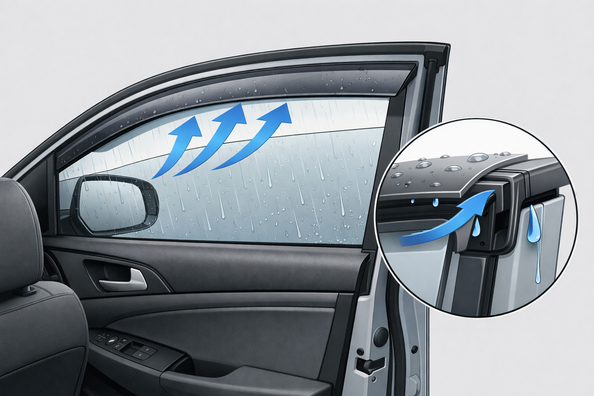

If you need ventilation in the rain without drops getting into the cabin, first you need to distinguish between two different situations: water flies in through a deliberately cracked window, or it has already gotten inside the door and is coming out where it shouldn’t. In the first case, the right window-opening mode and wind deflectors usually help. In the second, an accessory won’t solve the problem, because the cause is in the door itself.
The practical approach is simple: if everything stays dry with the windows fully closed, and the issue appears only during ventilation, look toward aerodynamics and deflectors. But if water shows up from the bottom of the door trim, you hear sloshing inside the door, or the top edge of the glass gets wet, you need diagnostics of the drains, the membrane, or the window position.
A car door is not a sealed capsule. In rain and during washing, some water inevitably passes the outer belt seal by the glass, gets inside the door, and then should calmly exit through the drainage holes at the bottom. This is normal operation.
The problem starts in two cases. First: the window is cracked open, and the airflow along with drops enters the cabin through the upper gap. Second: water has already collected inside the door, but it doesn’t drain out through the drain holes or it passes through a non-sealed membrane behind the trim. That’s why the same complaint about “water near the door” can mean completely different things.
DD Tuning expert comment: The most common mistake is buying deflectors as a universal answer to any water near the door. If there’s already moisture with the window closed, sloshing, or water coming from under the door card, check the drains and the membrane first. The second typical mistake is lowering the window too far and expecting even a good deflector to completely block rain at speed.
| Symptom | Likely cause | What to do |
|---|---|---|
| Drops enter the cabin only with the window slightly open | The window is opened too low or there is no deflector | Reduce the gap, check whether you need a vehicle-specific deflector |
| In the city it’s tolerable, but at speed it’s wet and noisy | Air turbulence, an unsuitable deflector profile, or no deflector | Keep the opening smaller, choose a deflector for the specific model |
| You hear sloshing inside the door | Clogged drain holes | Check the lower edge of the door and clear all drains |
| Water comes out from the bottom of the door trim | Leaking water shield (membrane) | Remove the trim and restore the membrane’s seal |
| The top edge of the glass gets wet or water passes by the frame | The glass sits too low, at an angle, or the seal is compromised | Check window adjustment and the condition of the seals |
For ventilation in the rain the only setup that truly works is when the window is slightly open and the airflow from above is covered by a deflector. That’s when fresh air enters the cabin and direct rain ingress is noticeably reduced. It also helps against fogging.
For water inside the door what works is not an accessory, but fixing the cause. If you hear water in the door, clean the drains. If water comes from under the trim, restore the membrane seal. If the issue is at the top edge of the glass, check the glass position and how it seals.
For everyday comfort a realistic habit matters: in heavy rain and at higher speed, open the window less. A deflector doesn’t make a window “dry” in any mode, but it noticeably expands the range where you can still ventilate without droplets.
If the cabin is dry with the windows closed and you simply need ventilation in the rain, it makes direct sense to look at window deflectors. This is exactly the case where the accessory works as intended: it lets you leave the window slightly open, catch fewer drops, and expel humid air faster.
If you’re unsure about the profile, it’s useful to compare thin vs. wide deflectors: against rain, a wider edge is usually more effective, but it affects airflow more. And when the priority is precise fitment without rattles and without extra pressure on the glass, it’s more logical to consider vehicle-specific vs. universal options.
Planning to replace parts makes sense when there’s a confirmed defect: the membrane lets water through, the drains don’t work, the window is misadjusted, or a seal is worn. In that situation an accessory can still be useful separately, but not as a repair.
| Solution | When it works | When it’s not worth spending money |
|---|---|---|
| Window deflectors | When you need to ventilate the cabin in the rain with the window slightly open | When you often open the window too low or water is already coming from inside the door |
| Cleaning door drains | When you hear sloshing, water stagnates inside the door, there are signs of moisture at the bottom | When the only issue is rain entering through an open window |
| Sealing the door membrane | When water comes from under the trim after the water test | When the door is dry and drops appear only during ventilation |
| Window adjustment | When water gets past the top edge or you can see improper sealing | When the only problem is heavy rain with the window opened wide |
| Replacing seals | When they are deformed, hardened, or don’t hold the glass edge | When the cause is clogged drains or a poorly chosen deflector |
From a customer’s experience: a person was looking for a way to drive in the rain with light ventilation because the side windows fogged up quickly. The check showed there were no leaks with the window closed, so the problem wasn’t the door but the ventilation mode itself. After choosing vehicle-specific deflectors and getting into the habit of keeping the window only slightly cracked, the cabin ventilates without direct droplets, and wind noise at speed stayed within livable limits.
The most useful thing here is not guessing, but separating the problem into two scenarios. If water bothers you only when you deliberately crack the window, deflectors and moderate window opening usually work. But if water accumulates in the door, comes out from the bottom of the trim, or gets past the top edge of the glass, you need drains, the membrane, window adjustment, or seals.
The material is based on real selection experience, hands-on practice, and real-world use cases: an accessory solves the ventilation task well, but it doesn’t replace door diagnostics when the cause is already structural or service-related.
Shipping to EU
Wholesale and retail
Own warehouse
Опис продукту
Подарунки не надаються при оформленні покупки у кредит під 0,01% або при покупці частинами.