14.07.2026
425
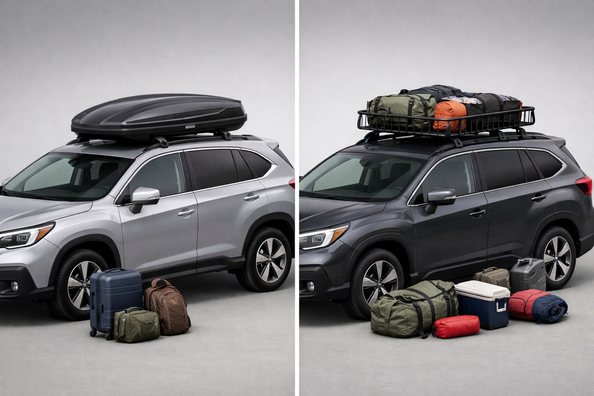
If your car is driven every day and the roof isn’t loaded all the time, it’s more practical to choose a basic roof rack for a smooth roof with crossbars. It has a lower profile, is usually quieter, and remains a universal platform for other attachments. A roof basket makes sense when you regularly carry dirty, wet, tall, or awkwardly shaped items and you’re willing to put up with higher air resistance.
The key nuance is simple: for a smooth roof, a basket is not an alternative to the base system—it mounts onto it. So you should compare not only “how much fits,” but also installation, noise, service life, practicality, vehicle height, load limits, and the final price of the whole set.
A basic roof rack for a smooth roof consists of feet, crossbars, and a fit kit specifically for your body style. For a daily driver, this is usually the more logical foundation: it affects aerodynamics less, is less annoying on the highway, and gives you the freedom to later add a cargo box, bike carrier, or ski holders.
A roof basket is a specialized open accessory. It’s good not on its own, but for a specific type of cargo: jerry cans, firewood, wet bags, camping gear, work tools, and non-standard shapes. If you don’t have that kind of cargo at least regularly, an empty basket turns into constant noise, extra height, and added weight with no real benefit.
Also check the load limit separately: the lowest value always applies out of three—vehicle rating, crossbar system rating, and the accessory’s rating. Usage discipline matters too: distribute the load evenly, don’t push speed with roof cargo above 130 km/h, and over speed bumps it’s better to slow to about 10 km/h.
| Option | Strengths | Weaknesses | Who it’s for |
|---|---|---|---|
| Basic roof rack for a smooth roof | Lower profile, usually less noise, universal base for other attachments, easier to live with every day | Requires precise vehicle-specific fitment; not as convenient on its own for dirty or loose items | For those who drive city and highway daily and only occasionally carry gear |
| Roof basket | Convenient for tall, wet, dirty, and non-standard items; open, quick access to cargo | Requires crossbars, noisier, adds height and weight, demands careful tie-down | For those who regularly carry camping gear, work equipment, jerry cans, firewood, or other tricky cargo |
DD Tuning expert comment: The most common mistake is people compare only the price of the crossbars and the basket itself, but forget that on a smooth roof a basket doesn’t work at all without the base system. The second typical issue is buying a big basket “just in case,” then ending up with extra noise, difficult parking, and hauling an empty structure for half the year. For a daily car, it’s better to first choose a properly fitted quiet base, and only then decide whether you really need a basket permanently.
Its main advantage is that it’s a foundational system, not a solution for just one scenario. If today you need to carry a ladder, tomorrow a bicycle, and in a month a cargo box, crossbars handle this better than a basket. For daily driving this matters: you’re not locked into one type of cargo.
In terms of noise and comfort, a basic rack also usually wins. Low-profile aerodynamic crossbars protrude less into the airflow, and if there’s no cargo, some owners remove them seasonally to get back to near-factory quiet. On a smooth roof, the correct fit kit is absolutely critical: if the system is not matched precisely, problems start earlier than any benefits.
Another practical point is load. Even if the system itself is rated for a lot, the real limit is often set by the vehicle. So a basic rack is good not because it “carries more,” but because it provides a correct foundation for cargo and attachments without extra day-to-day compromises.
A basket is strong where you don’t want to put cargo inside the cabin or into a closed box: a wet tent, muddy boots, a fuel jerry can, garden tools, firewood, something long and awkward. The open format is genuinely convenient here: items are visible, easy to wash, and access is faster.
But you pay for that convenience every day. An average basket often weighs around 10–16 kg, and that weight must be deducted from the allowable roof load before you even place the first bag. It sticks further into the airflow, adds vehicle height, and almost always requires more careful securing with straps or a net. Elastic bungee cords are not suitable for this.
Proper crossbar spacing is also important: in many systems, about 700 mm between the supports is desirable, and for long cargo a sufficient base is even more critical. After a short drive, it’s worth rechecking strap tension. In other words, a basket is not “install and forget,” but a working tool that only pays off when you actually use it.
For daily city use, commuting, and regular highway driving, a basic rack looks more sensible. Even if you occasionally need to carry something on the roof, you’re not carrying a постоянный penalty in the form of noise and height. This is especially noticeable on a car that often goes into underground parking garages, car washes, or has a panoramic roof.
A basket wins in the “often and no fuss” scenario: fishing, cottage trips, camping, work outings, tools, wet gear. There the open format really saves time and nerves. But if those trips happen once a month and the rest of the time the car lives in the city, a basket more often becomes not a convenience but an unnecessary structure.
If you’re not fully sure what you’ll be carrying in six months, the safer choice is the base system. It keeps options open. A basket is worth buying when the scenario is already clear and repeats regularly.
| Scenario | What to choose | Why |
|---|---|---|
| Daily city, highway, roof empty most of the time | Basic roof rack for a smooth roof | Less noise, lower profile, easier to park, and no point carrying an empty basket |
| You need a base for different attachments throughout the year | Basic roof rack for a smooth roof | Gives versatility for a cargo box, bike carriers, or ski holders without being tied to one type of cargo |
| Weekly trips to the cottage, fishing, camping | Roof basket | More convenient for wet, dirty, and non-standard items you don’t want in the cabin |
| Frequent visits to parking garages with height limits | Basic roof rack for a smooth roof | Adds less to overall vehicle height and is easier to remove for periods when you don’t need it |
| You need to regularly carry bulky but open cargo | Roof basket | Open access and easier securing for items that don’t require a closed cargo box |
| You want one “for every situation” solution without a clear scenario | Basic roof rack for a smooth roof | It’s a more flexible first purchase that doesn’t force you to live with a basket’s downsides every day |
A more expensive base kit is justified if the car does a lot of highway driving, often parks underground, and you don’t want to listen to constant humming above your head. In that case, it makes sense to pay extra for a low-profile aerodynamic system, a precise body-specific kit, and proper locks. A practical starting point for this scenario is a roof rack for a smooth roof.
If the doubts come down to noise and fuel consumption, it’s worth paying not for “more metal,” but for better aerodynamics and well-engineered mounting. Before buying, it’s useful to check how a roof rack affects fuel consumption, because in daily use this difference is felt the most.
A more expensive basket only makes sense with regular use: better corrosion protection, more convenient mounts, less play, a fairing, and locks. If you’re still leaning toward a basket, take a look in advance at how to make it quieter, otherwise the extra cost won’t deliver noticeable benefits in everyday driving.
From a customer’s experience: a common scenario is someone looking for a solution for a daily crossover, but once or twice a month they carried bicycles, a tent, and small cottage gear. At first they considered a basket as a “universal” option, but after calculating height, weight, and the fact that the roof would be empty most of the time, they chose a basic rack with crossbars. As a result, the car stayed quieter every day, and for specific trips they had a proper base for the needed attachments.
For daily driving, in most cases a basic roof rack for a smooth roof is the better choice. It’s quieter, lower, and more flexible in use, while a basket is worth buying when you truly and regularly carry dirty, wet, or non-standard cargo and you’re ready to put up with more noise and the hassle of securing it.
The main thing is to consider not only the purchase price, but the whole scenario: installation, vehicle height, load limits, frequency of use, and day-to-day comfort. This conclusion is based on real fitting experience, hands-on practice, and real-world use cases—not on the abstract idea that “bigger means better.”
| ✔ | A basic roof rack for a smooth roof sits lower and is usually quieter in everyday driving. It interferes less in the city, on the highway, and when pulling into parking garages. |
| ✔ | It is more versatile as a base: the same crossbars can be used for a cargo box, bike mounts, or ski holders. This is convenient if transport needs change throughout the year. |
| ✔ | A basket is convenient for wet, dirty, tall, and awkwardly shaped items. Open access makes loading, washing, and quick securing of cargo easier. |
| ✔ | A basket is useful for regular trips to the country, fishing, camping, or work travel. In such scenarios, it really saves time when you do not want to put the cargo in the cabin. |
| ✔ | For a daily car, a basic roof rack adds less unnecessary height and weight if the roof is empty most of the time. It is more practical than constantly carrying an empty basket. |
| ✘ | A basket for a smooth roof does not work on its own: you first need base crossbars, supports, and a mounting kit. So the initial purchase turns out more complicated and more expensive than it seems. |
| ✘ | A basket is noisier at speed and creates more air resistance, especially if you often drive on the highway. For a daily car, this is a noticeable downside in comfort and fuel consumption. |
| ✘ | A basket adds height and weight to the car, making parking, entering underground garages, and car washes more difficult. If transport is infrequent, this setup simply gets in the way. |
| ✘ | A basket requires more careful securing of cargo with straps or a net, and after you start driving, the tension needs to be checked again. This is less convenient than simply using basic crossbars. |
Shipping to EU
Wholesale and retail
Own warehouse
Опис продукту
Подарунки не надаються при оформленні покупки у кредит під 0,01% або при покупці частинами.