09.06.2026
508
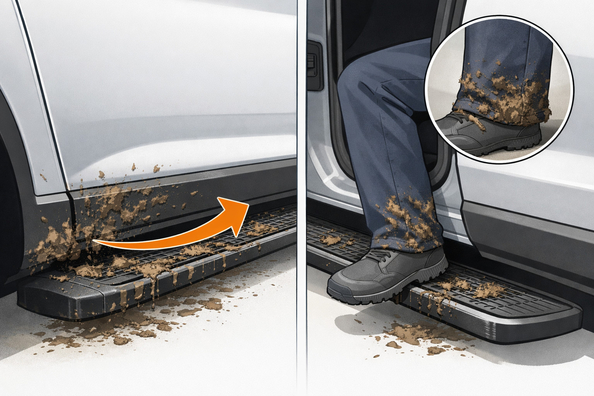
If side steps keep staining your trousers, the problem is almost never the clothing—it’s the vehicle’s geometry. A fixed side step sits right in the zone of lateral spray from the wheels, collects water, salt, and fine dirt, and then your pant leg either rubs against its edge or touches the already dirty surface when getting in and out.
The solution here doesn’t depend on one “magic” accessory—it depends on what’s actually happening: you don’t use the step as a foothold, the wheels throw dirt directly onto it, a lift changed your leg path, or in winter a slushy mix of snow and reagents builds up on the step. You can tell these apart fairly quickly and avoid spending money blindly.
A side step works like a shelf in the worst possible spot on the body. The front and rear wheels create lateral spray, and a low, wide step catches that mix instead of staying clean. If the design also sticks out, the step’s outer edge becomes the first point of contact with your trousers.
On some vehicles, fixed side steps also reduce side ground clearance by roughly 5–13 cm. Because of that, they pick up more mud, snow, and road slush. In winter the issue gets worse: a dense crust builds up on the surface and around the brackets, and you transfer it to clothing even after a short drive.
First wash the step itself and the lower part of the doors, then do two identical entries into the vehicle: once deliberately step on the step, the second time bypass it. If your trousers get dirty only when you don’t use the step, the cause is contact with the edge—not just wheel spray.
Look at where the dirt shows up. The outer edge of the pant leg or the lower calf usually points to rubbing on the step. Dirt on the front of the pant leg more often indicates direct contact with the dirty top surface. If it’s worst after rain, wet gravel, or snow, the problem is almost certainly amplified by spray from the wheel.
Also check whether the wheels and suspension were changed. After wider tires, a change in wheel offset, or a lift, the dirt trajectory and the point where your leg contacts the body often shift. If the issue appeared after such mods, you need to look not only at the step but also at the mud flaps.
DD Tuning expert comment: The most common mistake is this—people wash or polish the steps first instead of checking whether they actually use them. The second typical mistake is installing universal mud flaps on a vehicle with changed wheels and expecting OEM-level results. When we select parts, we always look at the step height, how far it protrudes, and whether it matches the real leg trajectory.
| Symptom | Likely cause | What to do |
|---|---|---|
| The outer edge of the pant leg gets dirty when getting out | The pant leg rubs the step edge because you don’t step on it | Test entry/exit while using the step; if it doesn’t help—change the design or remove the step |
| The step is covered in wet dust after rain | It sits in the zone of direct lateral spray | Assess the step’s height and width, check mud flap effectiveness |
| The problem got much worse after wider wheels | Factory mud flaps no longer block the dirt stream | Install mud flaps matched to the actual tire width instead of keeping the old ones |
| In winter the step is constantly in salty slush | Snow, slush, and de-icing chemicals build up on a fixed step | Wash the lower areas regularly, clean the step by hand, and if needed switch to a different design |
| The step is there, but no one uses it because it’s slippery | Uncomfortable or smooth platform | Look for a textured, narrower, and higher design—or ditch the step |
| After a lift, a different part of the pant leg gets dirty | Entry geometry and the contact area changed | Check the step and mud flaps as a system, not separately |
The best results come from eliminating the root cause. If you don’t need the step as a foothold, removing it often gives the cleanest outcome: there’s no part for your trouser leg to rub on, and no “shelf” to hold dirt. If you really need easier cabin access, high-clearance or retractable options work better. When retracted, retractable steps barely reduce clearance, which means they collect less dirt while driving.
The second effective solution is proper mud flaps for your real wheel setup. If the tire is wider, the wheel is pushed outward, or the suspension is lifted, the factory set often can’t keep up with the dirt stream. In that situation, it’s the mud flap that reduces spray—not some “magic” treatment for the step.
Third is ordinary but important maintenance. In winter the step needs washing more often than you think, because the main grime isn’t on the upper body—it’s underneath and on the inner edges. This won’t fix a flawed design, but it works well as support if the design is generally good.
Cosmetics like wax, polishes, or “blacking” products don’t remove the main issue—the step’s protrusion and its contamination zone. Sometimes these products make the surface even more slippery, so people use the step as support even less.
Small universal mud flaps often have a weak effect too. On stock wheels they may still work, but after wider tires, different offset, or a lift, they simply aren’t wide or tall enough. Likewise, don’t expect miracles from just “wiping the step more often”—if it’s low and sticks out, the dirt will come back after the first wet drive.
If you truly need more comfortable entry, you should focus not on just any steps, but on the design. In the side steps category, it makes sense to look for options that don’t hang too low and have proper texture, so they’re actually used.
When the vehicle often drives on poor roads, it’s more logical to look at rock sliders: they handle dirt and impacts better and, most importantly, usually don’t look like a decorative wide shelf that your clothing catches on.
If the step itself suits you but it’s constantly in the dirt stream, you should start with mud flaps. This is especially sensible after changing tires, wheels, or modifying the suspension, when you need to address not the consequence but the lateral spray from the wheel itself.
| Solution | When it works | When it’s not worth spending money |
|---|---|---|
| Remove unnecessary side steps | When the step is barely used and trousers get dirty from rubbing the edge | When entry becomes inconvenient for the driver or passengers without a foothold |
| Replace a fixed step with a high-clearance one | When you need a foothold but the current step is too low and wide | When the whole problem is wheel spray, not the step’s shape |
| Install retractable steps | When both cabin access and preserving clearance matter | When the vehicle constantly drives in mud and snow and the owner isn’t ready to maintain the mechanism |
| Select proper mud flaps | When the issue got worse after wider tires, wheel changes, or a lift | When trousers get dirty even on a clean step due to contact with its edge |
| Frequent washing of steps and the lower body | As support in winter and shoulder seasons | As the main solution for poor step geometry |
| Polish or “refresh” the step surface | Only for appearance | When you need to actually stop dirty trousers |
From a customer’s experience: after installing wider tires, a pickup owner first thought the problem was the steps themselves—because after rain almost every pair of trousers started getting dirty. The check showed otherwise: he was using the step correctly, but the factory mud flaps no longer covered the new wheel spray. After replacing the mud flaps, the situation improved sharply, and the steps stayed in place with no need for an expensive replacement.
Dirty trousers because of side steps isn’t about being careful—it’s about design and geometry: where the step sits, how far it protrudes, whether you use it as a foothold, and whether your mud flaps can handle your wheel setup. The smartest approach is to first understand whether it’s rubbing on the edge or contamination from wheel spray, and only then decide what to change: the step itself, the mud flaps, or nothing except how you use it.
This material is based on real selection experience, practice, and real usage scenarios—not abstract advice. That’s why the main recommendation is simple: don’t try to “treat” dirt with cosmetics if the source of the problem is the step’s shape or inadequate spray protection.
| ✔ | It explains that dirty pants are most often caused not by clothing, but by the vehicle’s geometry and the position of the sill relative to the spray zone. This helps you look for the cause in the design, rather than spending money on random products. |
| ✔ | There is a clear diagnostic method: wash the sill, get in two different ways, and see exactly where the dirt appears. This test makes it possible to tell rubbing against the sill edge from dirt thrown up by the wheel. |
| ✔ | The material separately takes into account changes after wider tires, a different wheel offset, and a suspension lift. That’s practical, because it is precisely after such modifications that factory mud flaps often stop working properly. |
| ✔ | Real options are described that help depending on the situation: remove an unnecessary sill, install retractable side steps, or choose mud flaps for the actual wheel configuration. In other words, the solutions are tied to the cause, not universal. |
| ✔ | It is stated honestly that frequent washing and cosmetic products may only be supportive, not a full solution to the problem. This reduces the risk of wasted spending. |
| ✘ | If the sill is low and sticks out, it becomes a contact point for trousers on its own. In such a design, the problem will keep recurring even if the car looks clean. |
| ✘ | Universal small mud flaps often fail after changing wheels or suspension. Then you have to choose a solution for the specific vehicle configuration, rather than install a standard kit. |
| ✘ | In winter, the sill quickly collects snow, slush, and road chemicals, so even a short trip can dirty clothing. This means the problem cannot be ignored without regular care. |
| ✘ | Not all options suit every car: removing the sill can worsen ingress, while retractable side steps require maintenance. So sometimes you have to choose between convenience, cleanliness, and practicality. |
Shipping to EU
Wholesale and retail
Own warehouse
Опис продукту
Подарунки не надаються при оформленні покупки у кредит під 0,01% або при покупці частинами.