27.05.2026
349
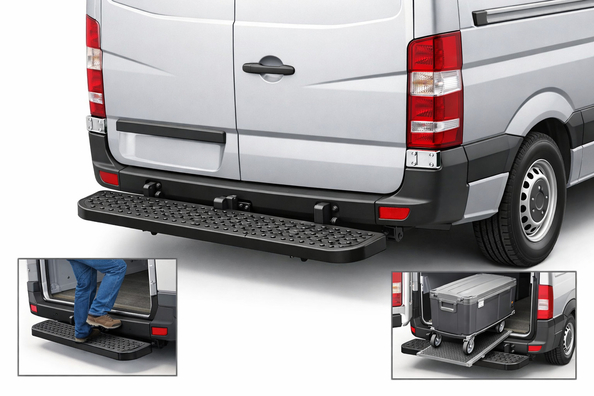
A rear step for a van isn’t for everyone. It really pays off when the rear sill is high, you have to climb into the cargo area many times a day, and the surface underfoot is often wet, snowy, or dirty. If the van has a low step-in height and the rear doors are opened only occasionally, the expense often isn’t justified.
The difference is easy to see in the body geometry. On the Ram ProMaster the cargo floor height is about 533 mm, while on the Ford Transit it’s roughly 729–734 mm, and on the Mercedes Sprinter it’s 711–787 mm depending on the version. So the decision shouldn’t be made “by eye”, but based on three criteria: step height, how often you work through the rear doors, and compatibility with the tow hitch and mounting points.
The problem appears when a normal entry into the cargo area turns into a constant high step. Once isn’t critical, but with deliveries, installation work, or service calls, the load repeats dozens of times per shift. That’s why the driver or crew instinctively starts putting a foot on the edge of the bumper, on the towing unit, or simply pulling themselves up with their body.
The second part of the problem is traction. On dry asphalt you can still tolerate a high sill, but in rain, snow, or on a jobsite, the slippery bumper edge no longer provides a solid foothold. Then the step is needed not for looks, but for a stable point of entry and exit.
Start with a simple tape-measure check: measure the height from the ground to the cargo floor or to the point where your foot actually lands when stepping in. If it’s a level where you have to lift your knee high, and entry isn’t just once or twice a day, the issue is the access geometry.
Next, look at your work scenario. If you or your employees climb into the cargo area 20–30 times or more per shift, you usually feel the benefit of a step within the first week. If most loading is done with a forklift or through the side door, and the rear opening is used rarely, the payoff is smaller.
Separately, inspect the lower rear area: tow hitch, brackets, parking sensors, bumper overhang, and the condition of the factory mounting points. This matters because some solutions are incompatible with the hitch, and poor installation cancels out even the right choice.
Another practical test is not to focus only on platform width. Compare platform depth, step-up height, and load rating. The difference between lighter and reinforced designs is big, so for a work van it’s not only the price that matters, but the strength margin as well.
DD Tuning expert comment: The most common mistake is buying a step based only on photos or on the principle “it’ll fit any van.” In practice, you first need to verify sill height, whether there’s a tow hitch, and the mounting points, and only then look at the platform shape. The second typical mistake is not checking the fasteners after the first days of use, even though loose tightening is most often what causes problems.
| Symptom | Likely cause | What to do |
|---|---|---|
| You literally have to “jump” into the cargo area | High sill and no intermediate step | Measure floor height; if the van has a high step-in height and rear access is constant, choose a rear step for the specific model |
| Your foot slips off the bumper edge in rain or snow | No proper anti-slip foothold | Look for a ribbed or grating-style platform that doesn’t hold water and dirt |
| Your knees and lower back get tired after a shift | Too many repeated high climbs into the cargo area | Count the number of entries per day; with frequent work, a step genuinely reduces strain |
| After installation something rubs or the tow hitch won’t fit | The step is incompatible with existing equipment | Before buying, check mounting and rear-end configuration; don’t choose a universal option without verification |
| The step has play or rattles | Incorrect installation or loose bolts | Stop using it until you check the fasteners, torque, and the condition of the brackets |
It’s not just the presence of a step that works, but the right combination of height, width, and mounting method. On Transit and Sprinter, where the floor is higher, even one well-matched step noticeably reduces step-up height. On low-step vans the effect can also be there, but it’s often more modest.
A truly useful platform has ribbing or an open structure that doesn’t accumulate water and dirt. In wet weather, the difference between “a bit more convenient” and “actually safer” is felt the most.
Correct installation helps as well. For a work van it’s critical that the assembly doesn’t conflict with the tow hitch, doesn’t hang too low, and doesn’t operate at the limit of its rated load. If the step is removable or has multiple mounting positions, it’s easier to adapt it to the real work scenario.
Trying to replace a step with the bumper edge or a random foothold almost never works. It doesn’t provide stable contact, especially when footwear is wet or you’re carrying a load.
A bad approach is installing the first universal design you find without checking the geometry. If after installation it interferes with the tow hitch, sits too high, or has weak brackets, it brings little benefit. The same applies to treating a step as protection against a serious impact: that’s not what it’s designed for.
Installation without follow-up fastener checks doesn’t last either. If the assembly is under daily load, bolts and mounting points must be checked periodically, not only after you notice play or rattling.
If you already see that rear access is daily and the step-up height gets in the way of work, it makes sense to start by selecting a rear step for your scenario. For high-step vans, this usually delivers more benefit than any small compromises like “stepping more carefully.”
When it comes to specific models, it’s logical to look at model-specific solutions: for Transit — steps for Ford Transit, for Sprinter — steps for Mercedes Sprinter. That reduces the risk of getting the mounting, offset, and compatibility wrong.
Replacing or reinstalling an already fitted assembly makes sense if the current step has play, sits too high, conflicts with the tow hitch, or has weak traction. If the only issue is rare use of the rear doors, the accessory may never pay off in daily work.
| Solution | When it works | When it’s not worth the money |
|---|---|---|
| Fixed rear step | When the sill is high and people enter the cargo area many times a day | When rear access is infrequent or the van has a low floor |
| Step with a ribbed or grating-style platform | When the vehicle works in rain, snow, mud, on construction sites | When the vehicle is used almost only in dry conditions and the issue isn’t traction, but geometry or installation |
| Removable or quick-release design | When flexibility is needed for a service vehicle or a fleet | When the van has a simple, stable use case and there’s no need to regularly change the configuration |
| Reinstallation with proper fastener torque | When the design itself fits, but there is play, noise, or incorrect positioning | When the step is incompatible with the vehicle from the start or interferes with the tow hitch |
| Not installing one | When the sill isn’t high, the rear doors are used rarely, and the inconvenience is minimal | When work is daily, the sill is high, and people are already looking for random footholds |
From a customer’s experience: the owner of a service Ford Transit initially wanted to do without a step because the van wasn’t used overloaded. But after a few weeks of field calls it became clear that the main problem wasn’t cargo weight, but dozens of entries into the cargo area per day and the slippery bumper edge after rain. After selecting a compatible solution with no conflict at the rear, access became easier and workers stopped putting a foot on random support points.
A rear step for a van is truly needed when three conditions come together: a high sill, frequent rear access, and slippery or dirty working conditions. The most noticeable benefit is on high-step Transit and Sprinter, while on the lower ProMaster the need is often smaller.
The key is not to buy it blindly. If you don’t check tow-hitch compatibility, mounting points, and installation quality, you can end up with costs and no result—or even a safety issue. This material is based on real selection experience, hands-on practice, and real use scenarios, not abstract advice.
| ✔ | A step really makes access to the cargo area easier when the sill is high and you get in and out many times a day. In such conditions, it reduces unnecessary strain on the knees and lower back. |
| ✔ | In wet, snowy, or dirty weather, it provides a safer foothold than the edge of the bumper or a random place for your foot. This is especially important on construction sites and during deliveries. |
| ✔ | You can choose a solution for a specific scenario: fixed, with a textured platform, removable, or with the proper mounting. This makes it possible to account for the tow bar, mounting points, and the actual sill height. |
| ✔ | On high-sill vans, including Transit and Sprinter, the effect of a good step is more noticeable. There it really reduces the step height, rather than just adding an accessory. |
| ✔ | If a step is already installed but there is play or an incorrect fit, a proper remount can solve the problem without replacing the entire assembly. This is useful when the model itself is compatible with the vehicle. |
| ✘ | On low-floor vans, the benefit may be small if the rear doors are used rarely. In such cases, the costs often do not pay off in daily work. |
| ✘ | An incorrectly chosen step may conflict with the tow bar or other rear-end elements. Then, instead of convenience, problems with installation and safety arise. |
| ✘ | Universal models without geometry checks often do not give a proper result. They may sit too high, have weak brackets, or interfere with the operation of the rear assembly. |
| ✘ | A step does not solve everything on its own: without checking the fasteners, it can develop play or rattle. For a work van, this means it needs periodic checks rather than a fit-and-forget installation. |
Shipping to EU
Wholesale and retail
Own warehouse
Опис продукту
Подарунки не надаються при оформленні покупки у кредит під 0,01% або при покупці частинами.