19.05.2026
220
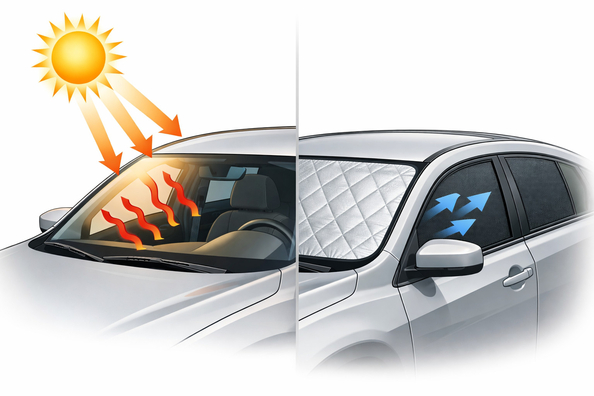
Yes, sunshades help prevent the cabin from overheating, but they’re not a complete solution. If the car is parked in direct sunlight, the temperature inside will still rise quickly. The difference is that a good sunshade reduces the heating of the dashboard, steering wheel, and upper cabin area and makes getting into the car less painful.
The main source of overheating is the glazing. It’s through the glass that most of the heat enters the cabin, and most of the temperature rise happens in the first half hour of parking. So the question isn’t whether a sunshade makes sense, but which sunshade, where it’s placed, and what you combine it with.
The sun heats the glass, dashboard, steering wheel, seats, and all dark trim. Then these surfaces release heat into the cabin air, and the car turns into a closed space with constant temperature buildup. So even when it still feels tolerable outside, it’s already very hot inside the car.
The windshield area suffers the most: the dash top, steering wheel, and the upper part of the front seats. If the car has a large windshield, a panoramic roof, or a dark interior, overheating feels even stronger. This is exactly where a sunshade can deliver the biggest effect, because it reduces direct heating of these elements.
A simple practical guideline: a good sunshade first of all lowers surface temperatures, and only then the air temperature. If the cabin air is almost the same but the steering wheel and dashboard are more tolerable, that’s a normal and realistic result.
DD Tuning expert comment: The most common mistake is buying a thin universal sunshade and expecting it to eliminate the heat completely. In practice, what matters is how tightly it fits the windshield and how much area it covers—not just the fact that you have an accessory. If the car has a panoramic roof, covering only the windshield isn’t enough: the upper zone will still warm the cabin.
| Symptom | Likely cause | What to do |
|---|---|---|
| The steering wheel and top of the dashboard burn to the touch, while the rear of the cabin is slightly cooler | Main heating comes through the windshield | Use a tight reflective sunshade for the windshield; park so the sun hits the front less |
| You have a sunshade, but the difference is barely noticeable | Thin interior model, large edge gaps, weak glass coverage | Replace it with a stiffer or more precisely fitted sunshade; check coverage near the A-pillars and the mirror |
| The upper cabin gets very hot even with the windshield covered | Panoramic roof or large area of overhead glazing | Add roof protection; don’t rely only on the front sunshade |
| It’s a bit easier inside, but after a long stop it’s still hot | The sunshade reduces heating but doesn’t fully eliminate heat buildup | Combine the sunshade with shade, tinting or better solar-control glass, plus brief ventilation before driving |
| A slightly open window barely changed the situation | A small gap has a limited effect | Don’t rely only on a ventilation gap; use it as an auxiliary measure |
| A dark car heats up noticeably more than a light one | The body and interior store heat more intensely | Focus on tight sun protection for the glass and shaded parking, not minor half-measures |
What works best isn’t just any sunshade, but a tightly fitted reflective sunshade for the windshield. Even better is an exterior version, because it intercepts the solar load before the glass itself and the dashboard beneath it heat up.
A second level of impact comes from combining solutions: a sunshade plus shaded parking, plus tinting or glass with better solar protection, plus brief ventilation before driving. This combination delivers noticeable results in real use, not just on paper.
Separately, it’s important to understand the role of time. In the first 30 minutes, the cabin heats up especially fast, so even a short stop by the store already matters. In this scenario, a good front sunshade is truly justified.
If the car regularly sits in the sun for 20–90 minutes, the simplest place to start is sun protection shades. This is a basic accessory that genuinely reduces heating in the front zone and makes the cabin less aggressive when you get in.
Window deflectors make sense as a supporting solution if you sometimes leave a small gap for ventilation. But they’re not a replacement for a sunshade: on their own, they don’t solve the overheating problem.
For long outdoor parking, especially in summer or on vacation, it’s logical to look at a car cover (tarp). It works more broadly than a single sunshade, because it reduces heating not only through the windshield but also through other sun-exposed areas.
Replacing elements makes sense when the car is parked in an open lot every day, has extensive glazing, or a panoramic roof. In that case, quality tinting or glass with better solar protection works continuously—not only when you remember to put up the sunshade.
| Solution | When it works | When it’s not worth spending money |
|---|---|---|
| Tight internal reflective windshield sunshade | Daily short and medium stops in the sun; a car without a panoramic roof or with moderate glass area | If you buy a cheap universal model with large gaps and expect maximum effect |
| External sunshade or windshield cover | When you need better protection specifically from direct sunlight and minimal dashboard temperature matters | If you’re not ready to install and remove the accessory every time or don’t have a place to store it |
| Slightly open windows | As an addition to a sunshade or shade, to reduce the temperature a bit | If you’re relying only on a gap without other measures |
| Tinting or glass with better solar protection | For a car that’s parked outside daily and has extensive glazing | If the car is rarely in the sun, or the issue is only short stops where a sunshade is enough |
| Shaded parking | Always works, especially together with a sunshade | Only irrelevant where there physically is no shade |
| Full car cover (tarp) | For long periods of standing in an open area—on trips, at a summer house, in a yard without a canopy | If you need a quick everyday solution for 10–15 minutes of convenience without extra actions |
From a customer’s experience: an SUV owner was looking for a way to avoid grabbing a scorching steering wheel after office parking and not wait long for the A/C to bring the cabin back to normal. At first, he tried only cracking the windows, but the difference was minor. After switching to a tightly fitted windshield sunshade and getting into the habit of not parking nose-to-sun, the improvement became noticeable every day—although in the heat the cabin still didn’t stay cool.
Sunshades against cabin overheating really help if you understand their limits. They reduce heating of the glass, dashboard, and steering wheel well, but they don’t cancel the fact of overheating in a car parked in direct sun. The best result comes not from a single sunshade, but from a combination: tight windshield coverage, shade, tinting or better glass when needed, and brief ventilation before driving.
The material is based on real-world selection experience, hands-on practice, and real usage scenarios—so the takeaway is simple. A sunshade is worth the money when it’s chosen correctly and used as part of a sun protection system, not as the only hope for a cool cabin.
| ✔ | The sunshade really reduces heating of the dashboard, steering wheel, and upper part of the cabin, so after parking, it feels less scorching when getting in. |
| ✔ | The biggest effect comes from a snug-fitting sunshade on the windshield, especially if the car is often parked in the sun for a short or medium time. |
| ✔ | When a car has a large windshield or a dark interior, the sunshade helps in the most problematic area — the front, where overheating is felt most strongly. |
| ✔ | The sunshade works well together with parking in the shade, tinting, and short ventilation, so it can be part of a real solution rather than a standalone accessory. |
| ✔ | For short stops by a store or office, the sunshade is justified, because overheating is most intense during the first 30 minutes of parking. |
| ✘ | The sunshade does not fully cool the cabin and does not eliminate overheating under direct sunlight — it only reduces its scale and speed. |
| ✘ | Thin universal models with large gaps work poorly, because the sun passes along the edges and the effect noticeably drops. |
| ✘ | If the car has a panoramic roof or a large area of upper glazing, one sunshade for the windshield may not be enough. |
| ✘ | Partially opened windows provide only limited relief, so relying on them alone as a replacement for a sunshade is not worth it. |
Shipping to EU
Wholesale and retail
Own warehouse
Опис продукту
Подарунки не надаються при оформленні покупки у кредит під 0,01% або при покупці частинами.