06.06.2026
250
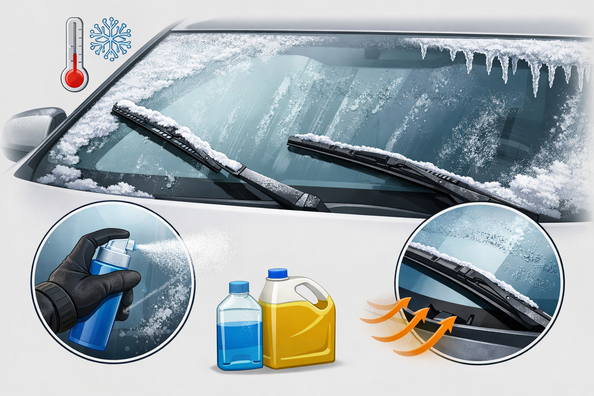
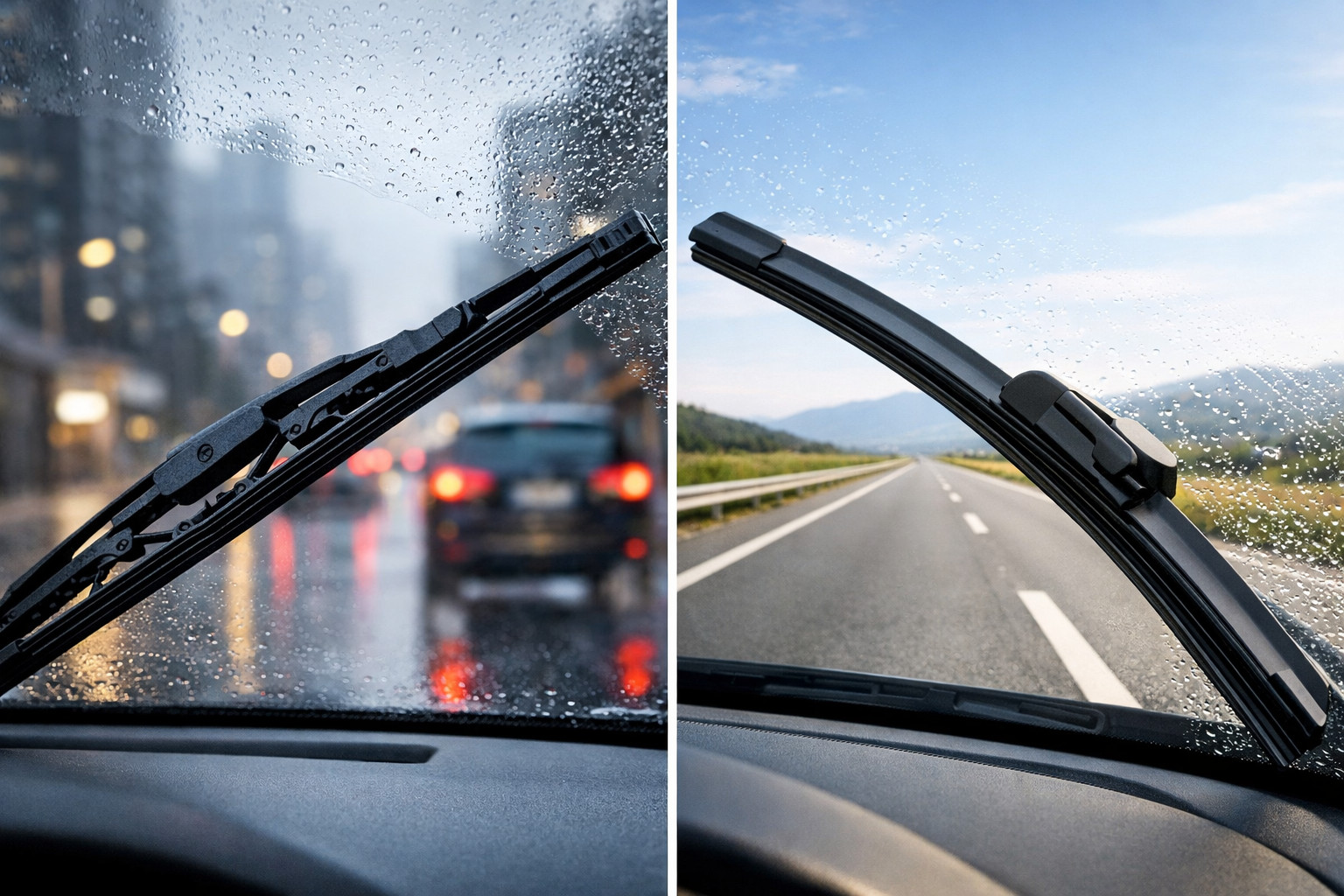
In winter, wipers usually don’t “suddenly become bad” — they’re hindered by ice in the frame, rubber that has gone hard or has a nicked edge, road film on the glass, and weak pressure. Because of this, the blade no longer follows the shape of the windshield, lets water through, chatters, and leaves streaks right when visibility is needed most.
What works best here isn’t brute force, but the right sequence: defrost the glass with the defroster, remove ice with a scraper, use winter washer fluid, clean the blade edge, and replace the wipers on time if the rubber has already lost elasticity. If the car spends the night outside, the problem almost always shows up more strongly.
A windshield on an open parking lot cools down quickly, and frost or a thin layer of ice appears on it. When the driver switches on the wipers right away, the blade moves not over smooth glass, but over ice, snow, and abrasive road grime. At that moment, the rubber edge, the frame, and the drive mechanism all suffer.
The second part of the issue is that winter clearly exposes everything that was already borderline: old rubber, the wrong length choice, a skewed adapter, weak arm pressure. In summer it may cause only a slight squeak, but in freezing temperatures it turns into streaks across the entire viewing area.
First, don’t run the wipers on ice. Warm up the windshield, lift the blade by hand, and check whether it flexes freely along its entire length. If the joints are stiff or the frame moves in jerks, the main problem is icing in the mechanics, not the rubber itself.
A separate replacement marker is simple: if, on clean glass, you still get several long narrow streaks at the edge of the viewing area or even one noticeable streak in the center, it’s no longer worth delaying a replacement.
DD Tuning expert comment: The most common mistake is trying to sweep snow away using the wipers themselves or yanking a frozen blade loose. After that, the driver buys new blades, but the streaks remain because the problem is already a twisted frame or dirty glass. Before replacing anything, it’s always worth checking the rubber, the frame, and the type of washer fluid separately — it saves both time and money.
| Symptom | Likely cause | What to do |
|---|---|---|
| The blade cleans in bursts, doesn’t follow the windshield shape | Ice in the frame or joints | Warm up the glass, remove ice by hand, don’t run the wipers over an ice crust |
| Long narrow streaks on clean glass | Worn or hardened rubber | Clean the edge; if streaks remain — replace the wipers |
| Chattering, squeaking, missed spots | Dirt on the glass or loss of rubber elasticity | Wash the glass and blades, check operation after warming up |
| Doesn’t clean at the edges | Weak pressure, play in the adapter, wrong size | Check the mounting, blade length, and arm condition |
| An icy film appears after spraying washer fluid | Summer or diluted washer fluid | Drain the unsuitable fluid and fill with winter washer fluid with a temperature safety margin |
| The problem is much worse after an overnight outdoor parking | Frost and ice on the glass and in the wiper park area | Scraper and defroster first, wipers only after that |
The key idea is simple: first you need to restore proper blade-to-glass contact. If there’s no contact, no “magic” fluid will remove streaks for long.
If the rubber is already hard, has tears, or leaves consistent streaks, it makes sense to replace it with wiper blades. If the blades are still okay but the issue is thin morning ice and frozen nozzles, it’s more logical to start with winter washer fluid. And when there’s already an ice crust on the glass in the morning, the fastest and safest tool is an ice scraper.
It’s not worth spending money only on new blades if the adapter has play, the arm presses unevenly, or the glass is constantly covered with a greasy film. In that situation, a new set may slightly improve things, but it won’t remove the root cause.
| Solution | When it works | When it’s not worth spending money |
|---|---|---|
| New blades | The rubber is old, hardened, cracked, or already streaks on clean glass | When the issue is ice on the glass, a dirty surface, or weak arm pressure |
| Winter or frameless blades | The car is parked outside, the frame often gets packed with snow and ice | If the wrong size was chosen or there’s play in the attachment |
| Winter washer fluid | The fluid freezes on the glass or in the nozzles | When streaks are caused by a worn blade edge |
| Ice scraper | There’s a thick ice crust on the glass after an overnight parking | When the problem appears only while driving due to worn blades |
| Hydrophobic coating | Wet snow, rain, fine slush on clean glass | When the blade no longer holds its edge or the frame is jammed with ice |
| Checking the arm and adapter | A new blade still doesn’t clean the edge or sits crooked | When, after cleaning the glass and replacing the blade, the problem completely disappeared |
From a customer’s experience: a typical winter situation — someone replaces the blades, but the streaks remain because there’s ice at the bottom of the windshield and autumn fluid still in the reservoir. After switching to winter washer fluid, cleaning the glass, and replacing the blades, the problem disappears without extra spending on “miracle products.” The greatest satisfaction usually comes not from a more expensive accessory, but from correctly finding the cause.
Wiper icing in winter almost always comes down to a few things: ice in the blade mechanics, old rubber, dirty glass, weak pressure, or unsuitable washer fluid. So the solution is sequential: don’t run the wipers on ice, defrost the glass, clean the edge, check the pressure, and replace the blades when they’re truly worn. This material is based on real selection experience, hands-on practice, and real usage scenarios — not myths about “magic” winter life hacks.
Shipping to EU
Wholesale and retail
Own warehouse
Опис продукту
Подарунки не надаються при оформленні покупки у кредит під 0,01% або при покупці частинами.