01.05.2026
281
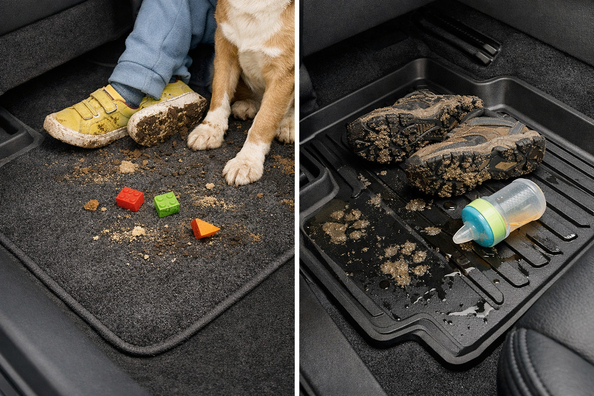
If kids, a dog, and someone in wet shoes all ride in the car at the same time, the main question isn’t which material feels nicer to the touch, but what actually contains water, salt, sand, fur, and crumbs without constant interior cleaning. In that kind of use, the most practical solution is vehicle-specific all-season liners with high sidewalls and OEM mounting points. EVA mats offer a good compromise between care and comfort, but for a dirty scenario it’s better to choose not a flat version, but a molded one or one with raised edges. Textile mats make sense mainly where the interior is dry more often than wet.
The mistake most buyers make is simple: they look only at the material, but don’t look at the shape, the fixation, the edge height, and who actually uses the car every day. It’s the installation, noise, lifespan, practicality, and price that determine whether the mats will still be convenient in a month—not just on the day of purchase.
In essence, there are three approaches. The first is to isolate the floor from dirt and water as much as possible. The second is to find a balance between protection, quietness, and ease of cleaning. The third is to keep the interior looking neat in a dry, city-driving routine.
For a car with kids, a dog, and regular dirt, the key difference isn’t so much the material itself, but whether the mat can keep all of that from spilling over the edge.
Installation. The driver’s mat must sit on the factory mounting points and not slide. One layer per position is a must. If a mat shifts or sits on top of another one, it’s not a comfort issue anymore—it’s a safety issue. Also check safety instructions on how to properly secure floor mats in the cabin.
Noise. Textile is usually the most neutral in feel, EVA often seems quieter and softer than rigid liners, and all-season tray-style mats are more utilitarian. But this parameter strongly depends on the specific shape and density.
Lifespan. Rigid all-season liners handle the wet season and frequent washing well. Properly made EVA also lasts a long time; some manufacturers claim 5–7 years, but in practice it depends on thickness, geometry, and usage intensity. Textile shows wear faster and gets dirty deeper.
Practicality. What matters is whether the mat keeps water inside, how easy it is to pour out sand, whether fur sticks to it, and how much time care takes. For a family car, this criterion is more important than looks.
Price. The cheaper option isn’t always cheaper to live with. If, because of a poor edge or universal shape, you constantly have to clean the carpet, the savings disappear quickly.
| Option | Strengths | Weaknesses | Who it’s for |
|---|---|---|---|
| Vehicle-specific all-season liners | Best at containing water, snow, salt, and dirt; high edge; good fixation; wash quickly | Stiffer feel; utilitarian look; quality vehicle-specific sets cost more | Families, active drivers, cars with kids, dogs, frequent winter and slush driving |
| EVA mats | Cell structure traps dirt; lightweight; easy to maintain; often quieter and softer than liners | Flat versions without an edge contain wet dirt worse; quality depends heavily on the manufacturer and geometry | Those who want a compromise between practicality and comfort and are ready to choose a vehicle-specific shape |
| Textile mats | Neat appearance; nicer to the touch; feel good in a dry interior | Absorb moisture, harder to wash, accumulate fur, sand, and salt faster | Those who drive mostly in the city in dry weather and don’t have constant dirty loads |
DD Tuning expert comment: Most often, people make mistakes when they choose a mat from photos or based only on the material. A flat set without sidewalls can look tidy, but after a few rainy days or winter trips dirt starts reaching the carpet, and a driver’s mat without OEM fixation shifts. If the car is used daily, vehicle-specific shape is almost always more important than decorative looks.
This is the strongest option for a dirty-use scenario. They work like a tray: there are water channels, the sidewall is often higher than on regular sets, and the shape follows the floor. That’s why water from kids’ shoes, snow, salt, and wet sand are less likely to escape beyond the mat.
The downside is a firmer, more utilitarian floor feel. Some drivers don’t like that, especially in a clean city car. But if the priority is not having to wash the carpet after every bad-weather day, it’s the most rational option.
EVA holds dirt in its cells, so sand and small debris don’t move around the surface as actively. In typical designs, thickness is around 10 mm, cell depth is 7–8 mm, and liquid capacity depends on the shape and can be sufficient for daily use. In practice, it’s a convenient format for those who often shake out mats rather than rinse them with a hose after every trip. Learn more about the material and format here: EVA-килимки для авто.
EVA’s weak point isn’t the material itself, but simplified configurations. A flat mat without a defined edge loses to a vehicle-specific liner in rain and snow. That’s why for a family car it’s worth looking at molded or sidewall versions, especially for the front row.
Textile feels nice in a dry daily routine: the interior looks calmer, it’s softer underfoot, and noise feels neutral. But when people often get in with wet shoes, carry kids’ items, snacks, or a dog, its advantages quickly move to the background.
Moisture and dirt sink into the pile, fur clings more, and cleaning takes more time. So for that scenario, textile is more like a second set for the warm, dry season—not the main everyday solution.
If the car constantly sees daycare, school, the yard, rain, wet snow, and walks with a dog, first place goes to vehicle-specific all-season liners. They require less attention and better tolerate real-life mess, not the tidy catalog scenario.
EVA makes sense where you want balance: the car is urban, but dirt happens regularly; you want to quickly shake out debris without sacrificing a calmer interior feel. The key is not to choose the simplest flat shape if the car is actively used in winter or shoulder seasons.
Textile is best left to those with a dry city route, underground parking, little moisture, and no constant load like a dog or kids’ gear. If the dog rides in the trunk, a separate trunk mat is almost always useful regardless of what you have in the cabin.
| Scenario | Best choice | Why |
|---|---|---|
| Daily trips with kids in fall and winter | Vehicle-specific all-season liners | Better contain water, dirt, and salt near footwear; wash quickly |
| City car where you want less stiffness and simple care | EVA with sidewalls or a molded shape | Cells collect sand and debris, and the floor feels calmer overall |
| A dog often rides in the trunk | Any practical cabin set + a separate trunk mat | Fur, paws, and dirt load the trunk the most |
| Dry city routine without constant slush | Textile or EVA | No need to overpay for maximum tray protection if the floor is rarely wet |
| Frequent trips outside the city, yard, cottage, wet shoes, stroller | Vehicle-specific all-season liners + trunk protection | Least chance that dirt reaches the carpet and side panels |
Paying extra is justified when the car truly lives in a tough routine: kids get in with wet shoes, the car is driven daily, the dog rides in both the cabin and the trunk, and you don’t want to clean the carpet. In that case, a pricier solution isn’t about decor—it’s about better geometry, higher edges, more precise fitment, and less time spent on care.
If EVA is closer to what you want, it makes sense to look not at a single mat, but at a system for your scenario: EVA-килимки в салон for everyday cleaning, EVA-килимки в багажник for fur, paws, and strollers, and EVA-килимки на пороги where kids regularly bring dirt into the entry area. If your main priority is to keep water strictly within the floor area, a more expensive vehicle-specific liner with a high sidewall is usually more practical than basic sets.
From a customer’s experience: In a family crossover, simple universal mats were installed at first, and after every bad-weather day sand and water would reach the carpet around the edges. After switching to better-fitting cabin mats and separate trunk protection, cleaning became noticeably faster, and fur and dirt stopped spreading throughout the car. The biggest difference the owner felt was in winter, when wet kids’ shoes stopped soaking the floor near the seats.
For a car with kids, a dog, and dirty shoes, the smartest logic is: if you need maximum protection and minimum hassle—choose vehicle-specific all-season liners with high sidewalls and OEM fixation. If you want to balance practicality, quietness, and easy daily care—look at EVA, but preferably in a molded or sidewall version. Leave textile for a dry city scenario, not for constant slush.
This conclusion is based not on abstract promises, but on real fitting experience, hands-on practice, and real-life use cases: what works in the wet season, what’s easier to wash, what’s less annoying in daily use, and where people most often buy the wrong thing.
| ✔ | Model-specific all-weather liners are the best at retaining water, snow, salt, and dirt thanks to their high edge and precise floor fit. For a car with children, a dog, and wet shoes, this is the most practical option, because dirt reaches the carpet less often. |
| ✔ | They hold well in the factory mounting points and do not shift if installed correctly. This is important not only for convenience, but also for the safety of the driver’s area. |
| ✔ | EVA mats offer a decent compromise between protection and comfort: they are easy to shake out, lightweight, and usually softer and quieter than rigid liners. For city driving with regular but not critical dirt, this is a convenient format. |
| ✔ | EVA with cells collects sand and small debris well, so it is less spread around the cabin. If you choose a model-specific or 3D version, such a set is better suited for daily trips. |
| ✔ | Textile mats look neat and feel nicer to the touch, so in a dry city cabin they add comfort. For a car whose floor is rarely wet, this is a normal option without unnecessary stiffness. |
| ✘ | Textile is a poor choice for wet and dirty conditions: it absorbs moisture, is harder to clean, and picks up hair, sand, and salt faster. In a family car, this means more time spent cleaning. |
| ✘ | Flat EVA mats without edges lose out in slush and winter because they do a worse job of holding wet dirt. Their practicality drops significantly if the car is often driven in rain, snow, or mud. |
| ✘ | Rigid all-season liners are not comfortable for everyone to the touch and look utilitarian. In a clean city car, they may be seen as a less pleasant option. |
| ✘ | Cheap or universal mats may seem like a good deal, but due to an incorrect fit or weak retention, dirt gets onto the carpet, and cleaning takes more time. In the end, the savings are often questionable. |
Shipping to EU
Wholesale and retail
Own warehouse
Опис продукту
Подарунки не надаються при оформленні покупки у кредит під 0,01% або при покупці частинами.